
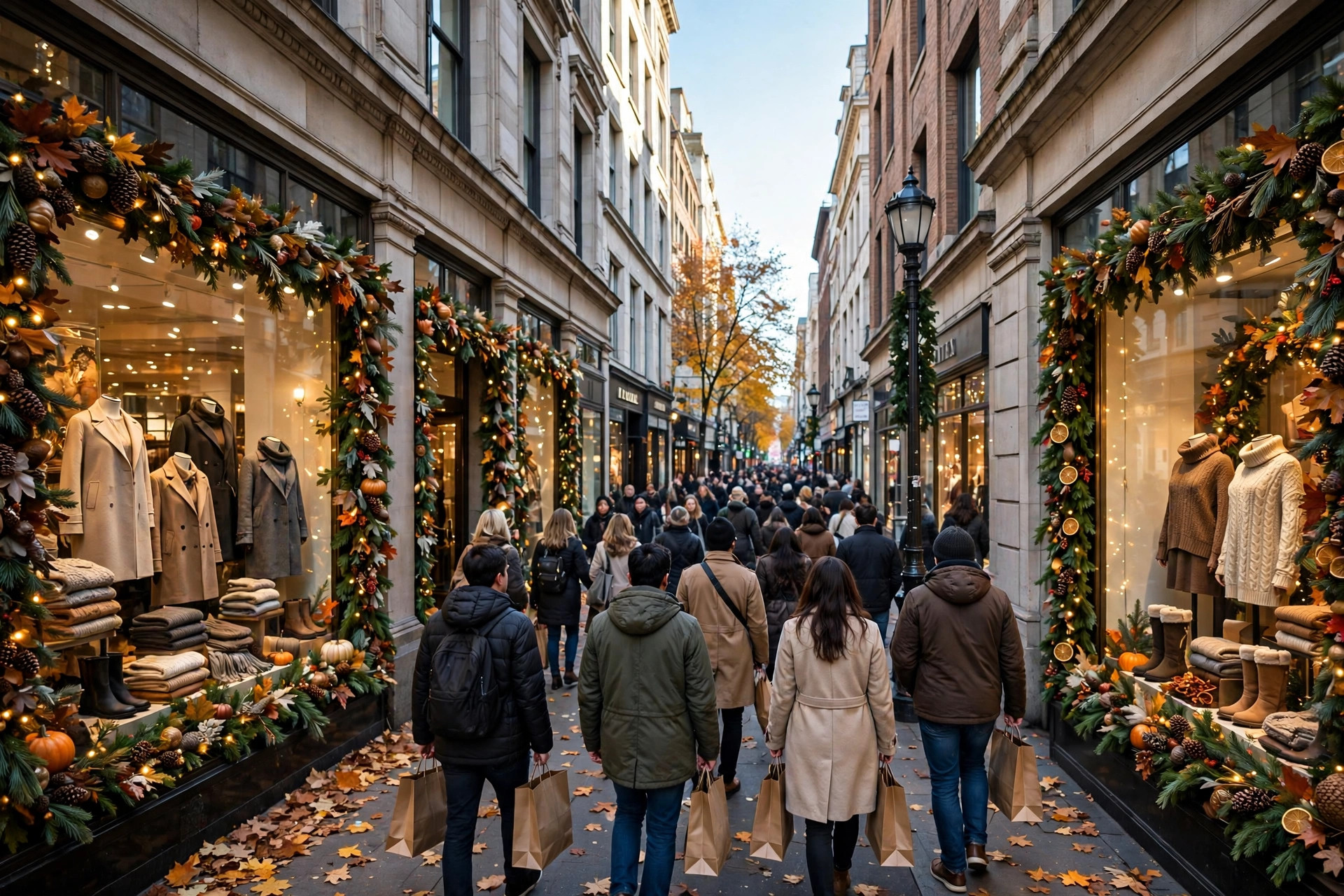
Black Friday 2026 falls on Friday 27 November, the day after the United States Thanksgiving holiday on Thursday 26 November, and Cyber Monday follows three days later on Monday 30 November. The date is fixed by a simple rule: Black Friday is the fourth Friday of November, the day after Thanksgiving, which is the fourth Thursday of November. What is less fixed is everything else. Many retailers start their promotions a week or more early, sales often run through Cyber Monday and into early December, and the biggest discounts are not spread evenly across the weekend. Adobe's forecast, published on 28 September 2026, expects $12.9 billion in Black Friday online sales in the US and $15.1 billion on Cyber Monday. This guide explains when the sales happen, what to buy on each day, and how to tell a real discount from a fake one — with no live prices, because prices change by the hour and any list would be out of date before it was read.
Black Friday 2026: The Dates That Matter
The core dates are straightforward. Thanksgiving is Thursday 26 November. Black Friday is Friday 27 November. The weekend runs through Saturday 28 and Sunday 29 November, and Cyber Monday is Monday 30 November. In practice, Black Friday stopped being a single day years ago. Early deals have already started appearing in late October and early November, and many retailers now run a "Black November" that stretches across the whole month, with the biggest drops landing on the Friday itself. Amazon UK, for example, ran a full Black Friday Week in 2025 from 20 November to 1 December, and a similar pattern is expected this year. In South Africa, Takealot has signalled early promotions from 26 October, building towards its main drop on 27 November, while Makro, Checkers, Game, Edgars and Woolworths are all running Black November campaigns.
The pattern is the same in Australia, where Finder reports that early Black Friday deals have already started popping up, and that Australians spend an average of $531 on Black Friday alone, contributing to an estimated $4.5 billion in total national spending. The lesson is to treat the Friday as the peak, not the start. The best preparation is to decide what to buy before the advertising starts, and to write down the usual price of anything planned, before 26 November, so the Black Friday price can be compared with the real price rather than with the percentage on the banner.
What to Buy on Each Day
Adobe's forecast gives a clear steer on timing. Its best-day calls for 2026 are: Thanksgiving for sporting goods, Black Friday for televisions, toys, apparel, appliances and furniture, and Cyber Monday for electronics and computers. The peak discounts it forecasts are up to 30 percent off listed price for electronics, 29 percent for toys, 23 percent for televisions and 23 percent for apparel. Adobe stresses that these are ceilings, not averages: they describe how deep a category's best deals are expected to go, not what a typical item gets. A television bought on Black Friday is therefore a better bet than a laptop bought the same day, because laptops are expected to be cheapest on Cyber Monday.
The categories that tend to shine most are televisions, headphones, earbuds, smart-home gadgets, power banks, Kindles, last year's phones, small kitchen appliances, vacuums, power tools and toys. Mobile and internet providers, and even some energy retailers, use the sales period to roll out special offers too. The categories to be careful with are the ones where the discount is hard to verify: fashion, where the "was" price may never have been charged, and bundled deals, where the saving depends on items the buyer did not want. The rule is to buy the thing that is cheapest on that day, and to leave the rest for its own best day.
Black Friday 2026: How to Tell a Real Deal From a Fake One
Not every discount is as good as it looks. The quickest test is to work out the price that will actually be paid and compare it with what the item normally sells for, not with the percentage on the banner. The first trap is stacked discounts. When a shop offers an extra discount on sale prices, the second percentage is taken off the already-reduced price, not the original. A coat that costs $200, cut by 30 percent, drops to $140. An extra 20 percent off that brings it to $112. The saving is $88, which is 44 percent of the original price — not 50 percent. The habit of adding percentages together is the most common way shoppers overpay on Black Friday.
The second trap is the inflated "was" price. Something can be marked as 60 percent off for Black Friday while normally selling at 50 percent off, and the only defence is the price history. Free tools such as Keepa and CamelCamelCamel show how an Amazon product's price has moved over the last months: if the Black Friday price is the lowest in three to six months, it is a genuine deal. Regulators have taken action on this: Australia's consumer watchdog found several misleading discount tactics in its Black Friday sweep, and last year it fined Michael Hill, MyHouse and Hairhouse Online a combined $59,400 after alleging misleading advertising around their 2024 Black Friday sales. The third trap is credit. A discount bought on a card that is not cleared in full can cost more than it saves: a $1,000 Black Friday balance at 22 percent annual interest, paid off at $50 a month, takes 26 months and adds $257.13 of interest.
A Simple Plan for the Week
First, make a list before the advertisements start, with a maximum price for each item, and match each item to its best day using the calendar above. Second, record today's prices now, so the Black Friday price can be checked against reality. Third, check return terms and shipping before paying: across 170 stores surveyed, the median return window is 30 days, but the range runs from 3 days to 365 days, and a bargain that cannot be returned is not a bargain. Fourth, on the day itself, check the price history, not the "was" price, and remember the stacked-discount maths. Fifth, if the price is not the lowest in months, walk away: the same item will very likely be cheaper again before Christmas. Black Friday 2026 is a good week to buy a television, a toy or a coat, and a good week to buy a laptop only on Monday. Everything else is a matter of checking the numbers rather than trusting the banner. For more on shopping across borders, see our guide to Japan's tax-free shopping rules, our Romania shopping guide and our Andorra duty-free shopping guide.