
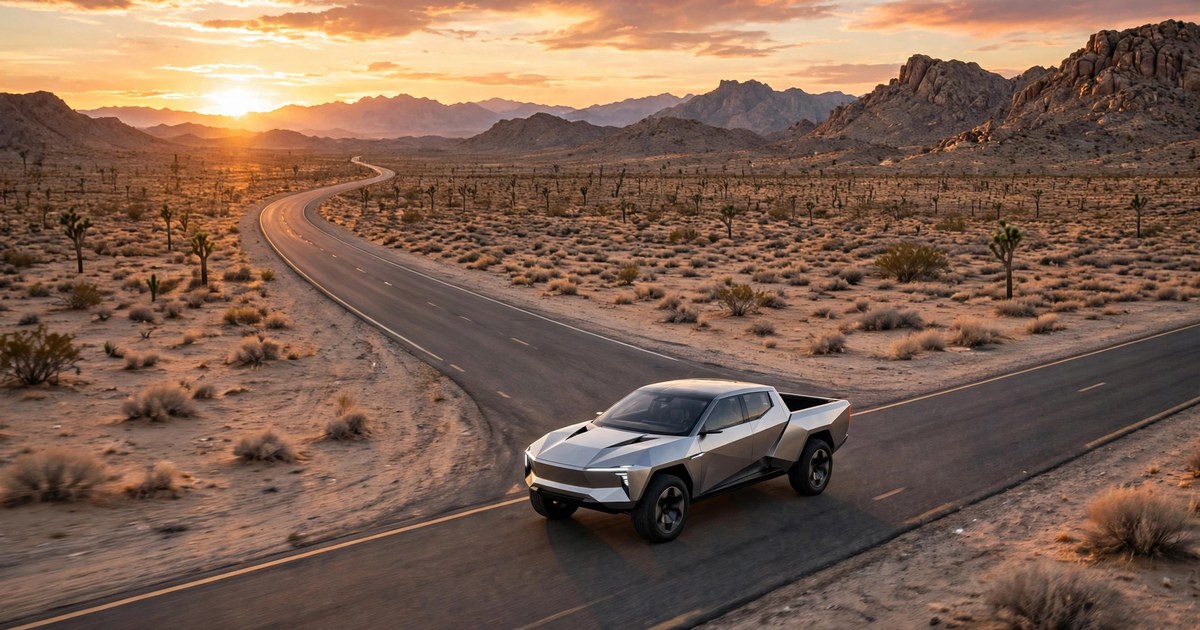
Tesla Cybertruck discontinued: Elon Musk confirmed on Friday 6 November that the company "will be winding down production of the Cybertruck at Gigafactory Texas around the middle of next year to make room for increased Cybercab production". The announcement ends, after just three and a half years on sale, the run of the most talked-about pickup truck of the decade — a vehicle unveiled to global fanfare in 2019, delayed for years, and then bought in numbers far below what Musk once promised.
Musk's wording was "winding down", but the effect is a discontinuation. Tesla has already stopped taking orders for the cheapest version, the dual-motor all-wheel-drive trim, and Gigafactory Texas in Austin is the only plant equipped to build the truck's specialised stainless-steel body, according to Reuters. CNN reported it appeared Tesla intended to discontinue the truck entirely rather than move production elsewhere. Musk himself called the decision the "end of an era", while insisting the Cybertruck was the "best vehicle Tesla has ever made".
Tesla Cybertruck Discontinued: The Sales Numbers Tell the Story
The reason is written in the sales figures. Musk once said Tesla would eventually build around 250,000 Cybertrucks a year. The reality, by every independent estimate, was a small fraction of that. Auto Express puts total sales at no more than 63,000 units since deliveries began in late 2023; Motor Intelligence puts the figure under 73,000. Either way, the truck never came close to its target — and the trend was getting worse, not better.
In the United States, Tesla sold 20,237 Cybertrucks in 2025, down 48% from 38,965 in 2024, according to Kelley Blue Book. Cox Automotive counted just 3,519 US sales in the first quarter of 2026 and 3,744 in the second, with 11,586 sold through September. Electrek's figures show the same slide: about 14,416 trucks in the third quarter of 2024, falling to roughly 3,700 in the second quarter of 2026. A production line built for 250,000 trucks a year was running at a fraction of its capacity.
Price did the truck no favours either. When Musk unveiled the Cybertruck in 2019, he promised a single-motor version for $39,900, a dual-motor for $49,900 and a tri-motor for $69,900. The cheapest version that actually reached buyers, a dual-motor all-wheel-drive trim launched in February 2026, started at $59,990 — and even that price did not last. It rose to $69,990 in March and $74,990 in August. Then, the day before Musk announced the wind-down, Tesla raised prices again: the dual-motor trim went to $82,490, the Premium to $92,490 and the Cyberbeast to $102,490. Hours later, the base trim was no longer orderable at all.
Then there were the recalls. Tesla has issued 11 recalls for the Cybertruck since it went on sale in late 2023, according to the National Highway Traffic Safety Administration — a tally Reuters put at the centre of its account of the truck's troubled run. And the market the truck could reach kept shrinking: it cannot be sold in Europe for regulatory reasons, it was never offered in most right-hand-drive markets, and last month Tesla confirmed it would not build a right-hand-drive version for Australia and New Zealand, refunding deposits from customers who had waited up to seven years.
From Cracked Windows to the End: The Cybertruck's Short Timeline
The Cybertruck's story began with a stunt that went wrong. Musk introduced it at Tesla's design studio in Hawthorne, California, on 21 November 2019, and during the unveiling a steel ball thrown at the supposedly shatterproof "armour glass" cracked the windows on stage. The truck still drew enormous attention, and Tesla opened pre-orders the same night with first deliveries promised for 2021.
Those deliveries took four years. Production promised for late 2021 was pushed to 2022, then to 2023, with Musk citing supply-chain shortages. The first truck came off the line at Gigafactory Texas in July 2023, and customer deliveries began late that year. By the time production winds down in mid-2027, the Cybertruck will have spent about three and a half years on sale — making it the shortest-lived production car in Tesla's history, beating the original Roadster's three years and ten months, according to Drive.
Tesla Cybertruck Discontinued: What It Means for Owners
For the roughly 63,000 to 73,000 people who bought one, the obvious question is what changes now. The short answer: not much, immediately. Ending production does not change existing warranty terms, Torque News notes, and Musk moved quickly to reassure owners, writing on X that the Cybertruck fleet "will be around for a long time".
What Tesla has not answered is how long it will keep supplying parts and service for the truck. Kelley Blue Book reports the company "has not shared how long it will continue to provide parts and services to current owners". That matters more than usual for the Cybertruck, because its stainless-steel body panels, steer-by-wire system and 48-volt architecture share little with any other Tesla. Owners should keep their service records, and anyone considering a used Cybertruck should weigh parts availability against the discount the market is likely to apply now that the truck is officially on its way out.
Resale values are the other open question. A discontinued vehicle with a small owner base can hold its value as a curiosity — or sink as buyers worry about support. With production running until mid-2027, there is no fire sale yet; but the direction of travel is now clear, and it points down for anyone holding the truck as an asset.
Cybercab Takes Over: Tesla's Lineup After the Cybertruck
The factory space freed by the Cybertruck has a named destination: the Cybercab. Tesla's two-seat robotaxi has no steering wheel and no pedals, and Musk has made it central to the company's autonomous-vehicle ambitions. Tesla started building the Cybercab at the Texas plant in April 2026, and the Cybertruck's exit clears the floor for higher volumes. The bet is plain: Tesla would rather build robotaxis than a pickup that sells a few thousand a quarter. The robotaxi race is already crowded, with Waymo expanding into new cities, so the Cybercab has to prove itself commercially — something it has not yet done.
The Cybertruck's departure also completes a reshaping of Tesla's range. Once production ends, the only human-driven cars Tesla sells will be the Model 3 sedan and the Model Y SUV, alongside the Semi commercial truck, according to MarketWatch. The Model S and Model X were discontinued earlier in 2026 to make room for the Optimus humanoid robot. The next-generation Roadster, long delayed, is promised for 2028 — a car Musk has pitched with SpaceX thrusters and flying-car claims. It is a lineup built around autonomy and spectacle, with the mass-market pickup experiment over.
Musk's wider ambitions for Tesla keep growing even as the lineup shrinks. He has floated the idea of a Tesla–SpaceX merger, arguing the two companies belong together. The Cybertruck's fate shows the other side of that ambition: when a product does not sell, Musk is willing to end it quickly, even one he once called his best.
Why It Matters — and What to Watch Next
The Cybertruck's failure is not just a Tesla story. It was the most ambitious attempt yet to reinvent the pickup truck — the best-selling vehicle class in America — as an electric wedge of stainless steel. Its failure says something uncomfortable about that ambition: truck buyers wanted a truck, and the Cybertruck, for all its spectacle, was a compromise — too expensive for the $39,900 buyers Musk courted in 2019, too strange for traditional pickup drivers, and too compromised by its own body to be built cheaply at scale. The development costs alone are said to have reached $5.6 billion, according to Auto Express.
What happens next is worth watching on three fronts. First, the exact end date: "around the middle of next year" leaves room for the final trucks to roll off the line anywhere from spring to autumn 2027. Second, Tesla's answer on parts and service for existing owners — the longer it stays silent, the more resale values will suffer. And third, the Cybercab itself: the whole justification for ending the Cybertruck is that the robotaxi matters more, so the Cybercab's production ramp at Gigafactory Texas in 2027 is the number that will decide whether this was a ruthless but correct call, or the moment Tesla gave up on a market it could not crack.
Sources: Reuters; Kelley Blue Book; InsideEVs; Auto Express; Drive.com.au; MarketWatch; Torque News; CNN; Cox Automotive; Motor Intelligence; Autocar India; National Highway Traffic Safety Administration.