
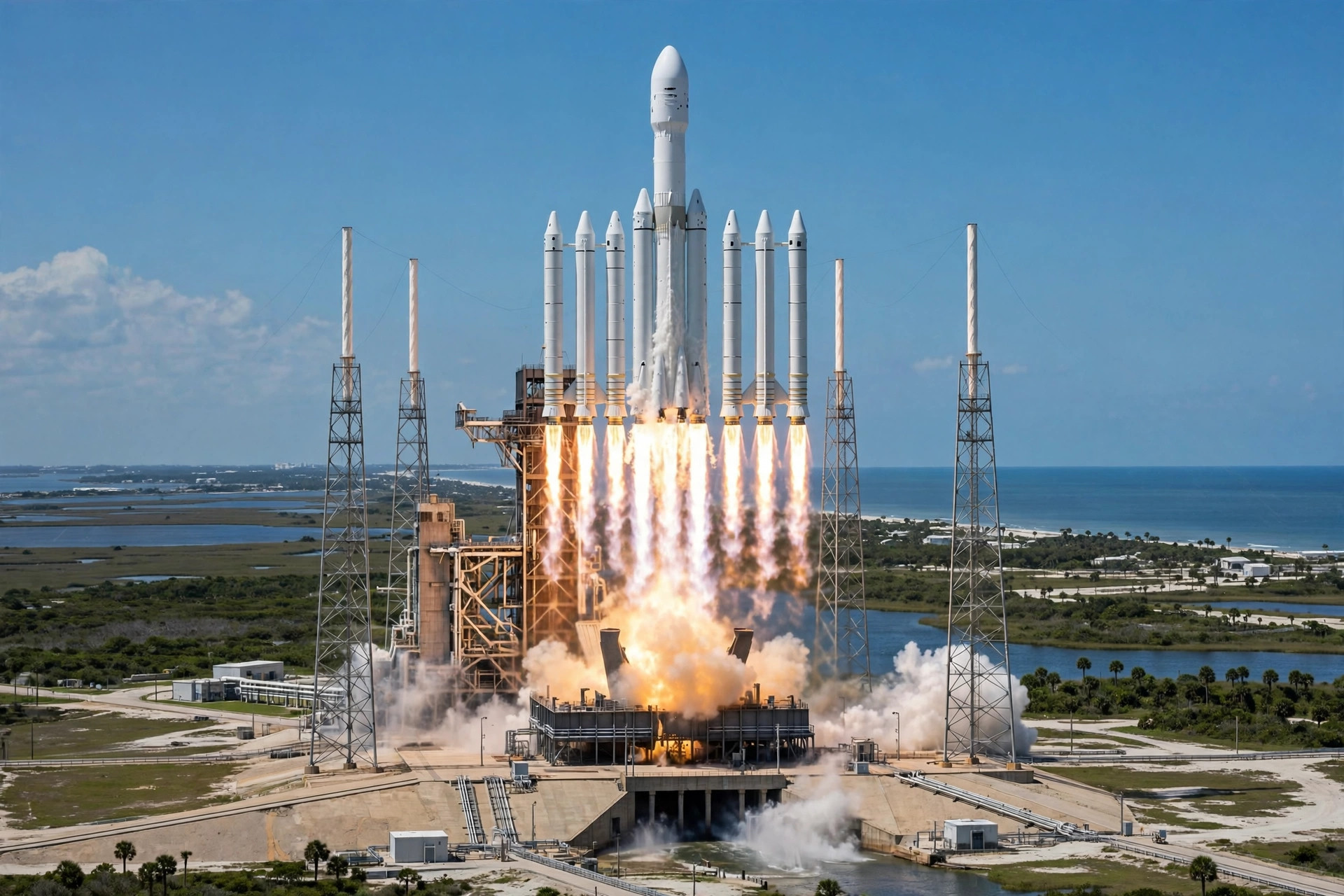
The ULA Vulcan rocket failure on Sunday, 15 November 2026, destroyed 40 Amazon Leo broadband satellites and handed both companies their worst day in years. United Launch Alliance confirmed about 50 minutes after liftoff that its Vulcan rocket had suffered an anomaly 10 minutes into the flight and failed to deliver the Amazon mission to orbit. The satellites never reached orbit, and the mission — the first of 38 Vulcan flights Amazon has bought — ended as ULA's first outright failure since the company was formed in 2006.
For Amazon, the timing stings. Its Leo constellation, formerly known as Project Kuiper, is racing a clock set by the United States Federal Communications Commission, and every lost launch narrows the margin. For ULA, the failure came on the comeback flight of a rocket that had already spent nine months on the ground while engineers fixed a problem with its booster nozzles. What happened in those 10 minutes, and what it means for the race to build a rival to SpaceX's Starlink, is now the question both companies have to answer.
How the ULA Vulcan rocket failure unfolded
The 214-foot-tall Vulcan lifted off from Space Launch Complex 41 at Cape Canaveral Space Force Station at 12:40 p.m. EST, at the very end of a 29-minute launch window, after two days of delays and a countdown hold with 20 seconds left to resolve a technical issue. The rocket flew in its VC6L configuration, with six Northrop Grumman solid rocket boosters strapped to its first stage and two methane-burning BE-4 engines providing the core thrust — 3.8 million pounds of it, according to Spaceflight Now.
The opening minutes looked normal. The six solid rocket boosters burned out and separated about one minute and 35 seconds into flight, and ULA confirmed burnout and jettison. Then, about 10 minutes after liftoff, during the burn of the Centaur upper stage, something went wrong. Spaceflight Now reported that the anomaly came during the Centaur's burn, and Ars Technica, cited by Gizmodo, reported that the problem originated in the rocket's main booster stage, with the two BE-4 engines firing for at least 30 seconds longer than planned. ULA has not confirmed a cause, and has said it does not yet have specific data on what went wrong.
At 1:30 p.m. EST, 50 minutes after liftoff, ULA confirmed the failure in a statement: "Based on data received by our Launch Director, we confirm that the Vulcan vehicle launched from Space Launch Complex 41 suffered an anomaly 10 minutes into the flight and failed to deliver the Amazon mission to orbit." The company added that it holds itself "to the standard of mission success. Today, we did not meet that standard." Amazon responded on X at 2:11 p.m. EST, saying: "There is risk with any launch, and that's especially true for inaugural missions like LV-01."
Had the flight gone to plan, the 40 satellites would have been released about 285 miles up, starting 70 minutes after liftoff. The payload weighed more than 50,000 pounds — a company record for ULA and the largest batch of satellites Amazon had put on one launch.
Why this flight mattered so much to both companies
Sunday's launch was only the fifth flight of a Vulcan rocket, and the first in nine months. ULA and booster supplier Northrop Grumman had spent that time working to resolve problems with the nozzles on the strap-on solid-fuel boosters that marred two earlier flights — the February 2026 booster-nozzle anomaly that grounded the rocket. A clean flight would have closed that chapter and opened the busiest manifest in ULA's history.
For Amazon, Vulcan is the workhorse of the Leo programme. The company has purchased 38 Vulcan launches, and the larger Vulcan is slated to carry more than 1,500 of Amazon's first-generation satellites — more than any other rocket in the programme. Sunday's flight was the first of those 38. Leo has about 396 satellites launched across 14 missions so far, with about 392 in orbit, and the 40 lost on Sunday would have pushed the launched total to 436, according to Spaceflight Now. The wider launch industry is moving fast around it: SpaceX recently caught a Starship booster with its Mechazilla arms, and new rocket factories are coming online in Asia, as covered in SpaceX's Starship booster catch and Hanwha's new rocket plant in South Korea.
The scale of the ambition explains the stakes. Amazon plans a constellation of 3,232 satellites, and the FCC requires half of them — 1,616 — to be in orbit by July 2028, with the full constellation up by the end of July 2029, according to the Proxima Report. Amazon has said Leo will start initial service before the end of 2026 in the United States and the United Kingdom, along with a few other countries. Every launch slot matters against that deadline, and a failure investigation now stands between Leo and its next Vulcan flight.
What the ULA Vulcan rocket failure means for Amazon Leo
The immediate consequence is a pause. Amazon Leo will have to wait for ULA's failure investigation to run its course before trying again with a Vulcan, and ULA has said it will work closely with its customer and other appropriate organisations to find the cause, determine the appropriate corrective action and return to flight as quickly as possible. No timetable has been given, and no cause has been named.
The programme does have other rockets to fall back on. Amazon's next scheduled Leo launch is an Ariane 6 mission, LE-04, carrying 36 satellites, targeted for 23 November at the earliest from Kourou, according to GeekWire. That flight, if it holds, would keep satellites flowing while Vulcan is grounded — but 36 satellites is a smaller batch than the 40 lost on Sunday, and Ariane 6 cannot carry the programme alone.
The competitive picture sharpens the pressure. Leo is designed to compete head-to-head with SpaceX's Starlink and other space-based internet providers, and Starlink already operates at a scale Leo is still building towards. A delayed Leo means a delayed service launch, and a delayed service launch means Starlink keeps its head start in the market for satellite broadband. NASA Administrator Jared Isaacman said the space agency is ready to support the teams in resolving the failure, according to the Proxima Report — a sign of how closely the wider space community is watching.
Why ULA's record made this failure a shock
Part of the reaction comes from ULA's history. Spaceflight Now reported that Sunday was the first outright failure of a United Launch Alliance rocket since the company, a partnership between Boeing and Lockheed Martin, was formed in 2006. The Proxima Report put it in starker terms: the failure broke a perfect reliability streak of no outright failures across 170 missions flown by the Delta IV, Atlas V and Vulcan rockets.
That record was ULA's calling card. Customers pay a premium for ULA launches precisely because the company almost never loses a payload, and its pitch to the United States government has always rested on reliability. One failure does not erase 170 successes, but it does change the conversation: the next Vulcan flight will be watched as a test of whether the company can find the cause, fix it, and restore the record — and how long that takes will shape Amazon's schedule as much as ULA's own.
What happens next after the LV-01 failure
Three things will decide how much damage Sunday does. First, the investigation: ULA has to identify what failed, and whether the fault lies in the booster stage, the Centaur upper stage, or somewhere else entirely. The early reporting points in different directions — Spaceflight Now places the anomaly during the Centaur burn, while Ars Technica's sources point to the main booster stage — and only ULA's own data will settle it.
Second, the return-to-flight timeline. ULA took nine months to return after the February nozzle problem, but that was a known issue with a known fix. An unknown failure can take longer, and every month of delay pushes against the FCC's July 2028 halfway deadline. Third, the Ariane 6 flight on 23 November: a successful launch of 36 satellites would show the programme can keep moving while Vulcan is grounded, and would take some of the pressure off the investigation.
For now, both companies are saying the right things — ULA promising a thorough investigation, Amazon accepting the risk of inaugural missions — but the numbers are unforgiving. Amazon needs more than 1,200 additional satellites in orbit by July 2028, and it has just lost 40 of them in 10 minutes. The ULA Vulcan rocket failure is a setback, not a programme-ender. Whether it stays a setback depends on how fast ULA finds the answer.