
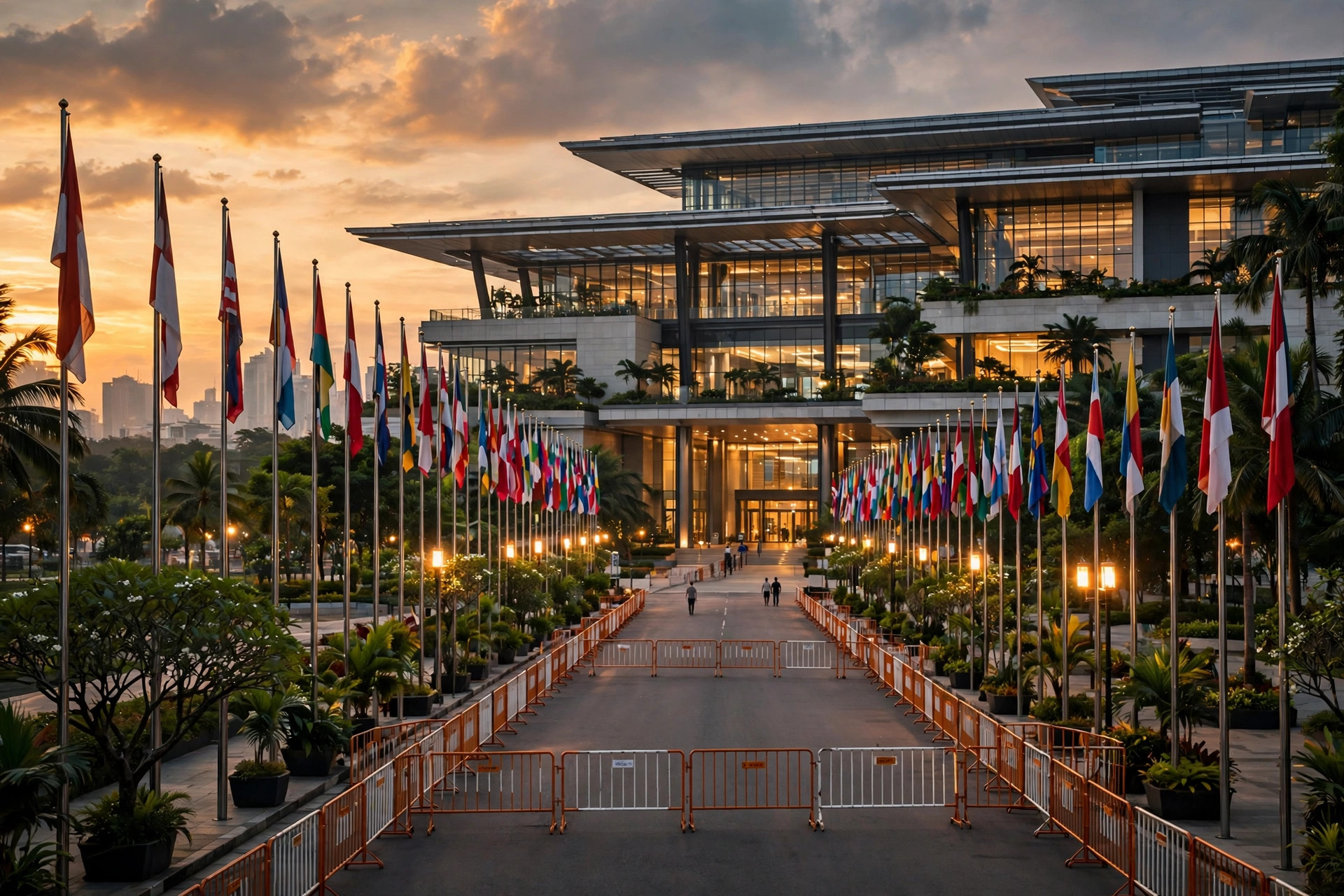
The 49th ASEAN summit Manila 2026 opens in Manila on Sunday 15 November, bringing leaders from across Southeast Asia and a long list of guest heads of government to the Philippine International Convention Center in Pasay City. The leaders' meetings run for three days, from 15 to 17 November, under the Philippines' chairmanship and the theme "Navigating Our Future, Together". One headline deal is already done: the bloc's digital economy pact was signed on 14 November, the day before the summit opened. The hardest questions, though, are still open — a South China Sea code of conduct that will not be finished this year, a five-year argument over Myanmar, and a political shock from Indonesia that arrived on the eve of the summit.
ASEAN Summit Manila 2026: Dates, Venue and Theme
The 49th ASEAN Summit and Related Summits take place from 15 to 17 November 2026 at the Philippine International Convention Center, known as the PICC, in Pasay City, Metro Manila. The wider programme runs from 14 to 17 November, according to the ASEAN Secretariat, and the leaders' sessions were preceded on 13 and 14 November by the ASEAN Foreign Ministers' Meeting and the 28th meeting of the ASEAN Economic Community Council at Conrad Manila. The Philippines holds the ASEAN chairmanship for 2026, and hosts the ASEAN summit Manila 2026 under the theme "Navigating Our Future, Together", built around three priorities: Peace and Security Anchors, Prosperity Corridors and People Empowerment. The Philippine Department of Foreign Affairs said at least 19 world and institutional leaders were expected to take part. Manila will hand the chairmanship to Singapore on 17 November, the final day of the summit. The scale of the year is considerable: the Presidential Communications Office said the summit programme covered more than 550 meetings, of which 393 had been completed and 164 were under way or scheduled, and Palace Press Officer Clarissa Castro said the government had allocated 22.9 billion Philippine pesos for ASEAN events in 2026, covering infrastructure, venue restoration and security. Metro Manila has special non-working days on 16, 17 and 18 November under Proclamation No. 1447, and the United States Embassy in Manila warned of heavy security, road closures and flight disruption across the capital during the summit week.
DEFA Signed a Day Early: What the Digital Pact Does
The ASEAN summit Manila 2026 headline economic deliverable arrived before the leaders even sat down. The ASEAN Digital Economy Framework Agreement, known as DEFA, was signed in Manila on 14 November 2026 at a ceremony held alongside the 28th ASEAN Economic Community Council Meeting, and ASEAN Secretary-General Kao Kim Hourn attended the signing, according to the ASEAN Secretariat. Philippine Foreign Affairs Undersecretary Leo Herrera-Lim described it on 6 November as the world's first binding region-wide agreement on the digital economy. Negotiations were finalised in Manila on 27 to 29 May 2026, after the initiative was launched during Indonesia's 2023 chairmanship, and ASEAN economic ministers reaffirmed their commitment to sign it at the ASEAN summit Manila 2026. Its signing is the first major deliverable of the ASEAN summit Manila 2026 programme. DEFA is the bloc's first comprehensive, digital-only economic agreement. It covers digital trade, cross-border e-commerce, electronic payments and e-invoicing, digital identity, cybersecurity, data flows and personal data protection, and competition. A Boston Consulting Group study cited by Indonesia's Coordinating Ministry for Economic Affairs found that full implementation could lift the value of the region's digital economy from about one trillion US dollars to two trillion US dollars by 2030. Signing, however, is not the same as enforcement. Each of the 11 member states must still ratify and implement the agreement at home, and Singapore's Deputy Prime Minister and Trade Minister Gan Kim Yong said in Manila on 14 November that he hoped it would come into force early in 2027. Indonesia's government, meanwhile, said the agreement enters into force 180 days after the final signature, so the timetable will depend on how quickly ratification moves in each capital.
South China Sea Code: 80% or 70%? Both Figures, Explained
The most closely watched security item at the ASEAN summit Manila 2026 is the long-running negotiation with China over a code of conduct for the South China Sea, and two different figures have been reported for how far the talks have come. Three senior Southeast Asian diplomats told the Associated Press on 11 November that, after the final round of talks in October, China and ASEAN had provisionally agreed on about 80 per cent of the paragraphs intended for the agreement. The diplomats spoke on condition of anonymity because they were not authorised to discuss the talks in public. The next day, Dominic Xavier Imperial, the Philippine foreign ministry's deputy secretary for ASEAN affairs, gave a different figure on the ANC programme Headstart: he said 70 per cent of the code package was agreed. The two numbers may not measure the same thing — the diplomats counted paragraphs, while the Philippine official spoke of the whole package — and neither figure is an official count confirmed by ASEAN or China. What both accounts agree on is that the hardest questions remain unsettled: the geographic scope of the waters the code would cover, the definition of several sensitive terms, and whether the agreement will be legally binding. China and ASEAN began negotiating the code in 2005, aiming to stop confrontations in the disputed waters from escalating into a wider conflict, and in 2023 they agreed to conclude the talks by the end of 2026. That deadline will now be missed, and the negotiations will continue into 2027, when ASEAN's rotating chairmanship passes from the Philippines to Singapore. The code will therefore not be finalised at the ASEAN summit Manila 2026, and leaders there are expected to discuss the state of the talks rather than sign anything.
Myanmar: The Seat That Stays Empty
Leaders at the ASEAN summit Manila 2026 are also set to review the Five-Point Consensus, the peace framework ASEAN adopted in April 2021 after the military seized power in Myanmar. The plan calls for an immediate end to violence, dialogue between all parties, humanitarian assistance and mediation by a special envoy able to meet all sides. Myanmar's military leadership remains excluded from high-level ASEAN meetings, and the country will be represented at the ASEAN summit Manila 2026 by the director-general of the ASEAN Affairs Department of its foreign ministry, the Philippine Department of Foreign Affairs confirmed on 11 November. Philippine Foreign Affairs Secretary Ma. Theresa Lazaro, who serves as ASEAN's special envoy on Myanmar, told reporters on 14 November that there was no easing of the bloc's approach. "To answer you bluntly, there is no easing," she said, according to Reuters. "There is still the Five-Point Consensus." Thailand has proposed allowing Myanmar's foreign minister to take part in ASEAN foreign ministers' meetings, and Lazaro said that proposal remained under discussion, with no decision made to allow the minister to take the country's seat. A draft review of the Five-Point Consensus was still under negotiation as leaders arrived, and Philippine foreign affairs spokesperson Dax Imperial said any decision would be reflected in a negotiated document issued after the leaders' meeting. The review at the ASEAN summit Manila 2026 is the clearest test of whether the bloc's five-year-old framework still holds, or whether events have overtaken it.
Gibran's Resignation: Indonesia Arrives in Turmoil
Indonesia, ASEAN's largest member, reaches the ASEAN summit Manila 2026 in the middle of a constitutional drama at home. Vice-President Gibran Rakabuming Raka submitted his resignation on 12 November 2026, two years into a five-year term, handing a letter to the leadership of the People's Consultative Assembly, known as the MPR. The five-paragraph letter said he was stepping down "at his own request" and gave no reason, according to Seasia, and MPR Speaker Ahmad Muzani said Gibran asked only that the assembly process his resignation. Gibran is the first directly elected Indonesian vice-president to resign early. The resignation followed two court rulings on the education documents behind his 2024 candidacy: on 6 October the Constitutional Court found no convincing evidence that he held a foreign diploma or certificate establishing completion of an equivalent secondary education, and on 30 October the Supreme Court annulled his high-school equivalency certificate in case number 742 K/TUN/2026. His resignation came hours before a parliamentary meeting on an impeachment initiative backed by 120 lawmakers from eight parties, the Associated Press reported. Under Indonesia's constitution the president nominates two successors, reportedly within 14 days, and the MPR elects one within 60 days, by 11 January 2027. The episode does not change Indonesia's presence at the ASEAN summit Manila 2026 — Coordinating Minister for Economic Affairs Airlangga Hartarto travelled to Manila to sign DEFA on 14 November — but it means Indonesia's delegation arrives with its domestic politics in unusual flux. For background on the court ruling behind the resignation, see our earlier report on the Supreme Court decision voiding Gibran's education certificate.
Who Is Coming — and When Trump Arrives
The guest list is what turns the ASEAN summit Manila 2026 into a global event. United States President Donald Trump is expected in Manila on Tuesday 17 November for the ASEAN-US Special Summit, after the main leaders' sessions, and the Presidential Communications Office confirmed on 14 October that he would attend. Canadian Prime Minister Mark Carney and Brazilian President Luiz Inacio Lula da Silva are attending as guests of the chair, hosts confirmed on 6 November, according to Agence France-Presse. Chinese Premier Li Qiang will represent China, Beijing's foreign ministry said on 11 November; President Xi Jinping is not expected to attend, and the Philippine Daily Inquirer has noted that he has never joined an ASEAN summit in person. Indian Prime Minister Narendra Modi will visit Manila from 16 to 17 November, his office said on 12 November, and Australian Prime Minister Anthony Albanese is also confirmed. United Nations Secretary-General Antonio Guterres is expected to take part in the ASEAN-UN Summit. President Ferdinand Marcos Jr. also invited Russian President Vladimir Putin, although Moscow had not confirmed his participation. The breadth of the guest list means the three days of the ASEAN summit Manila 2026 will carry bilateral meetings well beyond the formal ASEAN agenda, including on trade, where China remains the region's largest partner — see China's trade surplus passing one trillion dollars in 2026 — and on the US-Canada relationship, where a Canada-US trade deal was reported near after a Carney-Trump call.
ASEAN Summit Manila 2026: What Happens Next
Over the three days of the ASEAN summit Manila 2026, leaders will hold their plenary sessions on 15 November, meet dialogue partners including Australia, China, India, Japan, South Korea, New Zealand, Russia, the United Nations and the United States on 16 and 17 November, and issue a chair's statement summarising what the ASEAN summit Manila 2026 agreed. The chairmanship passes to Singapore on 17 November, which then inherits the South China Sea code talks for 2027 and the task of carrying DEFA from signature into force. The Myanmar review document, once negotiated, will show whether the bloc has agreed on any change to its five-year exclusion of the country's military leadership — or whether, as the special envoy indicated, the Five-Point Consensus simply continues. For the Philippines, the summit closes a year of chairmanship that began with the 48th summit in Cebu on 8 May 2026 and ends with a signed digital pact, an unfinished sea code and a region still arguing over how to handle its most difficult member. What leaders decide at the ASEAN summit Manila 2026 this week will set the terms for all three in 2027.