
Background
On Thursday, October 8, Apple confirmed what weeks of reporting had anticipated: a new product launch scheduled for Tuesday, October 13, 2026, under the tagline "Welcome Home." The wording left little doubt about the theme. Apple's senior vice president of worldwide marketing, Greg Joswiak, posted a short teaser on X showing hands stitching the company's retro rainbow logo into fabric before the words "Welcome home. October 13" appeared on screen. At the same time, invitations went out to members of the media for an "Apple Experience" in the Tribeca neighborhood of New York City, set for 9:00 a.m. Eastern Time on the day.
Rather than a stage keynote with a public livestream, the launch is expected to arrive as a batch of press releases published on Apple's Newsroom website, timed to coincide with the start of the New York hands-on session. Reporters and creators invited to the experience will get to try the new hardware in person, but as of October 12, Apple had not shared any information about whether viewers at home would be able to watch any part of the proceedings. USA Today reported that it had reached out to Apple for more information about how the public could tune in, and had received no answer by the day before the event.
The October 13 launch is the second major product debut under John Ternus, who took over as Apple's chief executive from Tim Cook on September 1. His first was the iPhone Duo, Apple's first foldable phone, unveiled on September 9. The device folds like a book, starts at $1,999, and becomes available on October 23, with pre-orders beginning the week of the "Welcome Home" event. That makes October an unusually crowded month for Apple, with the home launch sandwiched around the foldable's pre-order and release window.
Reporting from MacRumors and from Bloomberg's Mark Gurman, the journalist widely regarded as the most reliable chronicler of Apple's hardware plans, points to a single theme for Tuesday: the smart home. Apple has spent years laying the groundwork for a bigger push into the home, and coverage of the plans notes that the launch has been delayed in part while the company waited on a more capable version of its Siri voice assistant, now rebuilt around Apple Intelligence. The hub is widely expected to be a vehicle for that upgraded Siri, making voice the primary way to control it — AI features that depend on the kind of large-scale computing powering the global data-centre boom.
What happened
Apple's confirmation of the date and the New York media session was the concrete part of the story before the event. On 13 October Apple announced three new smart home products: the HomeView smart home hub, a fourth-generation Apple TV 4K, and the HomePod mini 2, plus an Apple Home Collection of accessories developed with LG and Schneider Electric. As MacRumors reported on 10 October, the launch arrived as press releases on Apple's Newsroom site, with hands-on time for select members of the media at the "Apple Experience" in New York at 9:00 a.m. Eastern Time.
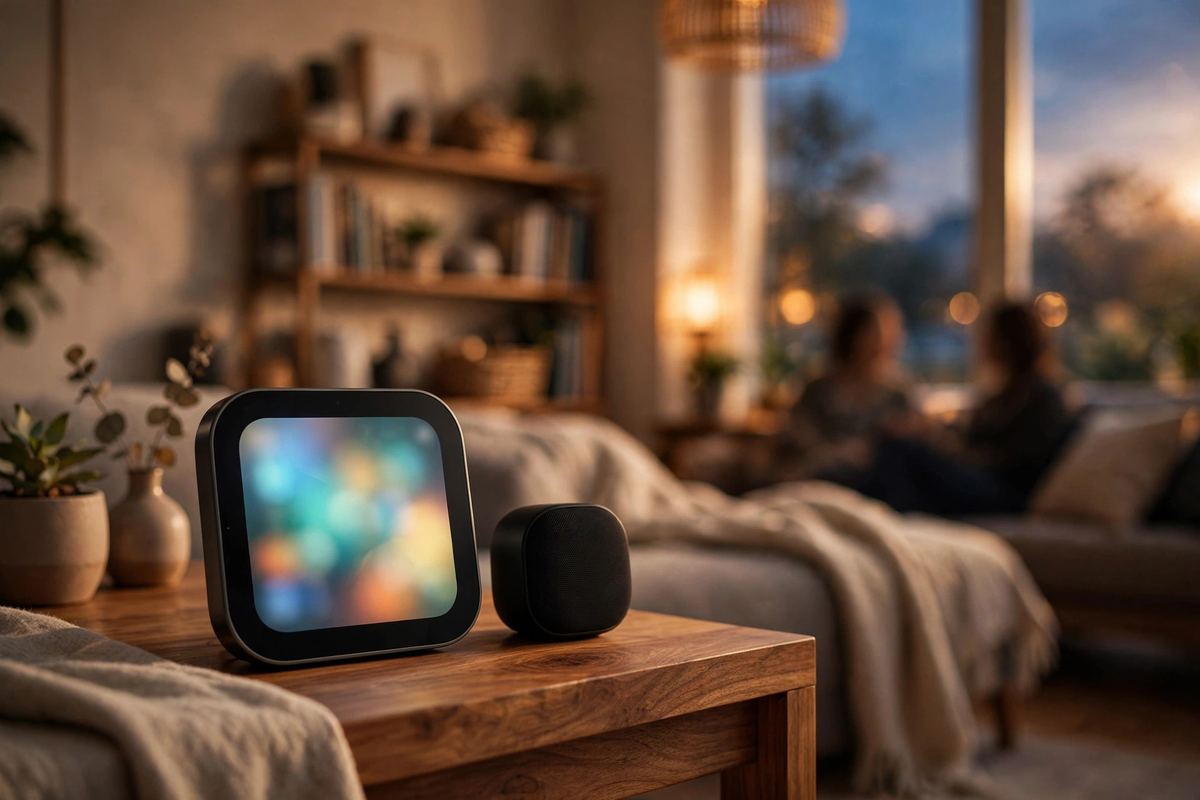
The centerpiece is the smart home hub, which Apple announced as HomeView — the name Bloomberg's Gurman had reported in his weekend Power On newsletter and an Instagram Reel shared on October 11. Gurman described the device as a Siri-powered command center for homes built around Apple devices, serving as a competitor to Amazon's Echo smart home hubs and Google's Nest Hub. The hub carries a 7-inch Liquid Retina display paired with an A18 chip to run Apple Intelligence features, with the rebuilt Siri as the defining capability. It costs $299 and becomes available on Friday, November 13.
Two versions of the hub were announced. The countertop model sits on a metal speaker base and is offered in four finishes: starlight, silver, space gray and rose pink. A wall-mounted version uses a flat, square base and is limited to space gray and silver. The device is designed to be managed primarily by voice, with touch supported on the screen, and it runs a limited selection of Apple apps — including Calendar, Messages, Photos, FaceTime, Notes, Reminders, Music and Podcasts — with no full App Store for third-party apps, though compatible third-party audio and video apps are supported. Apple instead appears to be directing users toward Siri, the Home app and connected accessories for control.
Alongside the hub, Apple refreshed two products that had gone years without major updates: the HomePod mini, which had not seen a full refresh since 2020, and the Apple TV, last updated in 2022. The new Apple TV 4K uses an A19 chip and has two notable features: a new remote control with a built-in speaker so it can be located through Apple's Find My app with Precision Finding, and three far-field microphones built directly into the Apple TV box so users can query the new Siri AI without reaching for the remote's microphone. It costs $299 and becomes available on Friday, November 13. The HomePod mini 2 uses the S10 chip and comes in new colors — pink, green, white, blue and midnight — with Siri AI arriving in a future software update rather than at launch. It costs $149 and reaches stores on Friday, October 30.
Why it matters
The "Welcome Home" launch represents Apple's most significant push into an entirely new product category in years. The smart home hub is a new kind of device for the company — a stationary, shared household screen rather than a personal mobile computer — and it arrives as Apple tries to prove that Apple Intelligence and the rebuilt Siri can anchor experiences beyond the iPhone. A hub that identifies family members and personalizes itself could give Apple a presence in the kitchen, bedroom and living room that persists all day, rather than only when someone picks up a phone.
It also matters because the competitive landscape has been set for years without Apple. Amazon and Google built their smart-home positions around the Echo and Nest Hub lines while Apple's home strategy rested on the Apple TV, the HomePod and the Home app. A dedicated hub, paired with what Gurman describes as an "Apple Home Collection" of accessories developed with LG and Schneider Electric — doorbells, deadbolt locks, thermostats, temperature sensors, indoor and outdoor security cameras, and a floodlight camera — would give Apple its first complete answer in the category.
The accessory partnership is unusual and telling. According to MacRumors, Apple is working with LG on accessories such as doorbells, smart locks and cameras that will be released under the LG brand rather than as Apple-branded products, with the collaboration bringing tighter integration and simpler setup inside the Apple ecosystem. Reporting also points to Schneider Electric as a partner for the European market. For a company famous for controlling every element of its products, leaning on established hardware brands suggests Apple wants breadth in the home quickly rather than building every accessory itself — a notable shift amid wider technology trade tensions reshaping global hardware supply chains.
The timing, under a new chief executive, adds another layer. The hub is only the second headline launch of the Ternus era, and its success or stumbling will be read as a signal of how the company is being steered after the Cook years. A strong reception would validate the bet that a more capable Siri, long delayed, was worth the wait. A weak one would raise questions about whether Apple arrived too late to a category its rivals have spent a decade shaping.
Key facts
- Apple confirmed a "Welcome Home" product launch for Tuesday, October 13, 2026, with an "Apple Experience" media session in New York City at 9:00 a.m. Eastern Time.
- The launch is expected to arrive as press releases on Apple's Newsroom site rather than a stage keynote, with hands-on time for invited reporters and creators.
- Apple announced HomeView, a smart home hub with a 7-inch Liquid Retina display and an A18 chip for Apple Intelligence, priced at $299.
- Two HomeView versions were announced: a countertop model with a metal speaker base in starlight, silver, space gray and rose pink, and a wall-mounted version in space gray and silver.
- The hub runs a limited set of Apple apps with no full App Store, is controlled primarily by voice through Siri AI, and recognises up to six household members with personalised profiles.
- A new Apple TV 4K was announced with an A19 chip, a remote with a built-in Find My speaker, and three far-field microphones in the box for hands-free Siri AI queries. It costs $299.
- A refreshed HomePod mini 2 was announced with an S10 chip and new colors — pink, green, white, blue and midnight — with Siri AI arriving in a future software update. It costs $149.
- The HomePod mini 2 reaches stores on October 30, while the HomeView and the new Apple TV 4K become available on November 13. All three opened for pre-order on October 13.
- An "Apple Home Collection" of accessories was announced from LG and Schneider Electric, including a smart doorbell, deadbolt lock, thermostat, temperature sensor, security cameras and a floodlight camera, with prices from $39.95 and availability from December.
- A second round of launches later in October is expected to focus on new Mac models, with Bloomberg corroborating MacRumors' reporting, and the iPhone Duo — Apple's first foldable, starting at $1,999 — goes on sale October 23.
What happens next
The immediate question was answered at 9:00 a.m. Eastern on October 13, when the press releases landed and the New York hands-on session began. That is when the rumored details — the HomeView name, the display size, the color lineup, the chip inside each device — were confirmed or corrected, and when pricing was finally revealed: $299 for HomeView, $299 for the new Apple TV 4K and $149 for the HomePod mini 2. Earlier coverage of the hub concept had speculated around $350, a figure the announcement undercut.
The weeks after the announcement follow a staggered release pattern. Pre-orders for all three devices opened on October 13, with the HomePod mini 2 reaching Apple stores on October 30 and the HomeView and the new Apple TV 4K following on November 13. The LG and Schneider Electric accessories follow from December, with some arriving in early 2027. That spacing gives Apple a rolling set of home products through the holiday season.
Beyond the products, the second half of October brings another expected launch wave focused on Macs, reportedly in the final week of the month, with a new iPad mini also possible. Gurman has separately reported that a high-end MacBook Pro with a touchscreen OLED display — expected as part of that wave — will be significantly lighter than current models. Between the foldable iPhone's release, the home push and the Mac updates, October 2026 is shaping up as one of Apple's busiest product months in recent memory, and the "Welcome Home" event is its opening act.
Apple's hardware momentum continued with the iPhone Duo, its $1,999 first foldable, which sold out within minutes of going on sale worldwide.