
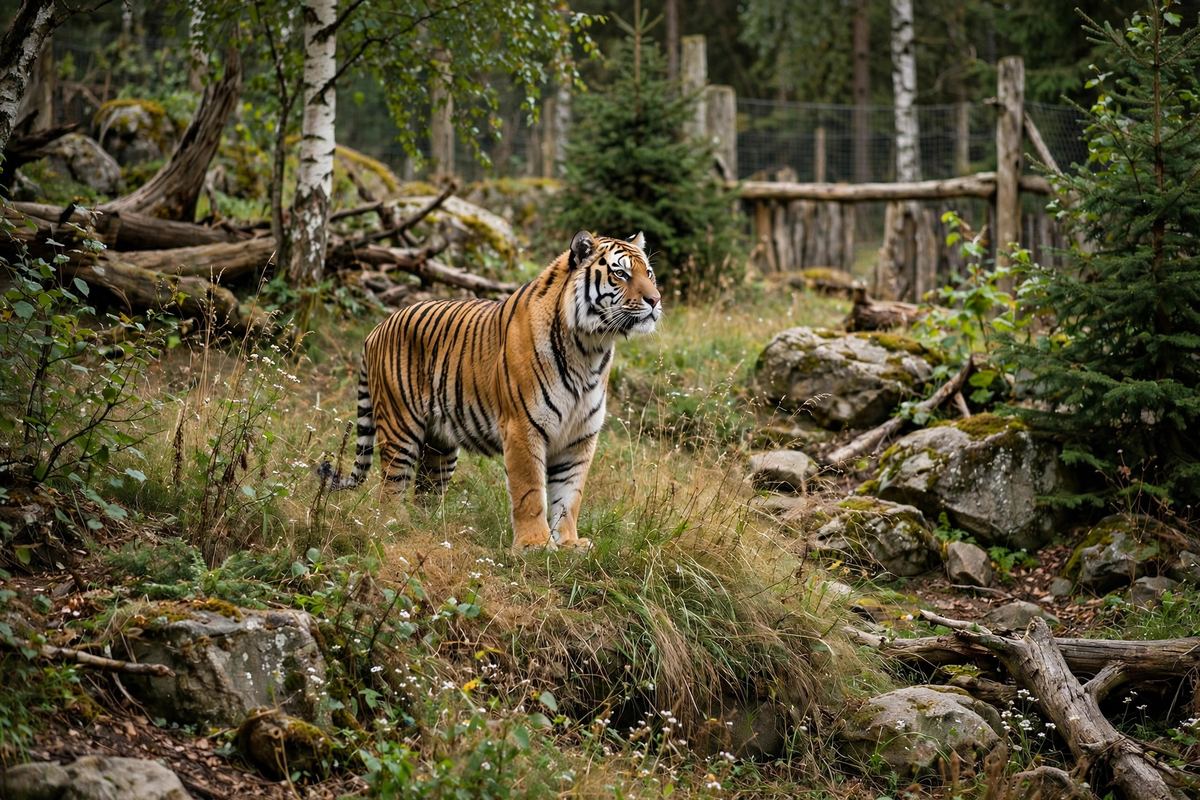
On the afternoon of 10 October 2026, a tragedy unfolded at one of Britain's best-known wildlife parks. South Yorkshire Police were called to Yorkshire Wildlife Park near Doncaster at around 1:35pm local time after reports that a man had entered the tiger enclosure. The tiger attacked, and despite the rapid arrival of emergency services, the man died at the scene. The incident has prompted a police investigation, the closure of the park for the weekend, and a wider conversation about how zoos protect both visitors and animals.
Because the man's identity has not yet been released, and the crucial question of how and why he entered the enclosure remains unanswered, much of this story is still developing. What follows is an explainer based on the verified facts established so far, along with context on how wildlife parks manage tiger enclosures, how such incidents are investigated in the United Kingdom, and what typically happens next.
A well-known park and its "Land of the Tigers"
Yorkshire Wildlife Park opened in 2009 and has grown into a major visitor attraction in South Yorkshire, drawing hundreds of thousands of visitors a year. Its tiger enclosure, which opened in 2011 and is marketed as the "Land of the Tigers", houses big cats in a large naturalistic habitat designed to give the animals space while keeping them securely separated from the public.
Tigers are among the most powerful predators kept in European zoos, and enclosures for them are built to rigorous standards. In the UK, zoos operate under the Zoo Licensing Act 1981, which requires enclosures to be designed and maintained so that animals cannot escape and visitors cannot gain access to animal areas. In practice this means tall fencing, moats or other physical barriers, stand-off distances, and signage warning visitors of the danger. Keepers never share an unenclosed space with a tiger; routine care such as feeding and cleaning is carried out using protected-contact systems, where solid barriers always separate people from the animal, and animals are routinely shifted into holding areas before staff enter an enclosure.
These layers of protection explain why incidents of this kind are extremely rare. When a person does enter a big cat enclosure, the outcome is almost always fatal for the human, because a tiger's instinctive response to an unfamiliar intruder in its territory is defensive and overwhelmingly powerful. It is worth remembering that such behaviour is entirely natural for the animal: a captive tiger is not a domesticated animal, and an encounter like this is not evidence of aggression in the clinical sense, but of a wild predator reacting as wild predators do.
What happened on 10 October
According to South Yorkshire Police, officers were called to the park at approximately 1:35pm on Saturday, 10 October 2026, following reports that a man had entered the tiger enclosure and been attacked. Emergency services responded at scale: an air ambulance, two land ambulances and a doctor were dispatched to the scene. Despite their efforts, the man died at the scene.
Police confirmed that the tiger was uninjured and remained within its enclosure, and that there was no wider risk to the public. The park was evacuated and closed, and it remained closed for the rest of the weekend. The man's family have been informed and are being supported by specialist officers, and his identity had not been released at the time of reporting.
In a statement, the park said it was "deeply saddened" by what had happened and that it was "working closely with the police and relevant authorities" to ascertain what had happened. South Yorkshire Police urged the public not to share videos of the incident that were circulating, a request that reflects both the distress of the family and the need to avoid prejudicing any investigation.
How the man got into the enclosure
The central unanswered question is how and why the man entered the enclosure at all. Police said this had not yet been established. Several possibilities exist in principle: he may have deliberately climbed over or through barriers, he may have found a point where fencing or gates had been compromised, or some other sequence of events may have led him into the animal's space. None of these has been confirmed, and speculation would be unfair to the family and unhelpful to investigators.
What can be said is that zoo barrier systems are designed to make unauthorised entry very difficult. Public viewing areas for big cats typically include a fence or glass barrier, a secondary stand-off fence set back from it, and sometimes a moat or deep channel between the public and the animal. Gates used by staff are locked and often alarmed. If someone is determined to bypass such measures, however, determined climbing or vaulting can defeat barriers that are perfectly adequate for their intended purpose, which is to keep compliant visitors at a safe distance and to keep the animals contained.
Investigators will therefore examine the physical state of the enclosure: the height and condition of fencing, the integrity of gates and locks, CCTV coverage, and the exact route the man took. Witness accounts from staff and visitors, along with any available footage, will be used to reconstruct the timeline between his arrival in the area and the attack.
Why the tiger was not harmed
One fact the police made explicit is that the tiger was uninjured and remained in its enclosure, with no wider risk to the public. In some past incidents at zoos around the world, dangerous animals have been shot in order to protect a person in the enclosure. That did not happen here, and the distinction matters.
From an animal-welfare perspective, the tiger was behaving as a tiger would; it cannot be blamed for the encounter. Modern zoo practice, and public expectation, increasingly hold that an animal acting on instinct should not pay with its life for a human's decision to enter its space. The park's statement of being "deeply saddened" extends, in this reading, to the whole situation: a life lost, a family devastated, and an animal caught in the middle of it.
The tiger's welfare will now be a consideration for the park. An animal involved in such an incident is typically monitored by keepers and veterinary staff for signs of stress, and enclosures may be reviewed to see whether any design change could reduce the chance of a repeat. But there is no indication that the animal faces any sanction, and none would be expected: dangerous-wildlife protocols in the UK focus on containment, barrier integrity and human behaviour, not on punishing the animal.
How investigations of this kind proceed in the UK
An incident of this seriousness triggers several parallel processes. South Yorkshire Police are leading the immediate investigation, which will establish the circumstances of the death and prepare a report for the coroner. In England, any death that is sudden, violent or of unknown cause is referred to the coroner, who holds an inquest to determine who died and how, when and where they came by their death. The inquest is a fact-finding process, not a trial, and it will likely be the forum where the public finally learns how the man entered the enclosure.
Separately, the park's zoo licence will come under scrutiny. The local authority that issued the licence, advised by specialist inspectors, can require changes to enclosures, procedures or staffing if the investigation finds shortcomings. The Health and Safety Executive may also take an interest if there are questions about the park's systems for managing public safety, since zoos are workplaces with duties toward both employees and visitors. Depending on findings, outcomes can range from required improvements to enforcement action.
The park's own internal review will run alongside these. Zoos that experience serious incidents typically commission a detailed review of barrier design, CCTV coverage, patrol and staffing levels, emergency response plans and signage, and many share the lessons learned with the wider zoo community through bodies such as the British and Irish Association of Zoos and Aquariums (BIAZA), so that one park's tragedy informs safety practice across the sector.
Visitor safety at wildlife parks: what the rules expect
The regulatory framework around UK zoos is deliberately layered. The Zoo Licensing Act requires that animals be kept in accommodation that takes account of their natural habits and that the public are not exposed to risk. Inspectors assess enclosures against detailed standards covering barrier heights, materials, stand-off distances, signage and emergency procedures. Staff working with dangerous animals must be trained and supervised, and parks must have written emergency plans covering scenarios including animal escape and, as in this case, a person entering an enclosure.
Emergency plans for a person-in-enclosure scenario are among the most difficult a zoo can face. Staff must simultaneously protect the person, protect other visitors, account for the animal, and summon emergency services, all within minutes. Drills are part of standard practice at accredited zoos. The speed and scale of the response at Yorkshire Wildlife Park — air ambulance, two land ambulances and a doctor — suggests the emergency plan was activated promptly, even though the outcome could not be changed.
It is also worth noting the role of visitor behaviour. Zoos invest heavily in barriers, but barriers assume a baseline of compliance: visitors stay behind them. Parks use signage, announcements and staff presence to reinforce this, but a determined individual can defeat measures that are more than adequate for ordinary visitors. This is one reason investigators look so carefully at intent and route: the lessons for prevention differ greatly depending on whether a barrier failed or was deliberately bypassed.
Key facts established so far
To summarise what is verified at the time of writing: on 10 October 2026 at around 1:35pm, South Yorkshire Police were called to Yorkshire Wildlife Park near Doncaster after a man entered the tiger enclosure and was attacked by the tiger. Emergency services including an air ambulance, two land ambulances and a doctor attended, but the man died at the scene. The tiger was uninjured, stayed in its enclosure, and police said there was no wider risk to the public. The man's family have been informed and are being supported by specialist officers; his identity has not been released. The park was evacuated and closed for the weekend. The park said it was "deeply saddened" and is working with police and relevant authorities to ascertain what happened. Police asked the public not to share circulating videos. How and why the man entered the enclosure has not yet been established.
What happens next
In the immediate term, the park will reopen only when police and its own management are satisfied it is appropriate to do so, and the tiger enclosure itself may remain closed to the public for longer while the investigation continues. The family's privacy will be protected as the coronial process begins.
Over the coming weeks and months, the police investigation and the coroner's inquest will establish the sequence of events, including the crucial question of how the man gained access. The zoo licensing authority and possibly the Health and Safety Executive will examine whether the park's barriers and procedures met the required standards. If deficiencies are found, enforcement or mandated improvements will follow; if the barriers were deliberately bypassed, the focus will shift to how parks can harden enclosures against determined intrusion without turning wildlife parks into fortresses.
For the wider public, the incident is a sobering reminder of a simple truth that underpins every zoo visit: the barriers between visitors and dangerous animals exist for a reason, and the animals on the other side, however calm they may appear, are wild. Yorkshire Wildlife Park, like the rest of the UK zoo sector, will now have to demonstrate that its barriers, procedures and emergency response were equal to the standards the law demands — and the investigation will determine whether they were.
Fatal incidents at visitor attractions have also made headlines in the United States, where a rider died on the Goliath roller coaster at Six Flags Over Georgia.