
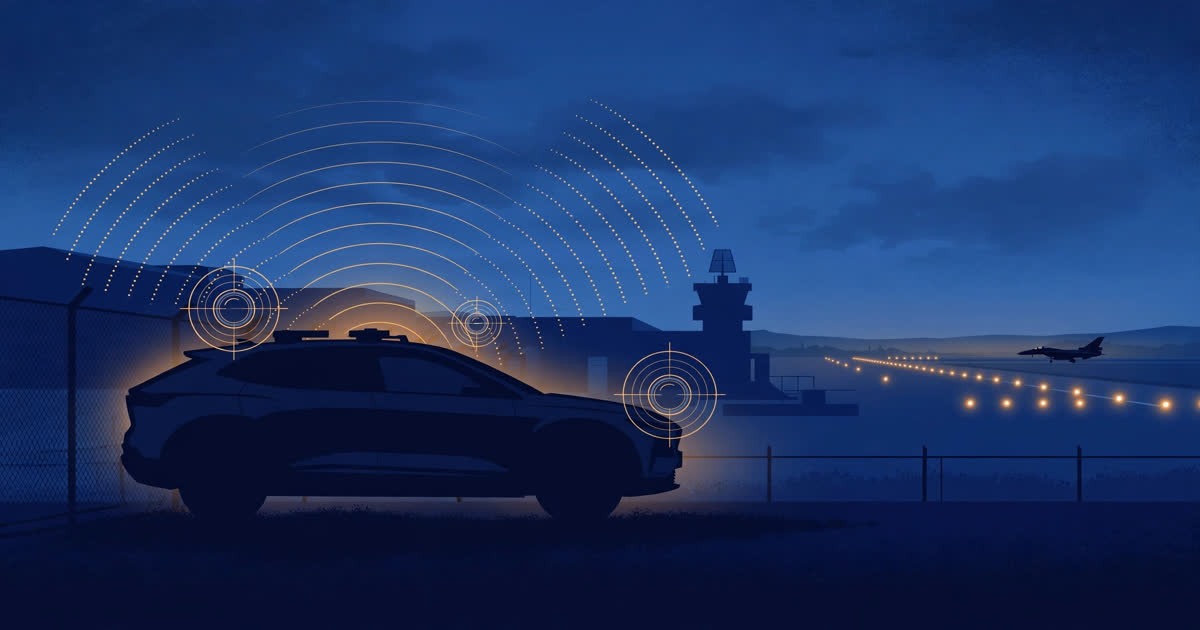
The US military is banning Chinese electric vehicles made by BYD from Kadena Air Base in Okinawa, Japan, after deciding the cars' cameras and sensors could quietly collect sensitive information about one of America's most important military installations in the Indo-Pacific. The restriction, reported on October 23, 2026, takes effect on Monday, October 26, and applies to every BYD vehicle — private cars, taxis, delivery trucks and contractor vehicles — with no exceptions.
The move, first reported by South Korea's Yonhap news agency and carried by Reuters, reflects how ordinary consumer technology has become a front line in the contest between the United States and China. Modern electric vehicles are rolling sensor suites: they film their surroundings with multiple cameras, map roads with radar and lidar, track precise GPS positions, and in many cases upload data to the cloud or allow remote access. At a base that houses fighter jets, transport aircraft, radar systems, ammunition stores — and, since mid-October, the US Army's Typhon mid-range missile system capable of firing Tomahawk cruise missiles — that kind of passive data collection is a security problem the Pentagon is no longer willing to tolerate.
US Forces Japan confirmed to Yonhap that security personnel at every base entrance will turn BYD vehicles around starting Monday. The 18th Security Forces Squadron, the unit responsible for protecting key assets and controlling traffic inside Kadena, will enforce the restriction. Importantly, the US military has not said the cars actually spied on anything: as with many security measures, the ban is preemptive, designed to close a possibility before it becomes an incident.
Why BYD, and why now
The ban did not arrive out of nowhere. In June 2026, the Pentagon added BYD — along with Alibaba, Baidu and NIO — to its Section 1260H list of "Chinese military companies," a designation for firms Washington believes are contributing to China's military capabilities. The designation bars the named companies from US defense contracts and has drawn sharp protest from Beijing, which called it discriminatory. Alibaba has since sued the US government over its inclusion.
The Kadena ban also fits a wider pattern across Western militaries. Recent reporting has documented similar restrictions at German, British, Swiss and French defense installations, and China's own government set an early precedent in 2021 by banning Tesla vehicles from military compounds over data-logging concerns — a restriction Beijing only eased after Tesla complied with Chinese data standards in 2024. In the United States, the Fiscal Year 2027 National Defense Authorization Act included provisions that would bar foreign-linked connected vehicles from Defense Department bases starting July 1, 2027. Earlier Commerce Department rules are already phasing out vehicle software and hardware tied to Chinese and Russian firms.
"Engine type alone tells security officials little about its ability to gather information," as one recent Asian security analysis put it. The risk is not the battery — it is the connectivity. A modern EV's cameras, microphones, radar and GPS can, in theory, map the layout of a base, log the movements of aircraft and personnel, and record electromagnetic and acoustic signatures. Whether any of that data ever reaches an adversary is almost beside the point for force-protection officers: the vulnerability is the risk.
Kadena's strategic weight
Kadena is one of the largest US air bases in the Indo-Pacific and a key hub for American operations across the region. Its 18th Wing operates fighter jets, transport aircraft, aerial refueling, radar and munitions storage. Since around mid-October 2026, it has also temporarily stored the US Army's Typhon mid-range missile system and HIMARS launchers, moved from Kanoya Air Base in Kagoshima for training with Japan's Self-Defense Forces — a deployment that drew criticism from China and Russia, and protests from the mayor of Kadena town, who called it "totally unacceptable."
Tomahawk cruise missiles have a range of roughly 1,600 kilometers, placing parts of the East China Sea, the Taiwan Strait and China's coastline within reach from Okinawa. That is precisely why the US believes Kadena's facilities, equipment and movement patterns need shielding from any foreign sensor network — even one as mundane as a taxi's parking camera. The US presence in Okinawa has also come under scrutiny this month after a US Marine was arrested in a murder case that sparked protests across Japan.
Could the ban spread to South Korea?
Aju Press reported that similar restrictions could expand to US military bases in South Korea — and the groundwork for such a debate is already there. Data disclosed last week by South Korean lawmaker Kang Dae-sik of the People Power Party showed at least 190 Chinese-made connected vehicles registered to enter South Korean military facilities, including naval bases in Busan and Jinhae and Air Force bases in Cheongju and Yecheon that house F-35 stealth fighters and KF-21 jets.
Earlier in October, Reform Party lawmaker Chun Ha-ram dramatized the policy gap by driving a BYD EV — while wearing smart glasses — into the South Korean defense ministry during a parliamentary audit, encountering no restrictions. Defense Minister Kang Shin-chul acknowledged the absence of specific entry rules for such devices and said the ministry was weighing institutional restrictions; Joint Chiefs of Staff Chairman Jin Young-seung promised guidance "as quickly as possible." A US Forces Korea restriction would be a natural next step, and USFK officials are likely watching the Kadena rollout closely.
The bigger picture: US-China tech-security tensions
The Kadena ban lands in a period of whiplash in the US-China relationship. Just weeks ago, Washington and Beijing reached a trade framework in Kuala Lumpur that took 100% tariffs off the table, and the two sides have an AI safety agreement on the books. Yet the same year has brought a Pentagon sweep of Chinese firms off defense supply chains and now a vehicle ban at a frontline base.
That duality is the signature of current US strategy in the Indo-Pacific: pursue a "decent peace" while erecting what Washington calls a denial defense along the first island chain. Connected-car restrictions are part of that defense posture — and part of a broader American campaign against Chinese-origin technology deemed a data risk, from apps to drones to software inside cars.
For BYD, the world's largest EV maker, the measure is small in commercial terms — base traffic is a rounding error next to global sales — but heavy in symbolism. It converts the 1260H designation into a physical reality: not just no defense contracts, but no wheels on America's most sensitive runways. Beijing has previously protested such measures as discriminatory; a response from China's foreign ministry is likely in the coming days.
What happens next
Starting Monday, the gates of Kadena will be a small test case for how far Washington will take connected-vehicle security. If the ban extends to USFK bases in South Korea — where nearly 200 Chinese-made connected vehicles already hold base access — it would mark a significant widening of the policy. Longer term, the FY2027 NDAA's base-entry provisions would codify the approach across the Department of Defense from mid-2027.
For now, the message from the US military is plain: at a base within missile range of the region's flashpoints, even a car is a sensor — and every sensor needs a clearance. As news coverage has noted, the story is trending per news coverage across Asia-Pacific outlets, and it underscores how the US-China technology rivalry has moved off the negotiating table and onto the tarmac.
Sources: Reuters, Yonhap News (via Aju Press and TradingView), JKN, Daily News US, EuropeSays.