
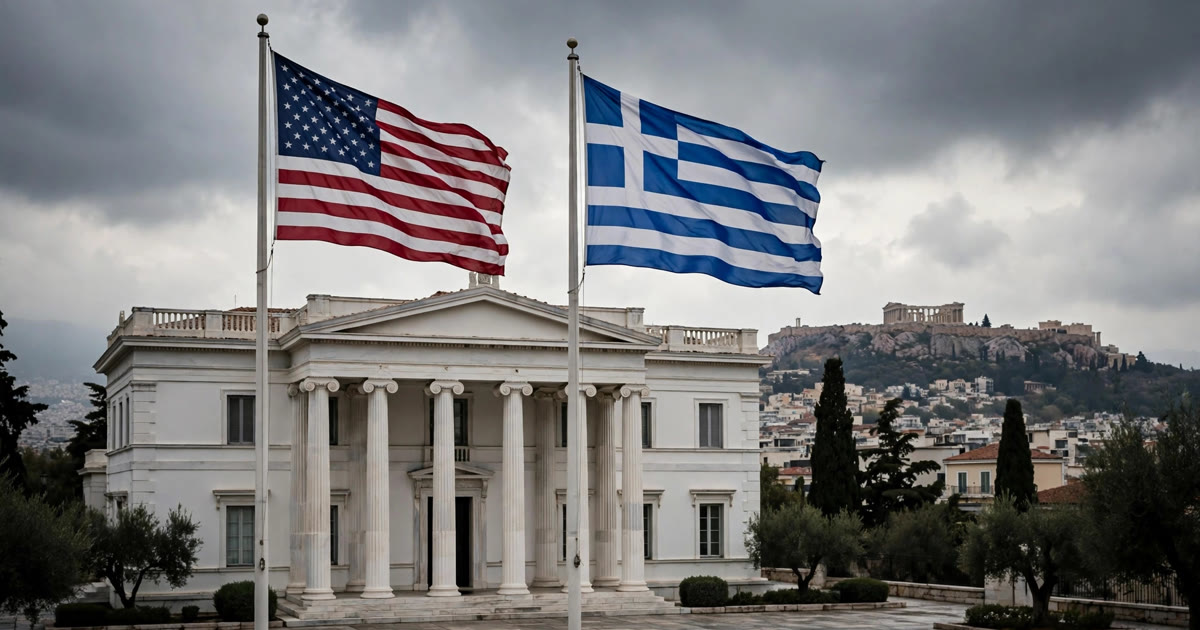
One of Donald Trump's most high-profile diplomatic appointments is in serious trouble. The president said Monday, October 12, 2026, that he is "looking at" firing Kimberly Guilfoyle as U.S. ambassador to Greece after a string of reports alleged she engaged in improper — and possibly illegal — conduct both before and during her time in Athens. Asked by reporters at the White House whether he was considering dismissing her, Trump was blunt: "Well, we're looking at it. Yeah, we're not happy."
The story is trending per news coverage across the Wall Street Journal, CNN, the Associated Press, the BBC, the Washington Examiner, and the New York Post. It is also the first major diplomatic scandal of Trump's second term — involving his former daughter-in-law-to-be, a sitting U.S. ambassador to a NATO ally, and an active State Department inspector general investigation.
What Trump actually said
Trump's comments on Monday were his most direct remarks on the controversy since the story broke. A day earlier, CNN reported that the president had been weighing whether to dismiss Guilfoyle after learning about the allegations, with a person familiar with the matter saying a decision was expected soon. On Sunday, the Associated Press, citing a senior U.S. official, reported that Trump and Secretary of State Marco Rubio were "extremely pissed off" by Guilfoyle's reported conduct and would likely decide her future this week.
The timing is awkward. The allegations surfaced last week just as Rubio was visiting Athens for a high-profile speech on Western democracy delivered from the Acropolis — a trip on which he had publicly defended Guilfoyle. Asked about the reports on Thursday, Rubio pushed back on reporters: "You guys walk around thinking that because some source told you something and you reported it, it's the gospel," he said. "It's not the gospel. It's not the gospel for me." Privately, officials now say he feels burned.
According to the Journal, administration officials spent the weekend debating whether Guilfoyle could continue in the post. One option floated: asking her to voluntarily relinquish her ambassadorship, sparing Trump the embarrassment of having to fire her outright. The U.S. Embassy in Athens has issued no comment, though one official told the Journal that Guilfoyle "was fully vetted by the bipartisan Senate Foreign Relations Committee and confirmed by the U.S. Senate" and "remains committed to representing the American people with dedication and integrity."
The $100,000 text messages
At the center of the scandal is the Wall Street Journal's reporting on hundreds of messages, emails, and letters it says it reviewed. The most damaging: Signal texts in which Guilfoyle allegedly asked Eric Deters, a Kentucky businessman and longtime Trump donor, to wire $100,000 to her personal American Express account shortly before her July 9, 2025, Senate confirmation hearing.
On July 3, 2025, Guilfoyle reportedly attached a PDF with American Express bill payment instructions and urged Deters to handle the payment that same day — six days before she appeared before the Senate Foreign Relations Committee. In one message, she allegedly wrote: "It won't show up anywhere if you wire money to American Express."
Deters, a former Ohio morning radio host who later founded Freedom Fest, an anti-COVID-mandate festival, has known Guilfoyle since 2020. He had paid her a combined $300,000 in speaking fees at past festival editions, alongside other members of the Trump family, and donated $125,000 to a pro-Trump PAC in 2022, according to Federal Election Commission records cited by the Journal. But he refused to pay the credit card bill, telling Guilfoyle he lacked sufficient liquid assets at the time.
After the 2024 election, the relationship grew complicated. Deters was facing an IRS investigation over a 2020 deduction he claimed after selling a stake in his family business, and he asked Guilfoyle to help arrange the extradition of an Ohio doctor who had fled to Pakistan after being charged with defrauding insurers. Deters has publicly characterized the $100,000 request as a quid pro quo — saying he has "no doubt" it was pay to play — although no official finding supports that claim. The Journal also reported that Guilfoyle told friends she felt broke after her engagement to Donald Trump Jr. ended, and needed to pay down roughly $100,000 in credit card debt.
Throughout their correspondence, Guilfoyle repeatedly urged Deters to keep their dealings out of writing. "Eric, I really wish you would stop papering all these things. It's really dangerous and not helpful to you or me while you could simply just call me on Signal," she reportedly wrote. In a January 2025 message, weeks after her nomination: "What a nightmare, you'll literally cost me my ambassadorship stop writing."
Who is Kimberly Guilfoyle?
Guilfoyle's path to the ambassadorship ran through courtrooms, cable news, and the center of Trump's political universe — not traditional diplomacy. Born March 9, 1969, she studied at UC Davis and earned her law degree from the University of San Francisco School of Law. She worked as an assistant district attorney in San Francisco from 2000 to 2004 and later as a prosecutor in Los Angeles.
From 2006 to 2018 she was a prominent Fox News host, co-hosting the panel show The Five, before leaving television to become a senior adviser on Trump's 2020 reelection campaign, where she led the fundraising division. From 2021 until late 2024, she was engaged to Donald Trump Jr., making her a fixture of the Trump family's inner circle.
Her earlier marriage is its own political curiosity: from 2001 to 2006, she was married to Gavin Newsom, now the Democratic governor of California, and served as San Francisco's first lady during his first years as mayor. The nomination, announced by Trump on December 10, 2024, surprised some observers precisely because her career had centered on law, television, and political activism. Trump praised her "extensive experience and leadership in law, media and politics," and the Senate confirmed her on September 18, 2025, by a narrow 51–47 vote. She held the post in Athens for eleven months.
The wider pattern of allegations
The $100,000 request is only part of the Journal's reporting. In subsequent stories, the paper described audio of Guilfoyle boasting that Greek business magnates had paid for her flight to Paris along with luxurious hotel accommodations — exactly the kind of private gift from foreign businesspeople that federal ethics rules for diplomats are designed to police. The reports also allege she made a threat to a host country official and offered to use her influence inside the administration in exchange for covering a large credit card bill, and pushed business interests tied to a Greek energy firm.
The State Department's Office of the Inspector General is now investigating Guilfoyle over the allegations, a source familiar with the effort told CNN on Monday. The OIG's press office declined to comment — "As a matter of policy, OIG does not confirm, deny, or comment on investigative matters," a spokesperson told CNN last week — but the existence of an inspector general probe into a sitting ambassador is rare and serious on its own.
How Guilfoyle's team is responding
Her attorneys, David Schwartz and Jesse Binnall, have denied any wrongdoing. In a statement late Sunday, they said Guilfoyle "has served, and will continue to serve, with integrity, honor and distinction," adding that they were "evaluating all available legal remedies" to collect what they characterize as a legitimate debt.
On the $100,000: the lawyers say it was not a quid pro quo but payment owed for prior speaking engagements and consulting services — "when Ms. Guilfoyle was preparing to leave private life for public service, she did what any professional does and tried to close out her outstanding receivables," they told CNN. On the texts themselves, her attorney Jesse Binnall told the Journal she disputed the authenticity of the messages but offered no specifics. On the private-jet travel, the lawyers say she "sought, obtained and followed State Department guidance" and travel regulations before every trip, and that she complied with federal gift and reporting requirements. Deters himself has not stayed silent: he has released screenshots of the messages and given interviews, including to CBS News.
Why Greece matters
Guilfoyle's post is not a ceremonial backwater. Greece is a NATO ally of strategic importance — a gateway to the Eastern Mediterranean, a partner on energy security and migration routes, and a country where Washington has been deepening defense and economic ties. The ambassador to Athens represents the United States in a region where Russia, Turkey, and Middle Eastern powers are all active. A prolonged scandal — or a vacancy — weakens American leverage at precisely the moment Washington is managing overlapping crises, from the Ukraine energy war to the escalation with the Houthis. For more on the administration's crowded foreign-policy plate this week, see our explainer on the Ukraine energy ceasefire and the White House's simultaneous domestic battles, from the DOJ's probe of TV networks to the fight over taxpayer-funded pro-Trump ads.
What happens next
Four things to watch. First, the decision itself: on Tuesday, 13 October, the White House asked Guilfoyle to resign, and she announced within about two hours that she was quitting. Trump said she had been doing a good job, but the White House did not like what it was reading. The decision came a day after he had said he was "looking at" removing her. Second, the inspector general investigation: its findings, if published, could establish whether ethics laws or the Foreign Corrupt Practices Act were violated. Third, the legal battle: her lawyers have promised to pursue "all available legal remedies," and Deters has already taken his claims public. Fourth, the confirmation fallout: the 51–47 Senate vote that put her in Athens will be re-litigated, and future nominees with thin diplomatic records will face harder scrutiny.
Guilfoyle's time in Athens ended on Tuesday, 13 October, when the White House asked her to resign and she announced within about two hours that she was quitting. She denied the allegations and said she would vigorously defend her name, reputation and integrity. Two days later, Eric Deters sued Guilfoyle and her lawyers for defamation in Kentucky state court over their denials of his claims; her lawyer called the suit frivolous. No successor has been named, and the embassy is expected to be run by a senior diplomat until a new ambassador is nominated and confirmed.
Sources
Reporting drawn from the Wall Street Journal (reporting 8–12 October 2026), CNN (11–12 October 2026), the Associated Press, the BBC, the New York Post, and the Washington Examiner (10–13 October 2026), plus Wikipedia for biographical details.