
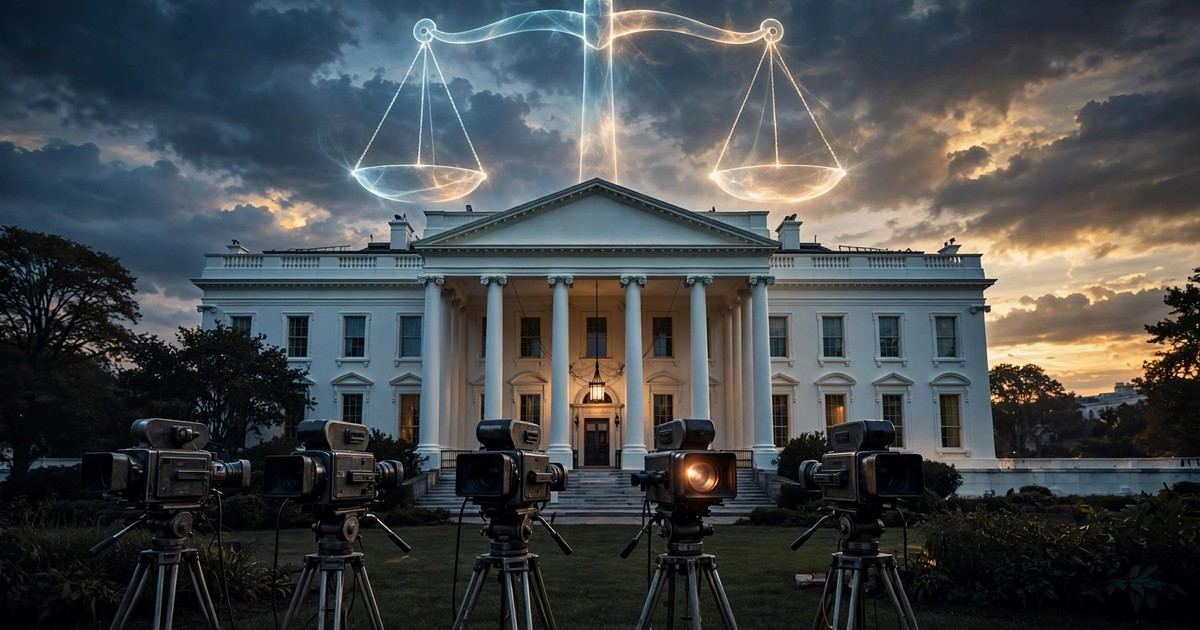
On Friday 10 October 2026, the US Department of Justice's Antitrust Division did something no administration had done before: it told five of America's biggest television networks — ABC, CBS, CNN, NBC, and Fox News — that their decision to stand together in a dispute over White House press access may have broken federal antitrust law. The department sent what are known as civil investigative demands — the civil equivalent of subpoenas — asking for communications and records tied to the White House television press pool. The New York Times first reported the probe. The story is trending per news coverage across the Times, Reuters, NPR, and other major outlets, and it has turned a behind-the-scenes press-access fight into one of the year's most consequential clashes between the Trump administration and the news media — one that could reshape how the press covers every future president.
What the Justice Department is alleging
A Justice Department spokeswoman, Emily Covington, framed the inquiry in blunt terms on Saturday. She said that group boycotts among commercial competitors can violate the Sherman Act, and that members of the television press pool had proudly boycotted covering White House events. She described the move as routine, saying the Antitrust Division is simply investigating to determine whether these news organizations violated the antitrust laws.
The Sherman Act, passed in 1890, is the foundation of American antitrust law. Among other things, it bars concerted action — agreements among competitors — that restrain trade. Courts have long treated "group boycotts," where rivals coordinate to withhold business from someone, as among the most serious antitrust offenses. The DOJ's theory is that the five networks, which compete fiercely for viewers and advertising, acted in concert when they simultaneously stopped performing their rotating pool duties. In the department's telling, that coordination amounts to a boycott of White House events — and boycotts among competitors can be illegal, whatever the motive.
So far, no charges or findings have been announced. A civil investigative demand is not a criminal indictment; it is a tool the Antitrust Division uses to gather documents and testimony while it decides whether a case exists at all.
How we got here: the September press bans
The dispute began on 19 September, when the White House revoked the press credentials of reporters from CNN, MS NOW, and Politico, declaring that covering the president was "a privilege — not a right." The move was the sharpest yet in a long-running confrontation: the administration has repeatedly threatened broadcast licenses and punished outlets whose coverage it dislikes.
The three barred outlets sued, arguing the exclusions retaliated against them for their reporting and violated the First Amendment. A federal judge — Timothy Kelly, an appointee of President Trump himself — issued a temporary order restoring their credentials, and the networks resumed their pool coverage on 25 September. The reprieve was later extended, and Judge Kelly is expected to decide on a longer-term preliminary injunction by Tuesday evening.
In between the revocation and the court order, the five networks made the decision that is now the target of the DOJ's inquiry: they declined to fill the pool rotation in solidarity with their banned colleagues. The networks' view, widely shared across the press corps, was basic solidarity — that allowing any president to pick off one outlet at a time would eventually threaten them all. For roughly five days, the pool that normally guarantees cameras at presidential events stood down.
What the White House TV pool actually is
To understand the stakes, it helps to know what the pool is. The White House television pool is a decades-old cooperative arrangement: ABC, CBS, CNN, NBC, and Fox News take turns sending a camera crew into spaces too small for every outlet — the Oval Office, Air Force One, motorcade departures — then share the footage and split the costs with the rest of the press corps, including C-SPAN and international broadcasters. Every modern administration, Republican and Democratic, has relied on it. It exists precisely because the alternative — five crews shoving into a doorway, or no cameras at all — serves nobody.
That history cuts directly against the DOJ's legal theory. The pool is itself a standing agreement among competitors to cooperate. As former Antitrust Division chief Jonathan Kanter put it, the networks' joint stand is no more an antitrust violation than the reporters coming together to form the pool in the first place.
Why legal experts say the case fails
Legal experts across the spectrum say the antitrust theory is extraordinarily weak. Kanter, who ran the DOJ's Antitrust Division under President Biden, told CNN the matter is not even in the same zip code as an antitrust violation. He pointed to Supreme Court precedent protecting boycotts organized as political protest — civil-rights-era boycotts, for example — as free speech. A coordinated refusal to perform pool duties as a protest over press access, in his analysis, sits in that protected category.
Seth Stern of the Freedom of the Press Foundation made the economic point: depriving Trump of the attention he craves is not a competitive harm, and antitrust law has long recognized First Amendment exceptions even when there is anticompetitive impact. In other words, antitrust law polices harm to competition in markets — not a news organization's decision to withhold its labor from the government as a protest. Stern also noted the irony: that after years of "fake news" rhetoric, the administration is weaponizing the Justice Department to pressure the very networks it calls the enemy of the people to keep filming at the White House.
Bruce D. Brown of the Reporters Committee for Freedom of the Press called the probe another and even more brazen attempt to try to intimidate journalists — and warned it may also be a pretext for the government to get its hands on the networks' internal records, since civil investigative demands reach communications far beyond the pool rotation.
The networks' response: mostly silence
So far, none of the networks has said much. ABC News said it had not yet received a notification but expected to; NBC, CBS, and CNN declined to comment; Fox News did not respond. The White House has not commented either. A source told CNN the probe may come up in the banned outlets' lawsuit — a reminder that this fight is playing out on two fronts at once: the courts, where judges have so far sided with the press, and the Justice Department, where the administration holds the initiative.
Jose Zamora of the Committee to Protect Journalists framed the stakes for the public: "The government should not use antitrust investigations to intimidate news outlets defending press access. The public's right to know depends on that access."
Why it matters beyond this week
Even if the probe never produces charges, its effects are already real. The first is a chilling effect: newsroom lawyers everywhere are now calculating the legal risk of the solidarity tactics that have historically been the press corps' strongest defense against divide-and-conquer pressure. The second is precedent: if antitrust law can be stretched to cover journalists coordinating on coverage decisions, future administrations of either party inherit the weapon. The third is practical: the pool arrangement itself could come under strain if networks fear that cooperating — or declining to cooperate — invites federal scrutiny.
There is also the calendar. The November 3 midterm elections are three weeks away, and the administration's confrontation with the media is unfolding against a campaign in which coverage of the president is itself part of the story. For parallel examples of how this administration has used legal tools against institutions it clashes with, see our explainers on the probe of Fed Governor Lisa Cook and the DOJ's denaturalization drive.
What to watch next
Three things matter next. First, the networks' response to the civil investigative demands — whether they comply, negotiate limits, or fight them in court — will set the tone for everything that follows. Second, Judge Kelly's ruling on the underlying credential ban, expected by Tuesday evening, could deflate or inflame the dispute: a preliminary injunction extending press access would be another judicial rebuke of the administration's approach. Third, whether the DOJ moves from investigation to enforcement — a step that would require it to convince a court that five news organizations conspired to restrain trade by declining to film the president.
For now, the facts are these: a federal department is investigating the country's five biggest TV networks under a law written to break up oil trusts, because they briefly refused to point their cameras at the White House. Our guide to how the court system works explains the legal machinery this fight is moving through. The press office itself saw a shake-up shortly afterwards, when Katie Zacharia left the press secretary role after only five days.
Broadcasters on both sides of the Atlantic are under pressure, with the BBC confirming that BBC Three, BBC Scotland and Radio 4 Extra will close next spring as part of a £500 million savings plan.
The legal pressure on broadcasters extends across the Atlantic: a judge has ordered Trump to sit for a deposition by December 11 in his $10 billion BBC lawsuit.
The department's aggressive posture extends to election law: Trump's DOJ has sued to block Alaska's Senate certification in the dispute over the two Dan Sullivans.
Sources
Reporting drawn from The New York Times, Reuters, NPR, CNN, Reason, and the Committee to Protect Journalists (10–12 October 2026).