
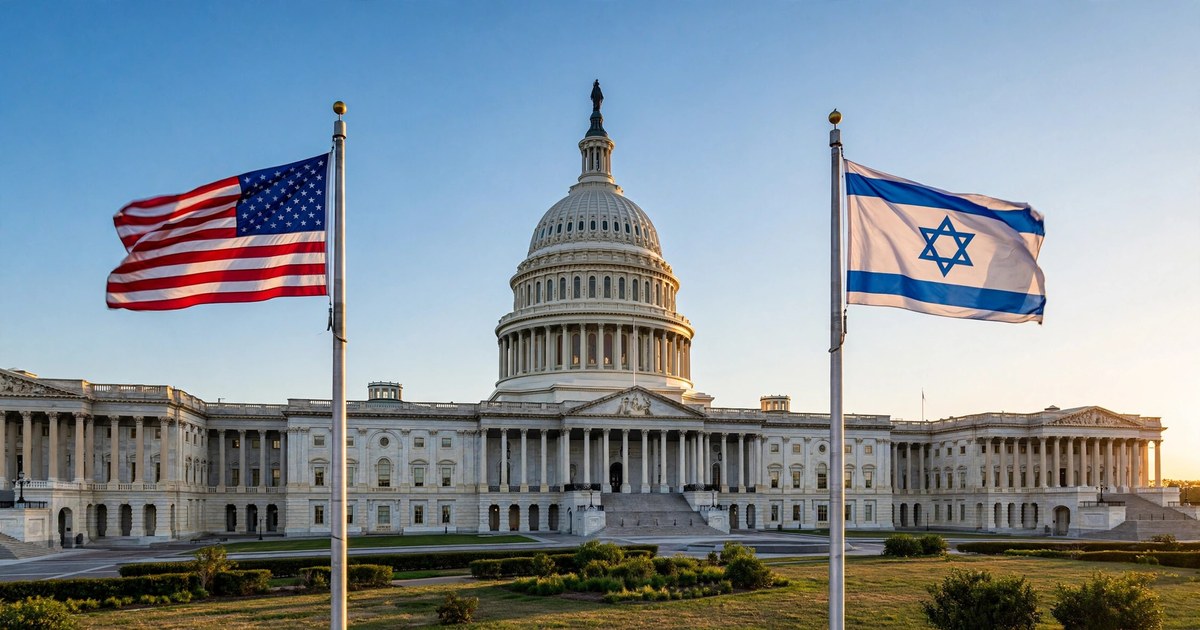
Trending per news coverage: the Trump Israel aid announcement landed on Election Day, Tuesday 3 November 2026, when President Donald Trump told Fox & Friends that the United States will end about $4 billion a year in aid to Israel by the end of 2026, saying he had agreed the cutoff with Israeli Prime Minister Benjamin Netanyahu months ago. The claim stunned even some of Trump’s own supporters — but the deal that actually governs the money runs until 2028, Netanyahu’s office has not confirmed Trump’s account, and Congress, which writes the cheques, has not acted. Here is what Trump said, what the $4 billion really is, and what would have to happen for the payments to stop.
Trump Israel Aid: What He Announced on Fox & Friends
Trump made the announcement in a phone interview on Fox News’ “Fox & Friends” on the morning of Election Day, as Americans voted in the 2026 midterm elections. “Bibi Netanyahu and I have made a deal that we give Israel $4 billion a year, and we made a deal months ago that we’re stopping,” Trump said. “We’ve already agreed that by the end of this year we won’t be paying Israel. Now we’ll help Israel if they need it.”
“It gets cut off at the end of the year… They don’t need it,” he added. “Israel is a very thriving country. They don’t need it.” Trump also said Israel was “our number one” recipient of American aid: “We give them more than anybody else. And they no longer need it.”
Trump said the idea came from Netanyahu himself. “He brought it up,” Trump said. “He said, ‘I think it would be appropriate if we do not receive aid.’” According to Trump, the two leaders had discussed phasing the aid out for several years before reaching an agreement. Netanyahu’s office has not confirmed that account, and no written agreement has been released.
Pressed on Fox over whether he was cutting $4 billion in military aid or $4 billion as a cheque, Trump answered: “Any way you want to define it.” He added: “You can consider it barter. You can consider military aid or cash. What we give them — $4 billion of things and money — and they don’t need it.” Reuters reported that Trump said the United States will still sell weapons to Israel, its close Middle East ally, even if the aid payments stop.
Trump also framed the move as politics. He said some Democrats and left-wing politicians were using American financial support for Israel to criticise Republicans, asking: “Why should we suffer the slings from lunatics like an El-Sayed when they [Israel] don’t need it?” He was referring to Abdul El-Sayed, the Democratic Senate nominee in Michigan. US aid to Israel amid the war in Gaza has been one of the most contentious issues of the midterm campaign: in July 2026, nearly half of House Democrats voted to cut off aid to Israel through an amendment to the State Department spending bill.
Trump Israel Aid: What the $4 Billion Actually Pays For
The figure Trump used — $4 billion a year — is his rounded version of the real number. The United States provides Israel with $3.8 billion a year in military aid under a ten-year memorandum of understanding, or MOU, signed in September 2016: $3.3 billion a year in Foreign Military Financing grants and $500 million a year for joint missile defence programmes.
All current American aid to Israel is military. Economic assistance was phased out entirely in 2008. The $3.3 billion in grants is spent on American-made weapons and equipment — CNN notes that most of the funds go to buying weapons from exclusively American manufacturers, so the deal has significant implications for American businesses and employment. The money, in effect, never leaves the United States: it flows from State Department accounts to American defence contractors. By the final year of the agreement, every dollar of the grant money must be spent on American-made products.
The $3.8 billion is a floor, not a ceiling. Actual American military aid to Israel has run well above it in recent years: Congressional Research Service figures put total US military and missile defence assistance to Israel at about $12.5 billion in fiscal year 2024, including supplemental packages passed after the war in Gaza began. Israel is the largest cumulative recipient of American foreign aid since 1946, at about $174 billion in total, according to the Congressional Research Service — although Ukraine is currently the largest yearly beneficiary, having received $6.75 billion in 2025.
For Israel, the money is significant but not decisive. The $3.8 billion is roughly 0.6% of Israel’s GDP, according to the Israel Policy Forum, and about a tenth of Israel’s defence spending, which reached an estimated 168 billion shekels — about $52 billion — in 2025.
The 2016 Deal Runs to 2028 — Why the Dates Do Not Match
The central problem with Trump’s timetable is the calendar. The memorandum of understanding that provides the $3.8 billion a year was signed on 14 September 2016, under President Barack Obama, and covers fiscal years 2019 through 2028 — a $38 billion pledge in total. It does not expire until September 2028.
Ending the payments at the end of 2026 would therefore cut the deal short by about two years, leaving roughly $7.6 billion of the pledged $38 billion unpaid. Trump’s own description does not explain how that gap is bridged: he did not provide details or explain how the funding would be halted at the end of the year, given that the memorandum runs to 2028.
One possibility is that Trump is talking about the successor agreement rather than the current one. The United States and Israel began formal talks in May 2026 on a new agreement to replace the memorandum when it expires, and Netanyahu told The Economist in January 2026 that he wanted to “taper off” American military aid within ten years. As one CNN analyst put it: “Whether he’s talking about, we’re going to end the MOU when it ends in 2028, or we’re going to stop it right now, I don’t know.”
Can Trump End Israel Aid Without Congress?
No — not on his own. The memorandum of understanding is a political promise, not a law: it needs no Senate ratification, and the money only flows when Congress appropriates it each year. Section 1273 of the fiscal year 2021 National Defense Authorization Act authorises “not less than” $3.3 billion a year in military grants to Israel through 2028, which makes the annual payment functionally guaranteed for the duration of the agreement.
Congress has yet to pass the fiscal year 2027 National Defense Authorization Act, the annual defence policy bill that authorises funding levels, and changing existing authorised programmes would require congressional action. As the Daily Caller noted, “changing existing authorized programs would require congressional action, and the current MOU remains in effect through 2028.” Trump’s announcement could prompt lawmakers to revisit Israel-related provisions when Congress returns after the midterm elections — but until Congress moves on appropriations, the announcement rests on a phone interview.
That is also why the White House and Netanyahu’s office matter. CNN has reached out to both for additional details. Until the White House publishes an instrument putting the change into effect, or Congress acts, there is no document ending the aid — only the president’s word that a deal was struck months ago.
Why Trump Says Israel No Longer Needs the Money
Trump’s case rests on Israel’s wealth. “Israel is a very thriving country,” he said, calling it a “great ally, much more reliable than most.” The argument is that a country with a large, advanced economy and a defence budget of about $52 billion does not need $3.8 billion a year in American grants — and that the money has become a political liability, a talking point Democrats use against Republicans.
The announcement is striking because Trump is, in CNN’s words, “arguably the most pro-Israel president of modern times.” It also fits a pattern in his second term: the president has repeatedly questioned long-standing American commitments, and he has said Netanyahu himself raised ending the aid. The same week, Trump also defended the American war on Iran and the United States carried out limited strikes on Iran’s Qeshm Island, while diplomats worked on a plan to reopen the Strait of Hormuz.
What Happens Next
Four things will show whether the $4 billion cutoff is real. First, whether the White House publishes any written agreement or budget document ending the payments. Second, what Netanyahu’s office says — silence so far leaves Trump’s account unconfirmed. Third, what Congress does when it returns after the midterms, and whether the fiscal year 2027 defence bill keeps the $3.3 billion grant in place. And fourth, what happens to the successor-agreement talks that began in May 2026, which were already expected to reshape American assistance after 2028.
Until one of those moves, the end of American aid to Israel is a statement on morning television, not a change in the law. The $4 billion figure is real, the 2016 deal is real, and the two do not yet add up — which is why the next words that matter will come from Congress and from Jerusalem, not from Fox & Friends.
Sources: Reuters; USA Today; CNN; Daily Caller; Congressional Research Service; US Department of State; Israel Policy Forum.