
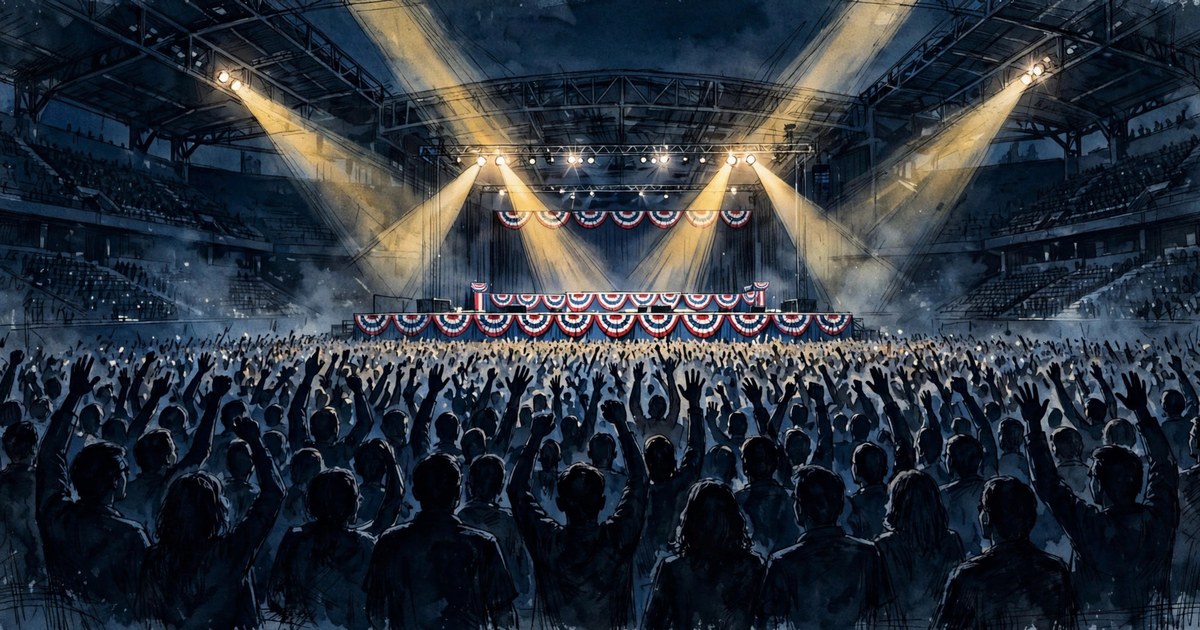
The Trump Michigan rally in Port Huron on Sunday, 25 October 2026, has become one of the most talked-about campaign moments of the final stretch before the United States midterm elections. Trending per news coverage across American outlets on Monday, the Trump Michigan rally combined a fierce attack on Democratic Senate candidate Abdul El-Sayed, a surprise appearance by rapper Nicki Minaj, and a direct appeal to voters in a state that could help decide control of the Senate. With the election just nine days away, the rally showed how sharply the Michigan Senate race is now being fought — and why both parties see it as a contest with national consequences.
President Donald Trump spoke to a packed crowd at McMorran Place in Port Huron, a hockey arena in the city on Michigan's eastern edge, where supporters in "Make America Great Again" gear filled the hall and a line of supporters stretched several blocks outside, according to reports from the event. He was campaigning for Republican Senate candidate Mike Rogers and for Republican gubernatorial candidate John James, urging voters to send Rogers to Washington and to keep Democrats out of the state's open Senate seat. The Trump Michigan rally came at a moment when Michigan is rated one of only about seven toss-up Senate races in the country, making it a prime target for both parties in the closing days of the campaign.
What happened at the Trump Michigan rally in Port Huron?
The centrepiece of the Trump Michigan rally was the president's sustained attack on El-Sayed, the Democratic candidate for the Senate seat being vacated by retiring Democratic Senator Gary Peters. Trump branded El-Sayed a "jihadist" and claimed, without evidence, that he was tied to the Muslim Brotherhood. "I'm here to keep a jihadist, Muslim Brotherhood member from becoming a United States senator," he told the crowd, according to reports of his speech. He also claimed that El-Sayed would be the only senator required to pass through a metal detector to enter the chamber, and alleged that El-Sayed would "invite jihadists" into the country if elected.
Trump then invoked the September 11, 2001 hijacking of United Flight 93, holding up Todd Beamer — the Michigan native who was among the passengers who fought back against the hijackers — as a model for voters. "Twenty five years later, Michigan needs to stand up and fight, just like Todd did, to stop a jihadist from walking into the Capitol," he said. The invocation of Flight 93, and of a Michigan man remembered as a hero of that day, was the most striking rhetorical turn of the Trump Michigan rally, and it drew cheers from the crowd inside McMorran Place.
The rally also featured a surprise guest. Rapper Nicki Minaj joined Trump on stage, led the crowd in chants for Rogers and for James, and told supporters that Trump had "changed the energy of the country" and "given us a future to look forward to". Dressed in a gold-coloured Gucci suit, she described herself as Trump's "number one fan", despite having criticised some of his policies during his first term, and said: "We really need all these great people to be elected, because this is a major turning point for our country." Reports said she had travelled to Michigan with Trump aboard Air Force One and had posted a video on social media in which she playfully pretended to interview for the White House press secretary role. Trump praised her appearance as she left the stage, telling the crowd: "She never looked more beautiful... She gets it. She's smart."
Who is Abdul El-Sayed, and how did he respond?
Abdul El-Sayed is a former Detroit health official who would become the first Muslim ever elected to the United States Senate if he wins in Michigan. He has repeatedly and vehemently denied any ties to the Muslim Brotherhood or to extremist groups, and he has denounced Trump's comments as Islamophobic. In a campaign advertisement, he said Trump "thinks he can use my name and my faith to distract us from the suffering his policies are inflicting on us at the pump, at the grocery store, and at the doctor's office". He has also called it "shameful" that Rogers would question his loyalty to the country, and in another campaign ad he said: "Faith is a thing there is just too little of in Washington."
Rogers, a former congressman, has repeated his concerns about El-Sayed in his own campaigning. Appearing on NBC's "Meet the Press" on Sunday, before the rally, Rogers said El-Sayed had failed to answer questions about the claims and described him as a candidate aligned with Democratic Socialists of America who has "pretty radical support groups". The exchange set the tone for the Trump Michigan rally later that day, where the president took Rogers's line of attack much further, framing the Senate race as a contest over loyalty, faith and national security rather than over the cost of living or health care.
That framing matters because it goes to the heart of how the Michigan race is being fought. El-Sayed's campaign has tried to keep the focus on what voters pay at the pump, at the grocery store and at the doctor's office — the same cost-of-living issues that have dominated much of the midterm campaign nationally. Trump's speech, by contrast, sought to make the race about identity and security, urging voters to see El-Sayed's faith itself as a disqualification. Critics, including El-Sayed himself, have called that approach Islamophobic; supporters in the Port Huron crowd cheered it as plain speaking. The divide is a measure of how polarised the final days of the campaign have become.
Why the Trump Michigan rally matters for the Senate race
The stakes in Michigan are unusually high. Republicans currently hold a 53-seat majority in the Senate, and 35 Senate seats are up for election in 2026. Michigan's open seat — Peters is retiring — is one of the small number of genuinely competitive races, and if Rogers wins it, Democrats would need to flip five other seats to regain control of the chamber. That arithmetic is why both parties have poured attention into the state, and why the Trump Michigan rally drew national coverage far beyond Michigan itself.
The rally also came a day after former President Barack Obama campaigned with El-Sayed on Saturday, in one of the former president's first rallies of this election cycle. The back-to-back appearances by two presidents — one past, one present — underline how seriously both parties take Michigan. Democrats are aggressively hitting the campaign trail in the closing stretch, with close elections on 3 November set to decide which party controls Congress for the remainder of Trump's presidency. For voters still making up their minds, the contrast between the two weekends' messages could hardly be sharper.
There is also a broader context to the Trump Michigan rally. Reports have linked Trump's slipping popularity in part to the cost of living and to the United States' confrontation with Iran, and the president has appeared politically on the back foot in recent weeks. Yet the Port Huron rally was also a demonstration of his continued ability to mobilise his core base: the arena stayed full and engaged throughout his speech, and the crowd roared and laughed with him as he worked through his attacks on his opponents. For Republicans, that energy is the point — turnout in a midterm is often decided by which side's supporters are most motivated to vote, and rallies like this one are designed to generate exactly that motivation. Readers following the wider campaign can also see how the final weeks are unfolding in our guide on how to vote in the 2026 midterms, and in our earlier coverage of the Trump Florida rally that opened the midterm push and the midterm rally sprint through Arizona and Montana.
What happens next in Michigan?
The immediate next step is voting day itself: the midterm elections take place on Tuesday, 3 November 2026, when Michigan voters will choose between El-Sayed and Rogers for the open Senate seat, alongside the governor's race and control of Congress. Early voting is already under way in many states, and the campaigns are expected to intensify their advertising and ground operations in Michigan in the final nine days, with further national figures likely to visit the state.
What to watch in that final stretch is whether the Trump Michigan rally changes the shape of the race or simply hardens positions that are already set. If the rally energises Republican turnout in Port Huron and across Michigan's eastern counties, Rogers could benefit in a race that polls have described as tight. If, on the other hand, voters recoil from the faith-based attacks on El-Sayed — or if the Minaj appearance draws more attention than the policy arguments — the rally could become a rallying point for Democrats instead. Either way, the Port Huron rally has ensured that Michigan will be one of the most closely watched states on election night, and that the question of who represents Michigan in the Senate will be answered by voters, not by rally speeches.
For now, the Trump Michigan rally stands as a snapshot of the 2026 midterms at their most combative: a president invoking Flight 93, a Democratic candidate defending his faith, a pop star endorsing a Republican ticket, and a Senate seat that could tip the balance of power in Washington. That combination — politics, celebrity and a genuinely close race — is why the rally is trending per news coverage, and why it will be remembered long after the last chant faded in McMorran Place.
Sources: BBC News; Reuters; Al Jazeera; USA Today; NBC's "Meet the Press" — reporting on the Port Huron rally, 25–26 October 2026.