
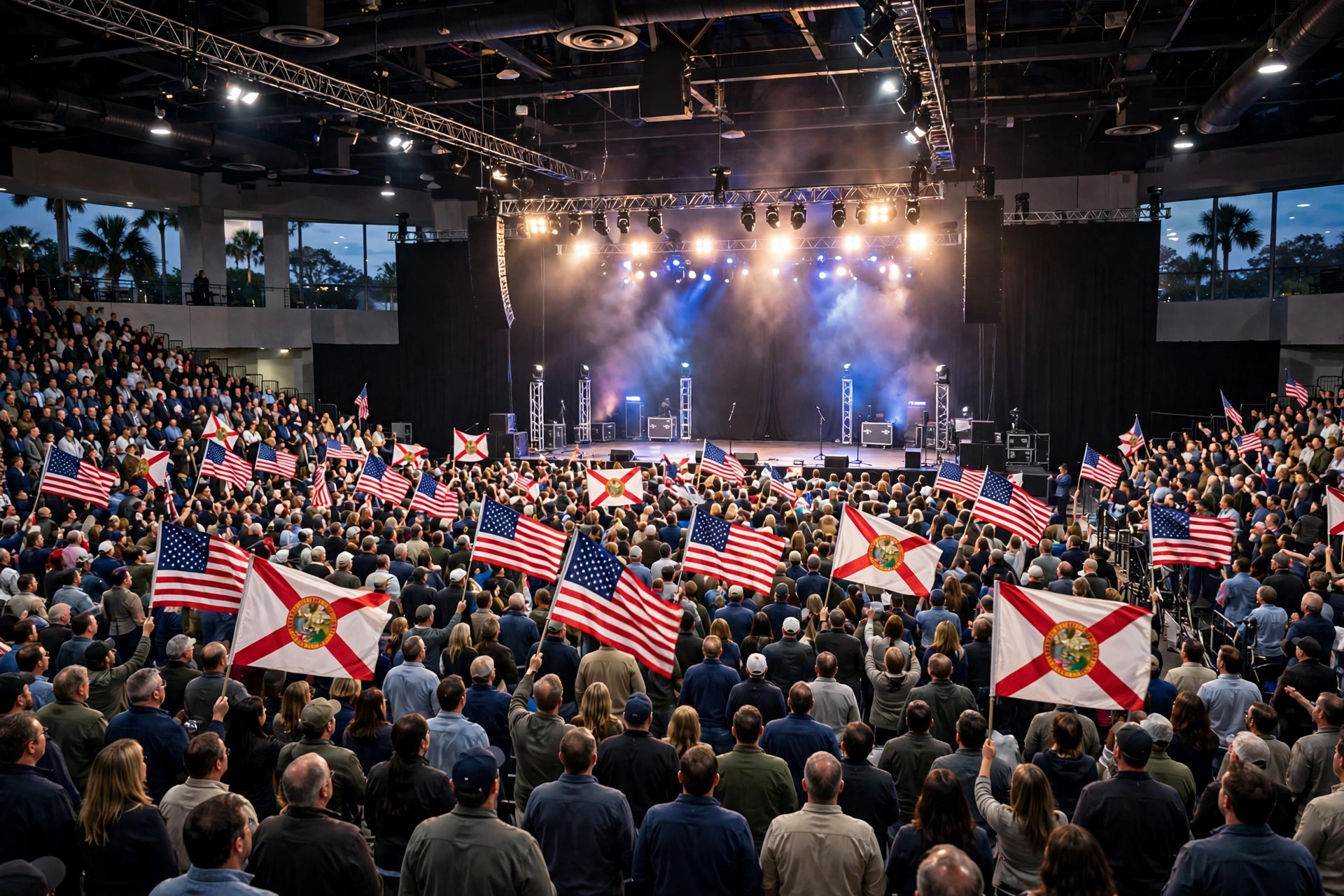
The Trump Florida rally in Fort Myers on Friday, 23 October 2026 marked the start of a final campaign push ahead of the midterm elections on 3 November 2026. Speaking at Florida Gulf Coast University's Alico Arena, former President Donald Trump addressed supporters for about one and a half hours, backing Republican candidates in Florida and framing the midterms as a decisive contest for the direction of the country. The rally combined local endorsements, national political messaging and campaign organisation, as Republican candidates seek to mobilise voters in the closing days before election day. With early voting under way in many states and election day less than two weeks away at the time of the rally, such events are designed to energise supporters, attract media attention and encourage turnout.
Trump Florida Rally: What Happened in Fort Myers
The Fort Myers rally took place at Alico Arena on the campus of Florida Gulf Coast University, a venue large enough to host a major campaign event and to bring together supporters from across southwest Florida. Trump spoke for approximately 1.5 hours, a length typical of his campaign rallies, which often mix prepared remarks with extended commentary on current events, opponents and policy themes. Rallies of this kind serve several purposes at once: they allow a candidate or campaign surrogate to deliver a message directly to supporters without media filtering, they generate clips and coverage for social media and news outlets, and they provide a visible demonstration of enthusiasm that campaigns hope will influence undecided voters and motivate volunteers.
Among the Florida candidates Trump backed was Byron Donalds, the Republican gubernatorial candidate, who faces Democrat David Jolly in the race for Florida governor. Polling cited from 270 To Win put Donalds at about 49.2 percent and Jolly at about 44.2 percent, a lead for Donalds but one that still leaves a meaningful share of voters undecided or supporting other options. Trump also backed Ashley Moody, the Republican Senate candidate, who faces Democrat Angie Nixon. Senate and gubernatorial races are among the highest-profile contests on the midterm ballot, because governors control state policy and administration while senators shape federal legislation and confirmations. Endorsements from a former president can help a candidate with fundraising, volunteer recruitment and base turnout, though they can also energise opponents, making the net effect difficult to predict from a single event.
Trump Florida Rally: RFK Jr and the Seafood Announcement
Robert F. Kennedy Jr joined Trump at the Fort Myers rally and announced a label for American-made seafood. The announcement, made on a campaign stage rather than through a formal policy briefing, illustrates how rallies are increasingly used to combine campaigning with policy messaging. A label for American-made seafood is presented by its supporters as a way to help consumers identify domestically produced products and to support American fishing and processing industries. Critics of such labelling schemes often ask about implementation details, costs and trade implications, though those details were not the focus of the rally announcement itself. For supporters in Florida, a state with a significant seafood and coastal economy, the announcement was intended to connect national politics to a local economic interest.
Trump also attacked Democratic Representative Ilhan Omar during the rally, including claims about her name. Those remarks are reported here as his claims, not as verified facts, and they should be read in that light. Campaign rallies often include sharp attacks on political opponents, and the accuracy of specific claims made on stage is frequently contested afterwards by fact-checkers, opponents and commentators. The neutral approach for readers is to distinguish between what was said at the rally and what has been independently verified, and to treat uncorroborated claims as part of campaign rhetoric unless supporting evidence is provided. That distinction matters in a heated campaign period, when rhetoric can move quickly across social media and when voters may encounter claims without context.
Why the Trump Florida Rally Matters for the Midterms
Midterm elections, held midway through a presidential term, determine control of Congress, state governments and many local offices, and they are often read as a referendum on the sitting administration. The 2026 midterms, with election day on 3 November 2026, will decide the balance of power in Washington and in state capitals, shaping legislation, budgets and policy for the following two years. Florida is a large and politically important state, with closely watched races that can influence national narratives about voter sentiment. A rally in Fort Myers therefore matters not only for Florida candidates, but for the broader Republican effort to mobilise voters in a state that has become central to national campaign strategy.
Florida's gubernatorial and Senate races also illustrate the interaction between state and national politics. A governor's race affects education, health care, housing, environmental policy and state administration, while a Senate race affects federal policy on the economy, judiciary, foreign policy and regulation. When a former president campaigns for both types of candidates at the same event, it signals that the party sees those races as linked parts of a single campaign effort. For voters, the practical consequence is that midterm ballots contain many offices at once, and decisions about a governor or senator can have effects that last well beyond a single news cycle. Related midterm coverage includes tariff decisions made days before the midterms and debate about a possible third term.
Trump Florida Rally: What Comes Next in Michigan
After Florida, Trump's campaign schedule continues in Michigan on Sunday, 25 October, where he is supporting Republican Senate nominee Mike Rogers. Rogers faces Democrat Abdul El-Sayed in a Senate contest that is part of the broader battle for control of the Senate. Michigan is a competitive state where presidential and Senate races have often been close, and where turnout in cities, suburbs and rural areas can each be decisive. Campaign events there are designed to reach voters who may not yet have decided, as well as to motivate supporters who have not yet voted.
The Michigan visit also coincides with campaign activity by former President Barack Obama, who campaigned with El-Sayed in Detroit on Saturday in support of early voting. The presence of two former presidents campaigning for opposing candidates in the same state on the same weekend underlines how competitive the Michigan Senate race is perceived to be, and how much national attention it is attracting. Early voting is a central feature of modern American elections: voters who cast ballots before election day reduce the pressure on election-day operations and allow campaigns to focus their final efforts on remaining voters. Both parties therefore invest heavily in early-vote mobilisation, and high-profile visits are a visible part of that effort.
Daytona Beach Rally and the Final Days Before 3 November
A further rally in Daytona Beach has been announced for Friday, 30 October, with doors listed at 3:30pm and speeches at 7pm according to a Republican Party site. At the time of reporting, the White House had not yet officially announced that event, so readers should treat the Daytona Beach details as announced by the party rather than as a confirmed White House schedule item. That distinction is worth noting because campaign events and official presidential travel are announced through different channels, and schedules can change. If the Daytona Beach rally proceeds as announced, it would place Trump back in Florida just days before election day, reinforcing the state's importance in the final campaign stretch.
The final days before 3 November will be dominated by turnout efforts: rallies, canvassing, phone and text outreach, and media appearances designed to reach voters who have not yet cast ballots. Polls in individual races will continue to be reported, but campaigns increasingly focus on their own turnout models rather than on public polls alone. For voters, the key practical information is when and where to vote, what identification or registration requirements apply in their state, and what offices and measures appear on their ballot. For observers, the midterms will be judged not only by which party wins which races, but by turnout levels, margins in competitive states, and the governing implications of the resulting balance of power.
Key Facts From the Fort Myers Rally
To summarise the verified core of this story: Trump held a rally in Fort Myers on Friday, 23 October 2026 at Florida Gulf Coast University's Alico Arena and spoke for about 1.5 hours. He backed gubernatorial candidate Byron Donalds, who faces David Jolly, with polling cited at about 49.2 percent versus 44.2 percent, and Senate candidate Ashley Moody, who faces Angie Nixon. Robert F. Kennedy Jr joined the event and announced a label for American-made seafood. Trump attacked Ilhan Omar over name claims, reported here as his claims. The next scheduled campaign stop is Michigan on Sunday, 25 October in support of Mike Rogers against Abdul El-Sayed, with Obama campaigning with El-Sayed in Detroit on Saturday for early voting. A Daytona Beach rally is announced for Friday, 30 October, with doors at 3:30pm and speeches at 7pm per a party site, but not yet officially announced by the White House. Election day for the midterms is 3 November 2026.
That summary keeps a clear line between reported facts, polling figures and campaign claims. Polling figures are snapshots with margins of error, not predictions, and they can move in the final days. Campaign claims made on stage are part of political rhetoric and should be checked against independent evidence before being treated as fact. Announcements on party websites may differ from official White House schedules. Keeping those distinctions visible helps readers follow a fast-moving campaign without mistaking enthusiasm, polling or rhetoric for the final result, which will only be known when votes are counted after 3 November.