
What happened in Highland Heights
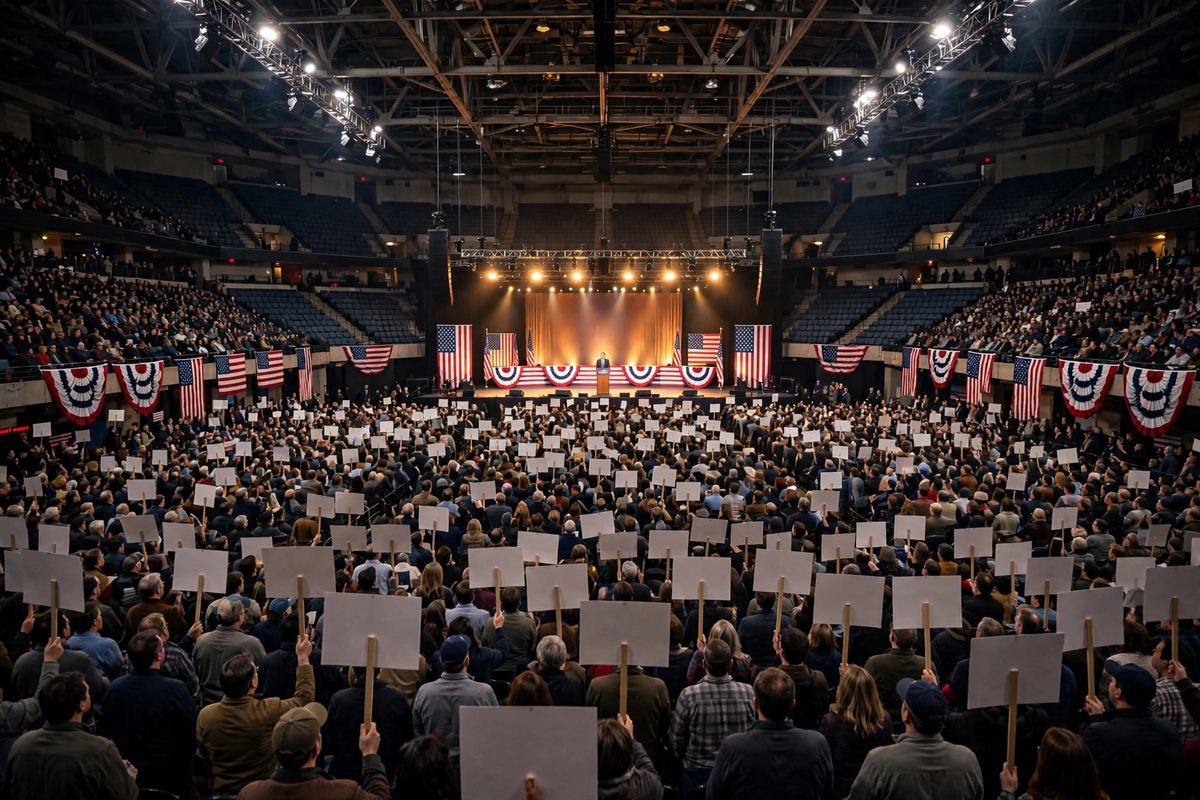
President Donald Trump held a midterm campaign rally on Saturday, 17 October 2026, at Truist Arena on the Northern Kentucky University campus in Highland Heights, Kentucky. The event was part of an accelerated schedule of rallies for Republican candidates in the weeks before the midterm elections on 3 November 2026. Trump took the stage in the early afternoon and spoke to a crowd of supporters, with Republican Senate candidate Andy Barr and Republican congressional candidate Ed Gallrein joining him on stage. The rally was Trump's second visit to the Cincinnati region in October, following an earlier rally in Vandalia, Ohio, on 3 October. Local police warned drivers to expect heavy traffic and road closures around the university between late morning and late afternoon, and organisers reported that the rally ended at about 3:50 p.m. Eastern Time.
The Kentucky stop mattered because several competitive races are on the ballot in the region. In Kentucky, voters will choose a successor to longtime Republican Senator Mitch McConnell, with Barr, the Republican nominee, facing Democrat Charles Booker. In Kentucky's 4th Congressional District, Gallrein, who won the Republican primary over incumbent Thomas Massie, faces Democrat Melissa Strange, Libertarian Jeremy Todd and an independent write-in candidate. Just across the state line in Ohio, Republican Senator John Husted faces Democrat Sherrod Brown, and the Ohio governor's race pits Trump-backed Republican Vivek Ramaswamy against Democrat Amy Acton. Trump's visit was designed to energise Republican voters in both states at once, since the Northern Kentucky media market reaches deep into south-western Ohio.
The $100 million Winchester pledge
The headline promise of the rally concerned a drug manufacturing facility in Winchester, Kentucky. Trump told the crowd: "If the Republicans win, the Department of War will be investing $100 million in the pharmaceutical company Antheia to revitalize a gigantic drug manufacturing facility in Winchester, Kentucky." He added that if Democrats win, "they wouldn't be able to do it, they wouldn't even know what you're talking about, they have no idea." Winchester sits in the congressional district Barr currently represents. Representatives for Barr and the Department of Defense did not immediately respond to requests for comment on the pledge, according to the reporting. As with any conditional campaign promise, the key details — the funding source, the timeline, and whether the investment would require congressional approval — were not spelled out at the rally, and voters will need to watch for follow-up announcements to judge whether the pledge becomes a concrete programme.
Trump also pointed to other investments he associated with Kentucky, including a $1 billion investment from GE Appliances and the IUE-CWA union that he said would make Louisville's Appliance Park the largest home appliance manufacturing site in the United States. Campaign rallies often blend confirmed corporate announcements with new promises, and the distinction matters: a company investment that is already under way is different from a government commitment that depends on an election outcome. Readers following this story should look for confirmation from GE Appliances, the union, Antheia and the Department of War about the status of each project.
The $5,000 dividend promise
Trump also repeated a promise to give all adult citizens a $5,000 dividend if voters elect a Republican Senate and House on 3 November. He had made the same pledge earlier at the Republican National Committee's midterm convention, saying the dividend was possible because of what he described as the "tremendous strength and success" of the American economy. He has not said how the dividend would be paid for or how much it would cost in total, according to the reporting. A payment to every adult citizen would be an enormous federal outlay, and any such proposal would need to pass Congress and be signed into law before any money could be sent. The promise has therefore become one of the most closely watched — and most questioned — claims of the midterm campaign, with supporters presenting it as a share of economic success and critics asking where the funding would come from.
Why Trump is campaigning in states he won comfortably
One of the notable features of this year's midterm campaign is that Trump has been spending time in states and districts where Republicans would normally feel safe. Kentucky is a heavily Republican state, and the New York Post noted that Andy Beshear, a potential 2028 presidential candidate, said Trump's decision to campaign in a state he won handily was a troubling sign for Republicans. Beshear said he did not take any vote for granted, but argued that a president visiting a state he won by a large margin suggested Republicans were worried about turnout. Political analysts have offered a more tactical reading: the Highland Heights rally also reached Ohio television markets, where several competitive races are on the ballot, and it gave Trump a chance to demonstrate loyalty to candidates he backed in primaries.
The Cook Political Report moved Kentucky's 4th District from "safe Republican" to the more competitive "leans Republican" category on 9 October, a reminder that even seats in friendly territory can tighten when voters are dissatisfied. Reports have also noted that Trump's approval rating has fallen to record lows, which is one reason the president has been barnstorming the country holding rallies for fellow Republicans. Midterms are often difficult for the party holding the White House, because voters who are unhappy with the direction of the country tend to turn out to register a protest, while the president's own supporters can be harder to mobilise without his name on the ballot. Rallies are one of the tools campaigns use to close that enthusiasm gap.
Moments from the rally
As Trump began speaking, a protester was removed from the arena. Trump told the crowd to take the protester "back home to mom" as the crowd booed, and said, without evidence, that protesters were paid $250. Claims of paid protesters are common at campaign events from politicians of both parties, and in this case no evidence was offered to support the figure. The episode was a small moment in a long rally, but it illustrated the confrontational style that has defined Trump's campaign events: supporters cheer the put-downs, opponents see them as distractions from policy, and the exchanges tend to dominate social media clips from the event more than the policy promises do.
Why it matters
The Kentucky rally matters for three reasons. First, it shows how the midterm campaign is being fought: not only on national issues, but through localised promises — a factory here, a dividend there — designed to give voters in specific places a concrete reason to turn out. Second, it shows the stakes Republicans themselves are setting: by tying a $100 million investment and a $5,000 dividend to a Republican victory, Trump has given voters a testable claim. If Republicans win, supporters will expect follow-through; if they lose, Democrats will say the promises were never real. Third, it shows the geography of the 2026 midterms. The battle is being fought in places like Northern Kentucky, where a rally in one state is really aimed at two, and where a congressional seat that once looked safe is now rated merely "leans Republican."
For voters, the practical lesson is to separate the rally from the record. Campaign promises are statements of intent, not actions. The Winchester investment will be real when a contract, a budget line or a company announcement confirms it. The dividend will be real when legislation exists. Until then, the rally is best understood as what it was: a high-energy attempt to turn a friendly crowd into votes in a midterm election that both parties say will shape the rest of Trump's term.
What happens next
The midterm elections take place on 3 November 2026. In the remaining weeks, expect more rallies in battleground states, more localised promises, and more polling that will shape how both parties allocate their time and money. In Kentucky, watch for Barr and Booker to debate the economy, health care and the drug-plant pledge, and for Gallrein and Strange to make their case in the 4th District. Nationally, watch whether the dividend promise appears in formal campaign materials or remains a rally-only line, and whether any federal agency confirms the Winchester investment. As with earlier stops on Trump's midterm tour — including the sprint through Arizona and Montana covered in our earlier reporting — the pattern is clear: the president is campaigning as if every seat matters, because in a midterm, every seat does. Readers can follow our earlier coverage of the Trump midterm rally sprint and the warnings about AI election scams ahead of the midterms for more context on the campaign season.