
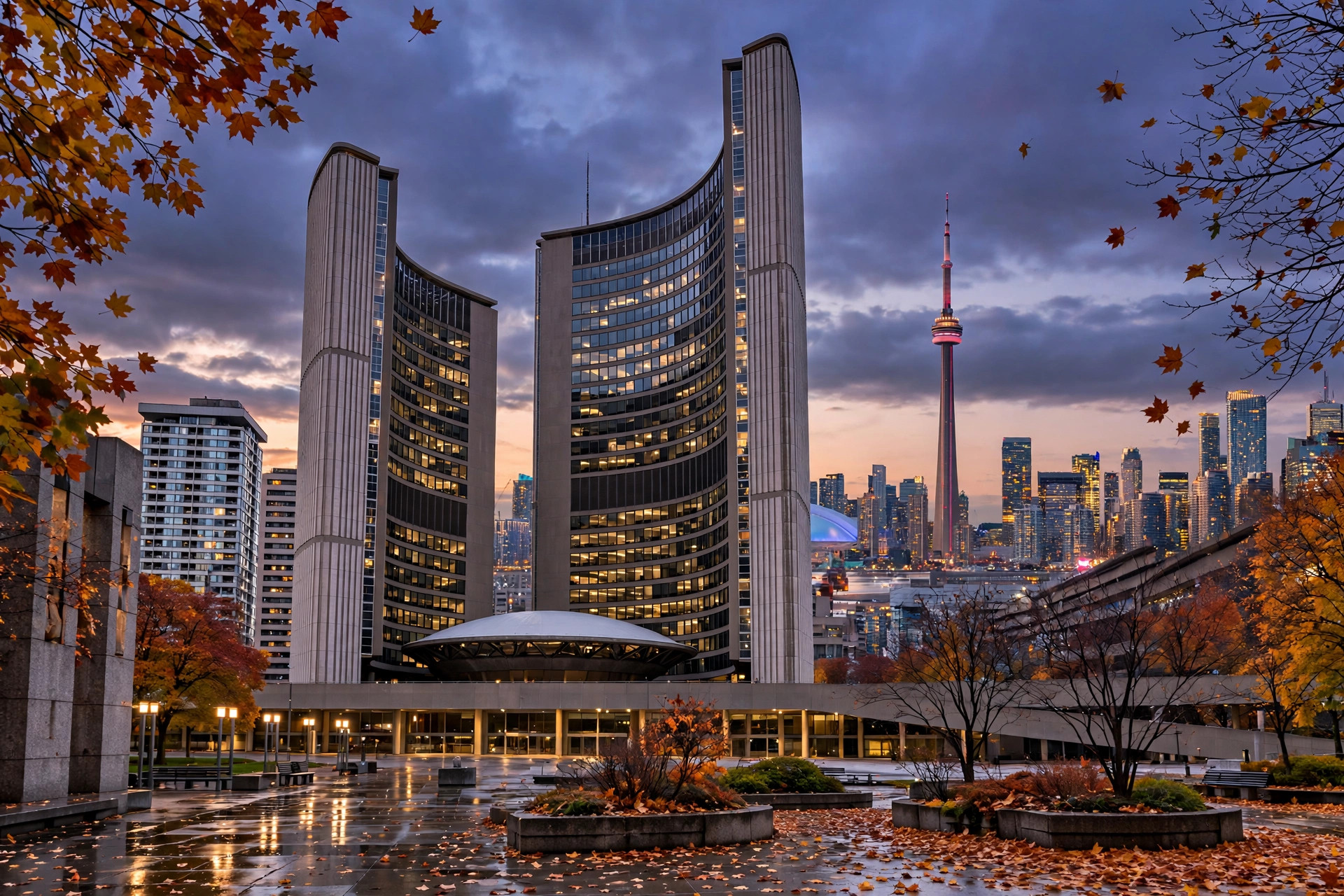
The Toronto mayoral race 2026 reaches its decisive day on Monday, 26 October 2026, when voters in Canada's largest city choose a mayor, 25 city councillors and school trustees for four-year terms. Incumbent mayor Olivia Chow, who first won the mayor's office in a byelection in 2023, is seeking re-election against city councillor Brad Bradford, who represents Ward 19 Beaches-East York. What began as a contest in which Chow held a substantial lead has tightened considerably in the final weeks, according to late polling, turning the closing days into a genuinely competitive race. With advance voting already showing much higher participation than in 2022, the result may depend as much on who turns out on election day as on the final movement in the polls.
Toronto Mayoral Race 2026: Background and How Toronto Votes
Toronto's municipal elections use a first-past-the-post system, meaning the candidate with the most votes wins, even without an overall majority. That system rewards candidates who can build a broad coalition across the city's diverse neighbourhoods, from the downtown core to suburban communities in the east, west and north. The mayor leads city council and plays a central role in setting the city's direction on housing, transit, public services and the budget, working with 25 councillors who represent individual wards. School trustees, also elected on the same day, oversee public education governance, making municipal election day a single ballot with consequences for several layers of local public life.
Olivia Chow came to the mayor's office through a byelection in 2023, after the previous mayor left office mid-term. Seeking re-election in a regular municipal election is a different test from winning a byelection, because voters are judging a record in office over a full period rather than choosing a successor in an abbreviated contest. Chow's campaign has asked voters to renew that mandate, arguing that her administration's work on housing, transit and public services deserves continuation. Brad Bradford, as a sitting councillor, has campaigned as an alternative, arguing that the city needs new leadership on affordability and services. For voters, the choice is therefore framed as continuity versus change, a familiar dynamic in municipal politics where the mayor's record is visible in everyday services such as roads, transit, libraries and community facilities.
Toronto Mayoral Race 2026: The Issues Voters Care About
Housing, transit, affordability and public services have dominated discussion in this campaign, according to the issues highlighted throughout the race. Housing affordability remains a defining challenge in Toronto, where the cost of renting or buying a home affects young families, newcomers and long-time residents alike. Transit is equally central, because millions of trips each day depend on buses, streetcars and subways, and because transit expansion shapes where housing can be built and how easily people can reach jobs. Affordability extends beyond housing to the broader cost of living, including fees, taxes and the price of everyday services, while public services cover the libraries, parks, recreation programs and emergency services that residents encounter directly.
Municipal elections often turn on competence and delivery rather than on national party politics, because city governments do not control income taxes or major social programs in the same way as provincial or federal governments. Voters tend to judge mayors on whether streets are maintained, transit is reliable, housing gets built and the city feels safe and livable. That practical focus means that debates about budgets, service levels and project timelines can matter as much as broader visions for the city. In a large and diverse city, different neighbourhoods may also prioritise different issues: downtown residents may focus on transit and public space, suburban residents on roads and local services, and growing communities on new schools, parks and infrastructure to match population growth.
What the Late Polls Show in the Toronto Mayoral Race 2026
The most striking feature of the closing weeks has been how much the race tightened. In September, Chow led by 17 points, a margin that suggested a comfortable re-election. By late October, several polls showed a much closer contest, though they did not all agree on who was ahead. Canada Pulse Insights polling for CityNews, conducted with 737 adults from 16 to 21 October with a margin of error of plus or minus 3.6 percentage points, put Chow at 51 percent and Bradford at 46 percent. That result still gave Chow a lead, but a much smaller one than in September, and within a range where further movement or turnout differences could matter.
Other late polls told a slightly different story. Liaison polling on 21 October put Bradford at 49 percent and Chow at 47 percent, with a margin of error of plus or minus 3.1 percentage points, based on 1,000 residents surveyed on 18 and 19 October. Mainstreet polling put Bradford at 48.9 percent and Chow at 47.5 percent, also with a margin of error of plus or minus 3.1 percentage points, based on polling from 16 to 18 October. Pollara, by contrast, put Chow at 55 percent and Bradford at 44 percent among decided voters, based on 1,094 residents surveyed from 13 to 19 October. Taken together, these polls do not point to a single clear winner. They point to a close race in which different pollsters, using different methods, samples and field dates, produced different leaders, and where the margins of error overlap. That is the textbook definition of a contest too close to call from polling alone.
Polls also differ in how they treat undecided voters and in how they model likely turnout, which can explain part of the variation. A poll that reports decided voters only will look different from one that includes undecided respondents. A poll conducted earlier in the week may miss late movement that a later poll captures. Sample size matters too: larger samples generally have smaller margins of error, but no poll can perfectly predict who will actually vote. For that reason, the responsible reading of the late Toronto polls is not that one candidate has won, but that a race once seen as comfortable has become competitive, and that election day turnout could be decisive.
Advance Voting Surge Before the Toronto Mayoral Race 2026 Vote
One of the clearest signals before election day came from advance voting. A total of 222,550 ballots were cast during six days of advance voting, nearly double the 115,911 advance ballots cast in 2022. On the final advance voting day alone, 53,363 ballots were cast. That surge suggests heightened interest in this election, whether driven by the competitiveness of the mayoral race, by greater awareness of advance voting options, or by a combination of both. High advance turnout does not by itself predict a winner, because advance voters may not mirror election-day voters, but it does indicate that a large number of Torontonians had already made up their minds before the final weekend.
Higher participation is generally seen as a healthy sign for local democracy, because municipal elections often suffer from lower turnout than provincial or federal elections. When more residents vote, the winning candidate can claim a broader mandate, and council decisions may better reflect the city's population. Election officials and campaigns alike watch advance numbers closely, not only for the total but for patterns across wards, which can hint at where engagement is strongest. For readers planning for winter conditions around election season, practical local guidance such as Canadian winter weather information can be useful, while the wider trade context is covered in recent tariff coverage affecting Canada.
Why the Toronto Mayoral Race 2026 Matters
Toronto is Canada's largest city and one of North America's major urban centres, so its mayoral choice has significance beyond city hall. Decisions made by Toronto council affect housing supply, transit investment, climate policy, public health services and economic development in a region that is home to millions of people and to a large share of Canada's economy. A mayor who can work effectively with council, with the provincial and federal governments, and with community organisations can shape how quickly housing is built, how transit expands and how services respond to population growth. A mayor who struggles to build those relationships may find even popular proposals difficult to deliver.
The result also matters as a test of incumbent performance in a major city at a time when affordability pressures are felt across Canada. If Chow wins re-election, it will be read as an endorsement of her record and direction. If Bradford wins, it will be read as a desire for change and a new approach to the same challenges. Either outcome will be studied by other municipal leaders and by provincial and federal politicians who watch Toronto as a bellwether for urban voter sentiment. The closeness of the late polls makes the result particularly interesting, because a narrow win for either candidate would still leave the winner needing to govern a divided city and to build consensus on council.
What Happens Next After 26 October
On Monday, 26 October 2026, polls will be open for election-day voting, and results will be reported as ballots are counted. Because the race is close, and because different polls disagree on the leader, it would be unwise to declare a winner before votes are counted. In first-past-the-post elections, the candidate with the most votes wins the mayor's office, and councillors are elected ward by ward under the same rule. School trustees are also elected, completing the municipal ballot. Once results are confirmed, the new council will be sworn in for four-year terms, and the mayor will begin forming an administration, appointing committee chairs and setting the agenda for the first council meetings.
The first months after the election will reveal the new council's priorities through its budget process and its decisions on housing, transit and services. Campaign promises will be tested against fiscal realities and council arithmetic, since the mayor must win support from a majority of councillors for major measures. Voters who participated in advance voting or on election day will be watching whether the issues that motivated them — housing, transit, affordability and services — translate into concrete action. Whatever the result, the surge in advance voting suggests that Torontonians engaged with this election in larger numbers than in 2022, a development that itself says something about the importance residents attach to who leads their city.