
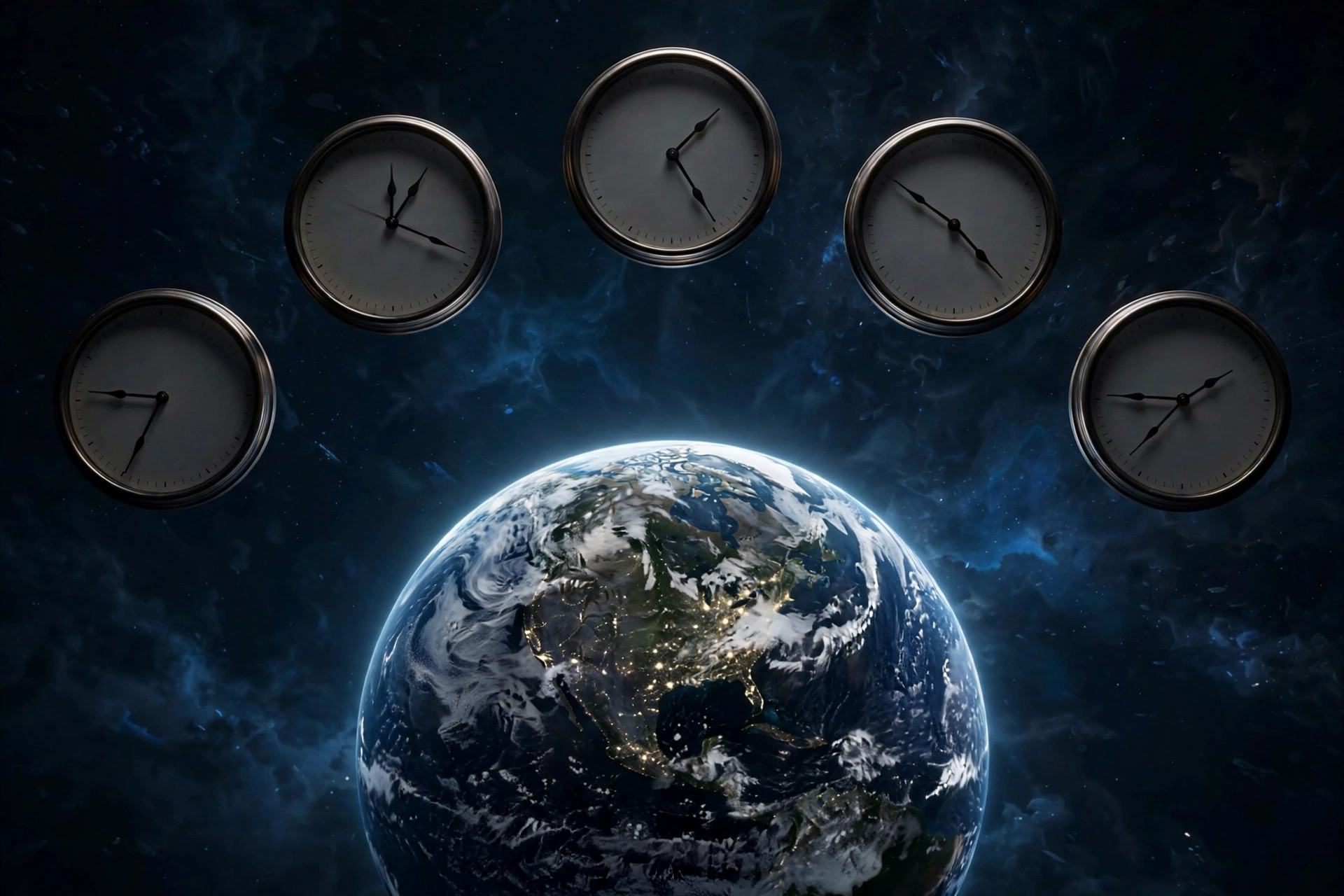
When it is noon in New York, it is 5 p.m. in London, midnight in Sydney, and already tomorrow in Tokyo. This everyday puzzle — why the world cannot agree on what time it is — is the result of one of the most practical inventions in modern history: the time zone. Before time zones existed, every town kept its own local solar time, and the difference between neighboring cities could be a matter of minutes. This guide to the geography of time explains what time zones are, how Coordinated Universal Time (UTC) and Greenwich Mean Time (GMT) work, how railways and an 1884 conference in Washington created the system we use today, and why oddities like Nepal's 45-minute offset and the International Date Line still exist.
What Is a Time Zone?
A time zone is a region of the Earth that observes a uniform standard time, usually expressed as an offset from Coordinated Universal Time — for example, UTC+5:30 for India or UTC−5 for New York in winter. Because the Earth rotates 360 degrees in about 24 hours, each hour of time difference corresponds to roughly 15 degrees of longitude. In a perfectly tidy world, the planet would be sliced into 24 neat zones, each one hour apart.
The real world is messier. Time zone boundaries zigzag around national borders, states, and even individual towns, because governments — not geometry — decide what time it is. China, which geographically spans five time zones, uses a single national time (UTC+8) from Beijing to its western deserts. Meanwhile, the United States stretches across six. Political and economic convenience, not longitude alone, draws the lines on the time zone map.
UTC and GMT: The World's Reference Clocks
Every time zone on Earth is defined relative to Coordinated Universal Time (UTC), the primary time standard by which the world regulates clocks. UTC is kept by a global network of more than 400 atomic clocks in laboratories around the world, averaged together by the Bureau International des Poids et Mesures in France. It does not observe daylight saving and never changes with the seasons.
Greenwich Mean Time (GMT) is the older term, based on the mean solar time at the Royal Observatory in Greenwich, London — the site of the Prime Meridian at 0° longitude. In everyday language, GMT and UTC are often used interchangeably, and for most practical purposes (scheduling a call, booking a flight) they give the same time. Technically, UTC is the precise atomic standard while GMT is an astronomical one, but the difference is a fraction of a second. When you see a time zone written as "UTC+5:30" or "GMT+5:30," both notations point to the same moment.
How Time Zones Were Created
For most of human history, time was local. When the sun was directly overhead, it was noon — in your town, and at a slightly different moment in every town east or west of you. Bristol was about 10 minutes behind London; there were once more than 300 recognized local times in the United States alone. This worked fine when travel was slow, but it became chaos with the arrival of the railway.
The Railway Problem
In the 19th century, trains began crossing hundreds of miles in a day, and railway timetables had to reconcile dozens of conflicting local times along a single route. Missed connections and even collisions were blamed on the confusion. The breakthrough came from Sir Sandford Fleming, a Scottish-Canadian engineer, who proposed a worldwide system of standard time in the late 1870s after missing a train in Ireland because of a timetable mix-up.
The 1884 Meridian Conference
Fleming's idea led to the International Meridian Conference, held in Washington, D.C., in October 1884. Delegates from 25 nations agreed on two foundational decisions: the meridian passing through Greenwich, England, would be the Prime Meridian (0° longitude), the universal reference point for measuring east and west; and the world would be divided into 24 time zones, each spanning 15 degrees of longitude, with the universal day beginning at midnight in Greenwich.
Adoption was gradual — it took decades for most countries to implement standard time, and some, like parts of Alaska and remote islands, took even longer. But the 1884 framework is the direct ancestor of the system your phone uses today.
Daylight Saving Time
Daylight Saving Time (DST) is the practice of moving clocks forward by one hour in spring ("spring forward") and back in autumn ("fall back") to extend evening daylight during the longer days of summer. The idea is usually credited to Benjamin Franklin, who jokingly suggested Parisians could save candles by waking earlier, and was seriously proposed by British builder William Willett in 1907. It was first implemented nationally by Germany and Austria-Hungary in 1916, during World War I, as a way to conserve coal.
Today, roughly 70 countries observe some form of daylight saving, including most of the United States, Canada, the United Kingdom, and the European Union. But the practice is controversial and declining: the EU has debated abolishing it for years, several US states have pushed for permanent standard or daylight time, and studies of its actual energy savings show mixed results. Countries near the Equator, where day length barely changes through the year — including India, Japan, and most of Africa — have never seen the point and do not observe it.
The International Date Line
The International Date Line is the imaginary line roughly following the 180° meridian in the Pacific Ocean, where the calendar day changes. Cross it westbound and you skip forward a day; cross it eastbound and you repeat a day. It is the reason you can leave Tokyo on Monday evening and arrive in Los Angeles on Monday morning — you gain back the hours by crossing the line.
Like time zone boundaries, the Date Line is not perfectly straight: it zigzags to keep island nations on a single calendar day. In 2011, Samoa skipped Friday, December 30 entirely, jumping from Thursday straight to Saturday, to move to the western side of the line and align its business week with Australia and New Zealand. The line has no legal international authority — it is a convention that countries voluntarily respect — but global travel and trade would be unworkable without it.
The World's Weirdest Time Zones
Most time zones sit neatly on the hour, but several countries and territories chose offsets that break the pattern:
- Nepal (UTC+5:45): The last country on a 45-minute offset, chosen to set Kathmandu's time apart from India's UTC+5:30 and to align with a local meridian.
- India and Sri Lanka (UTC+5:30): The half-hour offset dates to colonial-era standard time based on the 82.5°E meridian passing near Allahabad (Prayagraj).
- Newfoundland, Canada (UTC−3:30): The only place in the Americas on a half-hour offset — a point of pride for Newfoundlanders, who even have their own time zone name.
- Chatham Islands, New Zealand (UTC+12:45): Forty-five minutes ahead of mainland New Zealand, one of the first inhabited places on Earth to see each new day.
- Eucla, Australia (UTC+8:45): An unofficial time zone used by a handful of roadhouses along the Nullarbor Plain, sitting between Western and Central Australian time.
- Venezuela: Moved its clocks back by 30 minutes to UTC−4:30 in 2007, then returned to UTC−4 in 2016 — a reminder that time zones can be political decisions, changed overnight.
These quirks exist for the same reason the whole system does: time zones serve people, not geometry. A government may pick an unusual offset for national identity, trade alignment, or simply because a meridian runs through its capital.
Living on a 24-Hour Planet
Time zones are one of humanity's most successful pieces of invisible infrastructure. They let airlines publish timetables, broadcasters schedule global events, and friends on opposite sides of the planet find a mutual hour to talk. The system is imperfect — stitched together by 19th-century railways, tweaked by politics, and punctuated by half-hour oddities — but it works. And it all traces back to a simple fact of geography: the Earth spins, the sun rises in the east, and no two places can share the same noon.
Want to see the planet's biggest divisions rather than its smallest hours? Read our companion guide, The 7 Continents of the World: Size, Population, and Key Facts.