
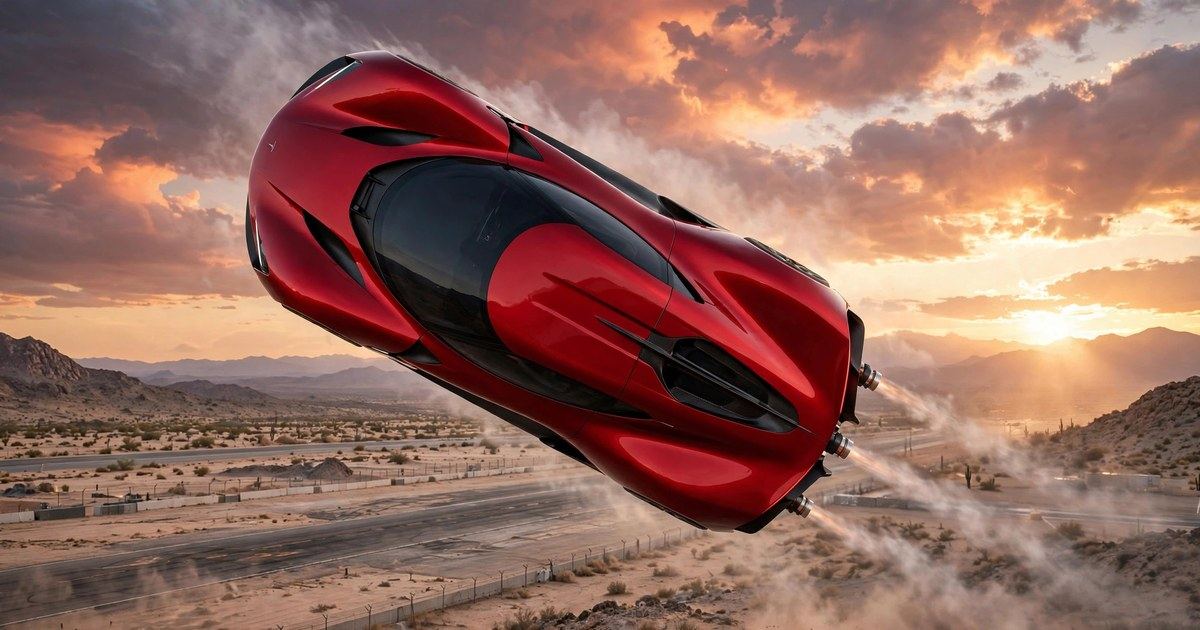
For years, the flying car has been a punchline — the future that never arrives. On Thursday evening, October 15, Tesla chief executive Elon Musk tried to change that, unveiling a new Roadster at a SpaceX test facility in McGregor, Texas, that he said could fly. In front of a crowd of enthusiasts, the car drove up a curved ramp until it was upside down, flipped off the ramp, spun in the air and landed using air jets. Later, it leapt over a line of parked Teslas while twisting in mid-air.
“Well, it worked,” Musk told the crowd. “Flying cars are real.” The demonstration, livestreamed and clipped across social media within minutes, quickly became one of the most talked-about technology moments of the week, trending per news coverage across major outlets including CNN, USA Today, The Wall Street Journal, Barron’s and The Times. But as with many Tesla reveals, the spectacle raised as many questions as it answered: what exactly did the car do, how does it work, is it legal, and when — if ever — could anyone actually buy one?
What the demonstration actually showed
The event was staged at a SpaceX rocket test site, an appropriate venue given the technology on display. The Roadster shown was a two-seater, developed in collaboration between Tesla and SpaceX engineers. It had no driver on board during the demonstration — a deliberate choice, Musk said, “to make sure we don’t kill anyone.”
The showpiece sequence had three parts. First, the car used a suction system underneath to climb a steep curved ramp, driving up the wall until it was hanging upside down. Then it launched off the ramp, flipped in the air and used air jets to land. In a second sequence, the car used the same jets to leap over a row of Tesla’s existing models parked side by side, and then used jets at the rear to accelerate from 0 to 60 mph in what Tesla said was a record time of under one second.
Before the demonstration began, Musk warned the crowd that the outcome was uncertain. “Success is not guaranteed,” he said. “I mean that. It’ll probably work, but if it doesn’t work, we’re at a safe distance.” It worked — at least on the night, in a controlled environment, with no driver inside.
How the thruster system works
The Roadster’s headline trick comes from ten nozzles fed by what Musk described as ultra-high-pressure air tanks — essentially cold-gas thrusters adapted from rocket technology. According to reports of the event, the system carries around 250 kilograms of air in special tanks that can recharge themselves, with no special refuelling equipment needed.
The thrusters do two jobs. In the air, they control the car’s attitude — the flip and the landing. On the ground, a vacuum system sucks the car toward the road surface, dramatically increasing grip. Tesla said the suction lets the car corner while pulling two Gs, twice the normal force of gravity. The same jets at the rear help the car accelerate: Tesla vehicle engineering chief Lars Moravy said the Roadster can go from 0 to 60 mph in 0.8 seconds and reach a top speed of more than 230 mph.
Musk framed the technology as “the results of what happens when you have a collaboration with the world’s best car company and the world’s best rocket company.” The crossover is real — SpaceX has long used cold-gas thrusters to steer its rockets — but adapting them to a road car is a different engineering problem, and one that regulators have never had to certify before.
Three versions, and only one is “road ready”
Tesla’s updated website lists the Roadster in three configurations, described as “Augments.” The base Performance version includes the suction system and active aerodynamics, seats two, and is described as “road ready.” The Thrust augment, a limited release, adds acceleration thrusters and is described as “race ready” — suggesting it may not be usable on public roads. The Rocket augment is invitation-only, seats one, promises “actual flight,” and carries the disclaimer: “Not approved for road use.”
That tiering matters, because it clarifies what Thursday’s show actually was. The car that flew was not the road car. The flying version appears to be a separate, track-only machine. When an audience member asked whether the car was street legal, Musk’s answer was telling: “Yeah, depends on your street, but it’ll be a viable car.” He later conceded the prototype is “not necessarily a safety-optimized car.”
Nine years of waiting
The Roadster is one of Tesla’s longest-delayed products. The company first showed the second-generation Roadster in November 2017, promising a 1.9-second sprint to 60 mph, a 620-mile range, a $200,000 base price and deliveries in 2020. None of that happened on schedule. Musk later set an April 2026 demo date, then moved it, before the event finally took place in mid-October.
Many customers have waited the entire time. Tesla collected $50,000 deposits for the standard version and $250,000 for a limited Founders Series of 1,000 cars — roughly $250 million in Founders deposits alone. At the event, Musk said production would begin in 2028. “Actually, for real,” he added. Given Tesla’s history of missed timelines, 2028 is best treated as a target rather than a promise.
Notably, Tesla announced no new price at the event, and gave no details on battery capacity, range or charging. The original $200,000 base price from 2017 was quoted in coverage, but with inflation, delays and the thruster hardware, the eventual price could be substantially higher. Some onlookers shouted for a price tag during the event; their questions went unanswered.
Wall Street’s reaction: an “engineering flex”
Markets greeted the reveal warmly, if cautiously. Tesla shares rose about 4–5% in premarket trading on Friday, briefly adding roughly $80 billion in market value — more than the entire market capitalisation of Ferrari — before settling back to a gain of around 1.3% shortly after the open.
Analysts were more measured than the stock move. HSBC’s senior global autos analyst Michael Tyndall called the reveal “an engineering flex rather than a demonstration of earnings power,” noting there were no details on units, pricing or financial impact. Gene Munster of Deepwater Asset Management called it an “engineering flex” with little commercial value beyond showing up traditional carmakers, while reading the event as a sign that Musk wants to bring Tesla and SpaceX closer together. JPMorgan analyst Rajat Gupta said the “rocket upgrade” showcases deep collaboration with SpaceX, though production remains years behind the original schedule. Musk himself has said the Roadster will not “move the needle massively from a revenue standpoint.”
The event also fuelled speculation about a Tesla–SpaceX merger. Barclays senior autos analyst Dan Levy wrote that a combination has “increasingly become the consensus expectation,” and Musk has publicly pointed to “more and more overlap” between the two companies. The Roadster, built by their engineers together, is the most visible product of that overlap yet.
The reality check: legality, safety and real flight
The biggest questions are regulatory. In the United States, the Federal Aviation Administration generally treats airborne vehicles as aircraft, and specialised approvals would be required for anything operating above ground level. Certified electric air-taxi companies such as Joby and Archer have spent years and large sums working through certification — a process Tesla has not started for the Roadster. Aviation experts have also stressed that what the Roadster demonstrated was short-range “hopping,” not sustained flight. Roger Conner, a vertical flight curator at the Smithsonian’s National Air and Space Museum, told CNN that hybrid designs tend to be compromised on both sides: “Inevitably, something that is a hybrid between the two is going to be a poor performing aircraft and a poor performing vehicle.”
Safety is the other open question. A car that can launch itself into the air, with thrusters and high-pressure tanks on board, would face crash-testing and type-approval regimes that were never designed for flying vehicles. Tesla has not said how much of the demonstration hardware will survive into a production car, or how it would pass the safety standards that apply to road vehicles. The “not necessarily safety-optimized” remark was honest — but it also underlines how far the Roadster is from being a product anyone can drive home.
Context matters too. Tesla is simultaneously pivoting toward autonomous driving and robotics, and Musk said the Roadster would eventually be the “only manually driven car that Tesla makes.” The company’s broader technology ambitions — including its work with SpaceX, which has drawn scrutiny in other arenas, as seen in the recent Starlink outage probe — mean the Roadster sits inside a much larger story about how far one entrepreneur’s companies can push into new domains.
What happens next
Three things will determine whether the flying Roadster becomes more than a viral moment. First, Tesla will need to publish real specifications — price, range, battery, and which thruster features actually ship. Second, regulators will need to say what, if anything, can legally be used on public roads or in public airspace; expect aviation and automotive authorities to weigh in on any marketing language that implies the production car can fly. Third, Tesla must hit its 2028 production target — something it has failed to do for this car for nine years.
For now, the fair summary is this: Tesla demonstrated a genuinely impressive piece of engineering theatre, built on real SpaceX hardware, in front of a live audience. It did not demonstrate a flying car that anyone can buy, drive and fly. The distinction matters — and it is the gap between Thursday’s applause and a product on the road. As the technology world watches, with Apple crossing $5 trillion in the same week, the Roadster’s real test will not be a flip over a ramp. It will be whether Tesla can turn a stunt into a certified, priced, deliverable car.
Musk's ambitions are reaching into family finance as well, with his pledge of a SpaceX share for every American child through the Trump Accounts plan.
Sources: CNN; USA Today; The Wall Street Journal; Barron’s; The Times; Reuters. This article is based on news coverage of the October 15, 2026 reveal event.