
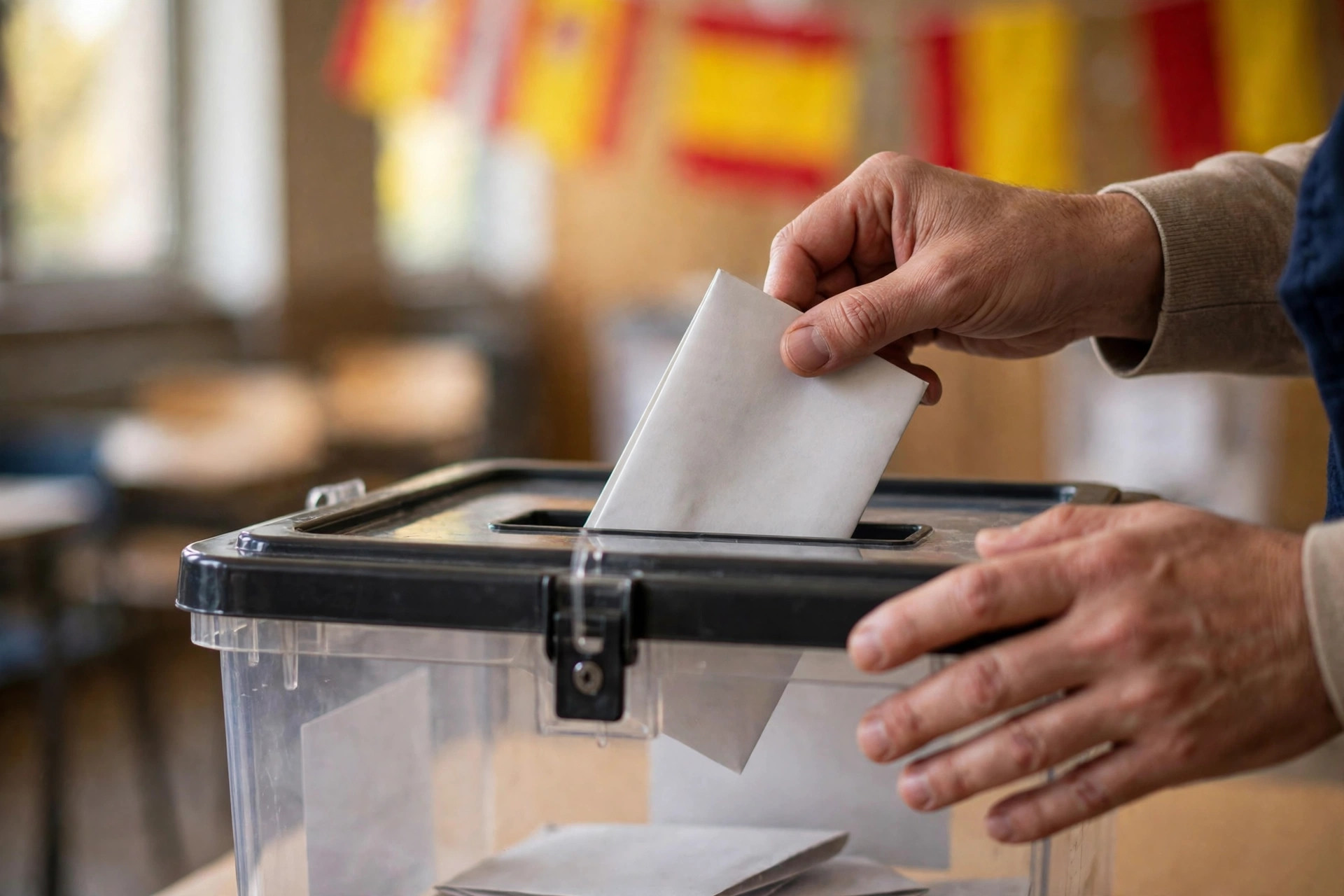
Spain election polls disagree with each other by more than they ever have. The state-run Centro de Investigaciones Sociológicas (CIS) published its pre-electoral macro-survey on 12 November 2026, putting Pedro Sánchez's PSOE on 33.3 percent of the vote and 134 to 143 seats, with the conservative PP on 25.5 percent and Vox on 18.4 percent, and the PP and Vox combined short of the 176 seats needed for an absolute majority. Private pollsters say the opposite: their median puts the PP first on about 31 percent against about 26 to 27 percent for the PSOE, with the PP and Vox together holding close to 190 to 199 seats. Both sets of numbers cannot be right, and with the campaign now open and the vote on 29 November, the split itself has become the story of the election.
The disagreement is not a rounding error. It is a gap of roughly eight points on the PP's vote share and roughly seven on the PSOE's, with opposite winners, opposite majorities and opposite routes to government. Voters, parties and markets are being asked to choose between two different Spains, and the only way to resolve it is the election itself. What follows is what each side actually says, why they differ, and what the seat arithmetic means for who governs after 29 November.
Spain Election Polls: What the CIS Found
The CIS published its pre-electoral study on Thursday 12 November, just before the official start of the campaign. Based on 45,074 interviews in 4,190 municipalities, with fieldwork running from 7 to 30 October and a reported margin of error of plus or minus 0.5 percent, it estimates the PSOE at 33.3 percent of the vote and between 134 and 143 seats in the 350-seat Congress of Deputies. The PP is estimated at 25.5 percent and 98 to 106 seats, eight points less than the party won in 2023, while Vox would rise to 18.4 percent and 57 to 65 seats. The new left-wing alliance Frente Amplio is put at 4.7 percent and 7 to 11 seats.
Under the CIS projection, the PP and Vox together would total 155 to 171 seats, and would fall short of the 176 needed for an absolute majority even in their most optimistic projection. The PSOE plus Frente Amplio would reach 141 to 154 seats, and could pass 176 only with extra partners from the investiture bloc that backed Sánchez in 2023. The survey also projects an unusually high turnout of about 83 percent, puts the PSOE first in most autonomous communities except the Basque Country, and notes that its fieldwork closed two days after the Urda train crash on 28 October, an event the CIS itself says may have affected responses. The CIS presents wide provincial seat ranges, and warns that they are not strictly summable, because Spain's district-level proportional rules make the translation from votes to seats uncertain.
Spain Election Polls: What the Private Polls Say Instead
Every private poll published up to 12 November tells a different story. All 15 private polls gave the PP and Vox a combined absolute majority, averaging 50.6 percent of the vote between them, according to Brussels Signal's account of the campaign opening. A Sigma Dos survey for El Mundo on 9 November put the PP on 131 seats, the PSOE on 105 and Vox on 68, giving the two right-wing parties 199 seats, well above the 176 needed. The polling aggregator Polling Forecast put the PP on 31.0 percent and the PSOE on 27.1 percent on average, with the PP winning 132 seats, the PSOE 112 and Vox 67, and the PP and Vox together on 199 seats, reaching a majority in 99 percent of its 5,000 simulations.
The pattern holds across the individual institutes. NC Report, published on 9 November, put the PP on 32.6 percent and the PSOE on 25.6 percent. GAD3 for ABC put the PP on 31.9 percent and the PSOE on 25.9 percent, and gave the PP and Vox 199 seats. EM-Analytics put the PP on 31.1 percent against 25.3 percent for the PSOE. 40dB, for El País and SER, put both parties closer together, the PP on 31.9 percent and the PSOE on 29.9 percent, but its seat model still puts the combined PP-Vox bloc at around 190 seats. PolitPro's weighted election trend, which aggregates all the institutes, had the PP on 29.9 percent, the PSOE on 26.7 percent and Vox on 18.4 percent as of 13 November, projecting 129 seats for the PP, 115 for the PSOE and 79 for Vox. Only one private tracker, SW Demoscopia, gives first place to the PSOE, by 2.2 points in its 7 November report, with 128 seats for the PSOE, 116 for the PP and 61 for Vox.
Why Spain Election Polls Disagree So Sharply
The gap has a history. The CIS has long faced criticism from opposition parties over its methodology, and its surveys have repeatedly put the PSOE higher and the PP lower than other pollsters. Over 35 recent polls, the CIS has on average shown the PP about 5.7 points lower and the PSOE about 4.2 points higher than the other institutes. The October CIS barometer, published on 14 October, had the PSOE on 34.0 percent against 22.2 percent for the PP, an 11.8-point lead, while NC Report on 9 November had the PP seven points ahead. Between those two readings there is a margin of 18.8 points, as the newspaper Demócrata pointed out in its analysis of the polling chaos.
Three explanations are offered, and they are not mutually exclusive. The first is timing: the CIS interviewed between 7 and 30 October, while the most recent private polls were conducted in early November, after the campaign dynamics had moved on. The second is method: the CIS uses very large samples and wide provincial seat ranges, and its turnout model, at about 83 percent, is far higher than a typical Spanish general election. The third is the house effect itself, the persistent lean that has made the CIS the outlier in Spanish polling for years. None of the three proves which side is right. What they prove is that the polls are measuring different things in different ways at different moments, and that treating any single survey as a prediction is a mistake. The polls are snapshots with statistical fluctuations, as PolitPro itself warns, and the only snapshot that counts is the vote.
The Seat Maths: Who Can Govern After 29 November
Spain's Congress has 350 seats, and 176 are needed for an absolute majority. No party comes close to that alone. The election will be decided by blocs, and the two polling worlds produce two different blocs. On the CIS numbers, the PP and Vox fall short, the PSOE and Frente Amplio fall short, and the result depends on the small regional parties, as it did in 2023, when Sánchez built his government with their support. On the private numbers, the PP and Vox clear 176 comfortably, by 14 to 23 seats, and Feijóo could govern with Vox alone.
That is why the debate over the Spain election polls is also a debate over legitimacy. If the CIS is right, the campaign's central claim, that the right already has a majority, collapses, and Sánchez's path to a renewed government with left-leaning allies strengthens. If the private polls are right, the PP and Vox have a mandate neither needs to negotiate hard for. The smaller parties know this too: the Basque and Catalan parties, the Galicians and the Canarians hold the seats that decide a hung parliament, and their price will be set by whichever arithmetic survives election night. Housing, the issue behind Spain's general strike, is the voters' top concern, with the CIS recording 55.7 percent naming it among the country's top three problems in October 2026, and it will shape the result more than any single poll.
What Happens Next Before Spain Votes
The campaign opened at midnight on 13 November and runs until 27 November, with the vote on Sunday 29 November. The PSOE opened its 15-day campaign in Seville, with Sánchez as the central figure under the slogan "Vota con fuerza". The first leaders' debate between Sánchez and the PP's Alberto Núñez Feijóo is scheduled for 16 November, and it is the next moment the numbers could move. The CIS survey itself notes that its fieldwork predates the campaign, and the private Spain election polls will keep coming through the final week, each one narrowing or widening the gap between the two Spains.
After 29 November, the arithmetic takes over. If neither bloc reaches 176, the king's consultations and the investiture votes will decide the government, and the small parties will hold the balance. Spain has been here before, and the 2023 investiture took weeks. The lesson of this polling split is simpler: no poll, state-run or private, deserves to be read as a result. The CIS and the private institutes disagree by more than their margins of error allow, which means at least one of them is wrong about the country. On 29 November, the voters will say which one. Spain's transport minister resigned during the same period, and European politics continues to shape the backdrop, but the election itself is now the only poll that matters.