
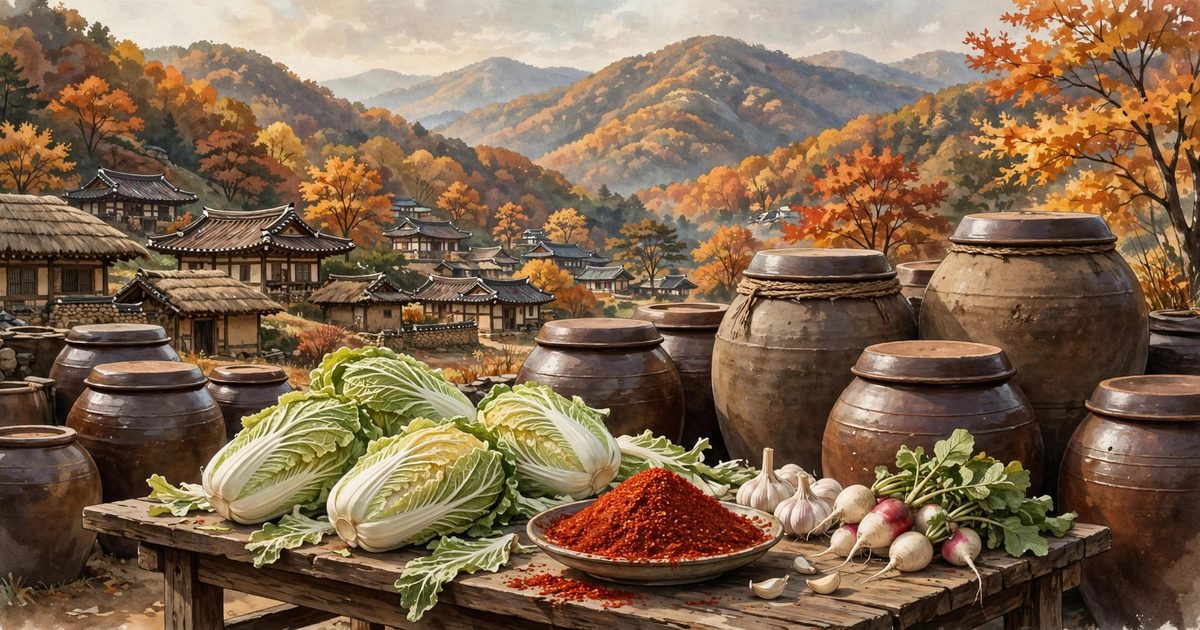
In courtyards, community halls and festival grounds across South Korea, the most delicious logistics operation of the year is under way: kimjang season 2026. Kimjang is the communal making of winter kimchi — mountains of napa cabbage salted, seasoned with crimson chilli paste and buried in jars or slid into dedicated kimchi fridges to ferment through the cold months. It is part food preservation, part family reunion, part neighbourhood festival, and it is important enough that UNESCO inscribed kimjang culture on its Intangible Cultural Heritage list in 2013. This guide explains what kimjang is, when kimjang season 2026 peaks, what the ingredients cost this year, and where visitors can roll up their sleeves and join in.
What is kimjang — and why does Korea do it?
Kimchi — vegetables fermented with salt, chilli flakes (gochugaru), garlic, ginger and fermented seafood — accompanies virtually every Korean meal. Before refrigeration, the only way to keep vegetables edible and nutritious through Korea's harsh winters was to ferment them in late autumn and store them cool, traditionally in earthenware jars (onggi) buried in the ground. Kimjang is the name for doing that job at scale, together: extended families and neighbours pooling labour to process scores of cabbages in a day, then sharing the results — and the gossip — around. The science behind it is elegant; our explainer What Is Fermentation? shows how lactic-acid bacteria preserve the food and produce kimchi's signature tang. The social function matters as much as the chemistry: kimjang redistributes food to elderly relatives and poorer neighbours, and remains one of Korea's strongest rituals of mutual care.
Timing is everything. Kimchi ferments and keeps best when ambient temperatures hover around 4°C and below, so kimjang season follows the first real cold: in most of Korea that means November, with the northern and mountain regions starting in late October. Make it too early and the kimchi sours before spring; too late and the cabbages freeze in the field.
Kimjang 2026 prices: cheaper cabbage, pricier shrimp
Every kimjang season opens with the same national conversation — the price of the ingredients. In 2026 the news is split. Napa cabbage, the main event, costs about 12.9 percent less than a year ago, a relief after several seasons in which heat waves and heavy rain battered cabbage harvests and sent kimjang costs spiking. The offset is in the seasoning: salted shrimp (saeujeot), the fermented seafood that gives much kimchi its deep savoury base, is up about 23.4 percent, and other marine ingredients have firmed too. For a household pricing a full batch, the two movements roughly cancel out — a welcome change from the years when every line of the shopping list rose at once.
The economics explain kimjang's slow transformation. Only about 62.3 percent of Korean households still make their own kimchi, down steadily as one-person households multiply, apartment kitchens shrink, and supermarkets sell factory kimchi of genuinely high quality year-round. Yet the tradition is not dying so much as relocating — into festivals, workplace volunteer days, charity kimjang drives for elderly residents, and premium "experience" events where urban families book the ritual as a day out. How festivals carry cultural identity in exactly this way is a theme we explored in How Festivals Shape Cultural Identity.
The Pyeongchang festival and Kimchi Day, 22 November
The season's flagship event is the Pyeongchang Highland Kimchi Festival, running 4–16 November 2026 in the mountain county that hosted the 2018 Winter Olympics. Pyeongchang's highland cabbages — grown in cool mountain air — are prized for dense, sweet leaves, and the festival lets visitors make their own kimchi on the spot: 69,000 KRW covers 10 kg of prepared ingredients, seasoned under expert supervision and shipped or carried home. It is kimjang as both heritage and tourism, and it sells out its weekend slots.
The season's fixed point is Kimchi Day on 22 November — a date chosen by wordplay: kimchi's 11 traditional ingredients, and its 22 celebrated benefits. Expect supermarket promotions, municipal kimjang events and a wave of kimchi content across Korean social media. For South Korea stories beyond the food pages, see also our report on South Korea's embassy staff withdrawal from Ukraine.
How a kimjang day actually works
A traditional kimjang runs like a relay. Day one: cabbages are halved or quartered and brined in salt water for 10–12 hours, then rinsed and drained. Meanwhile the seasoning — the yangnyeom — is built: glutinous rice porridge as a base, gochugaru for heat and colour, minced garlic and ginger, fish sauce and salted shrimp for depth, plus julienned radish, mustard greens and spring onions. Day two is the assembly line: workers pack seasoning between every leaf of every cabbage, wrap the heads, and load them into jars or kimchi fridges, with the first taste — a fresh cabbage leaf wrapped around a slice of boiled pork (bossam) — as the crew's traditional reward.
Whether it happens in a village courtyard or a Seoul festival tent, kimjang season 2026 shows a tradition adapting rather than fading: the cabbage is cheaper, the shrimp is dearer, the jars increasingly share space with a kimchi fridge — and the neighbours still show up. That, more than the kimchi itself, is what UNESCO was honouring.
Kimjang also sits inside a bigger Korean food story. South Korea's kimchi exports have climbed to successive records in recent years as Korean cuisine has globalised on the back of K-dramas, K-pop and a worldwide appetite for fermented foods; kimchi now appears on supermarket shelves and restaurant menus from Los Angeles to London. That export boom cuts both ways at home: it has professionalised production and quality, but it also ties the price on a Korean family's kimjang table to global demand for cabbage, chilli and seafood. Traditionalists grumble that factory kimchi can never match a family's own yangnyeom — every household's seasoning is a fingerprint — yet the export industry's rise is one reason the skills, and the market for the ingredients, stay strong even as home production declines.
Sources: Aju Press; BeforeYouGoKorea; Korea Agro-Fisheries & Food Trade Corporation price data; UNESCO, October 2026.