
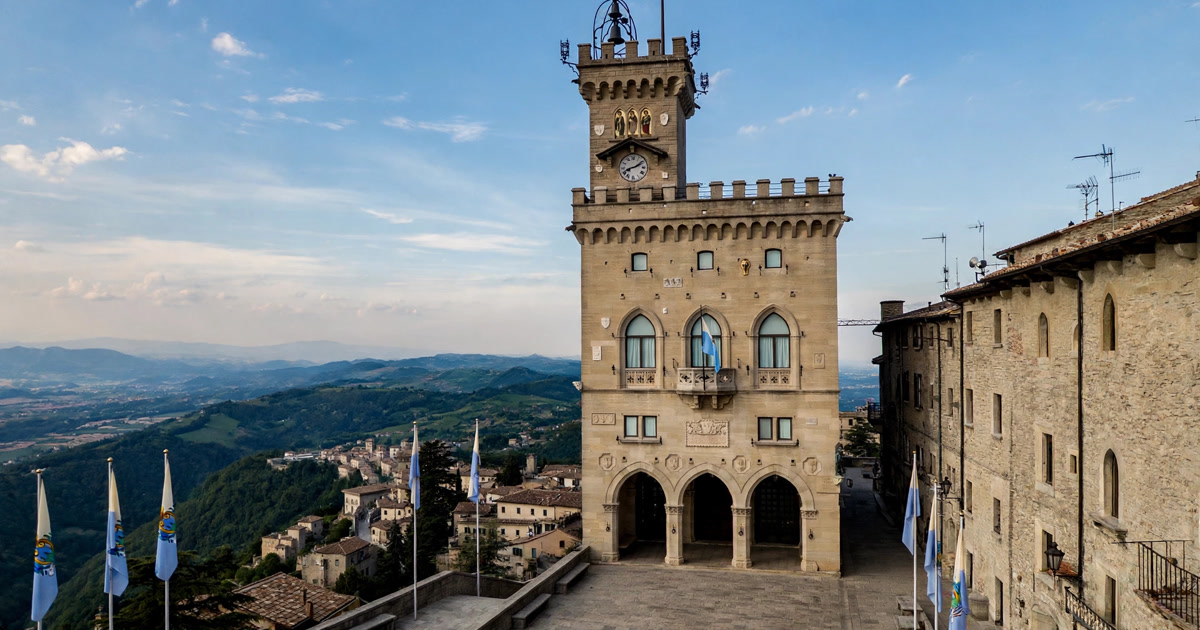
San Marino, the world's oldest surviving republic, runs a distinctive public administration shaped by centuries of independence, close Italian ties and tiny scale. San Marino public administration combines ancient institutions, such as the Captains Regent, with modern ministries, agencies and digital services.
This guide explains San Marino public administration: how government works, what services residents use, how Italian links shape administration, and how newcomers access services. It is written for residents, businesses and curious observers.
Captains Regent and the Great and General Council
San Marino public administration centres on the Captains Regent, two heads of state elected every six months from the Great and General Council, the 60-member parliament. This dual, rotating headship, dating to the 13th century, prevents power concentration.
The Council legislates, elects Captains Regent and the Congress of State, the government, and oversees administration. Parties, coalitions and frequent elections reflect San Marino's lively democratic culture within a tiny electorate.
Congress of State and Ministries
San Marino public administration executive is the Congress of State, with Secretaries of State covering foreign affairs, interior, finance, health, education, territory and tourism, among others. Ministries are small, with officials handling broad portfolios.
Small scale means direct access: citizens often know officials personally, and administration feels personal rather than bureaucratic. Digital services grow, but face-to-face contact remains central to Sammarinese public life.
Public Services for Residents
San Marino public administration services include healthcare through the Social Security Institute, ISS, education from nursery to university, social services, civil registry, police, and utilities, often delivered through small agencies and Italian partnerships.
Residents access services via government offices in San Marino City and Borgo Maggiore, plus online portals for many procedures. Understanding how the internet works helps explain digital service development, while local offices handle complex cases personally.
Italian Links and Cross-Border Administration
San Marino public administration is deeply linked to Italy through friendship treaties, customs union, currency use of the euro, and cooperation on healthcare, transport, policing and taxation. Many Sammarinese work, study and receive care in Italy, and vice versa.
Italian links simplify daily life: Italian is the official language, Italian media and products dominate, and Rimini provides airport, hospital and commercial services. Treaties govern tax, social security and cross-border workers, requiring coordination between administrations.
Practical Access for Newcomers and Businesses
Newcomers to San Marino public administration should register residence, tax and health cover through relevant offices, with procedures varying by nationality, purpose and Italian-link status. Businesses register through company and tax authorities, with small-market rules and Italian trade links shaping operations.
A 50-30-20 budget rule helps newcomers manage living costs, since San Marino prices reflect Italian imports and small-market premiums. Professional advice helps businesses navigate company, employment and tax rules in a microstate system.
San Marino's Electoral System
San Marino's electoral system uses proportional representation with majority bonus, electing the 60-member Great and General Council, with coalitions forming governments and Captains Regent elected from council members. Turnout is high in the small electorate.
Electoral rules, party lists and preference votes shape Sammarinese politics, with frequent elections and coalition negotiations reflecting lively democratic culture. Understanding elections helps observers follow San Marino public administration.
San Marino's Judiciary and Rule of Law
San Marino's judiciary includes courts, judges and the Guarantors' Panel on constitutionality, with Italian legal traditions influencing procedures. Rule-of-law institutions, though small, handle civil, criminal and administrative cases for residents and businesses.
Legal proceedings run in Italian, with lawyers and notaries guiding clients through Sammarinese law. Small scale means cases move relatively quickly, though complex cross-border matters involve Italian cooperation.
San Marino's Social Security System
San Marino's social security system, run by ISS, covers healthcare, pensions, family benefits, unemployment and disability, funded through contributions from workers, employers and the state. Benefits reflect small-state solidarity and Italian-linked arrangements.
Residents register for ISS coverage through employment, self-employment or residence routes, with entitlements varying by contributions and status. Cross-border workers coordinate benefits with Italian systems under treaties.
San Marino's Education System
San Marino's education system includes nursery, primary, lower and upper secondary schools, plus the University of the Republic of San Marino, with Italian-language curricula and cross-border university options in Italy for many students.
Schools emphasise Sammarinese history, civic education and Italian culture, while university students often study in Bologna, Rimini or Urbino. Education links to Italy enrich opportunities for Sammarinese youth.
San Marino Public Administration: Digital Services
Digital services in San Marino public administration grow through online portals for civil registry, tax, health and business procedures, reducing office visits for residents. Digital identity and e-signatures support remote access, though face-to-face help remains.
San Marino public administration digital growth faces small-state challenges, including limited IT resources and Italian system interoperability, but progress continues with EU-aligned standards and cross-border cooperation.
San Marino Public Administration: Transparency
Transparency in San Marino public administration includes published budgets, council debates, audit reports and anti-corruption measures, with small scale enabling citizen scrutiny of officials and spending. Media and civil society monitor governance closely.
San Marino public administration transparency improves with open data, public procurement disclosure and international assessments, though small-state personal networks require vigilance against conflicts of interest.
Citizens and Public Services
Citizens interact with public services through parish offices, central registries and online portals, with most procedures conducted in Italian. Small scale means officials often know residents personally, and queues are short compared with larger states.
Service quality benefits from proximity: residents can raise issues directly with councils and ministries, and public consultations draw genuine community participation. Digital services continue to expand, reducing office visits.
Accessing Services in Italian
Most administrative procedures run in Italian, so newcomers benefit from basic Italian skills or a translator for complex matters. Forms, websites and office signage rarely offer English versions, though staff often help patiently.
Learning key administrative vocabulary pays off quickly: residency, tax, health and vehicle terms recur across nearly every procedure a new resident encounters.
San Marino's administration blends ancient republican institutions with modern services and Italian partnership. Small scale brings direct access, while treaties and cooperation make the microstate work.
Sources: Republic of San Marino government; San Marino State Secretariat guides; Italy-San Marino agreements.