
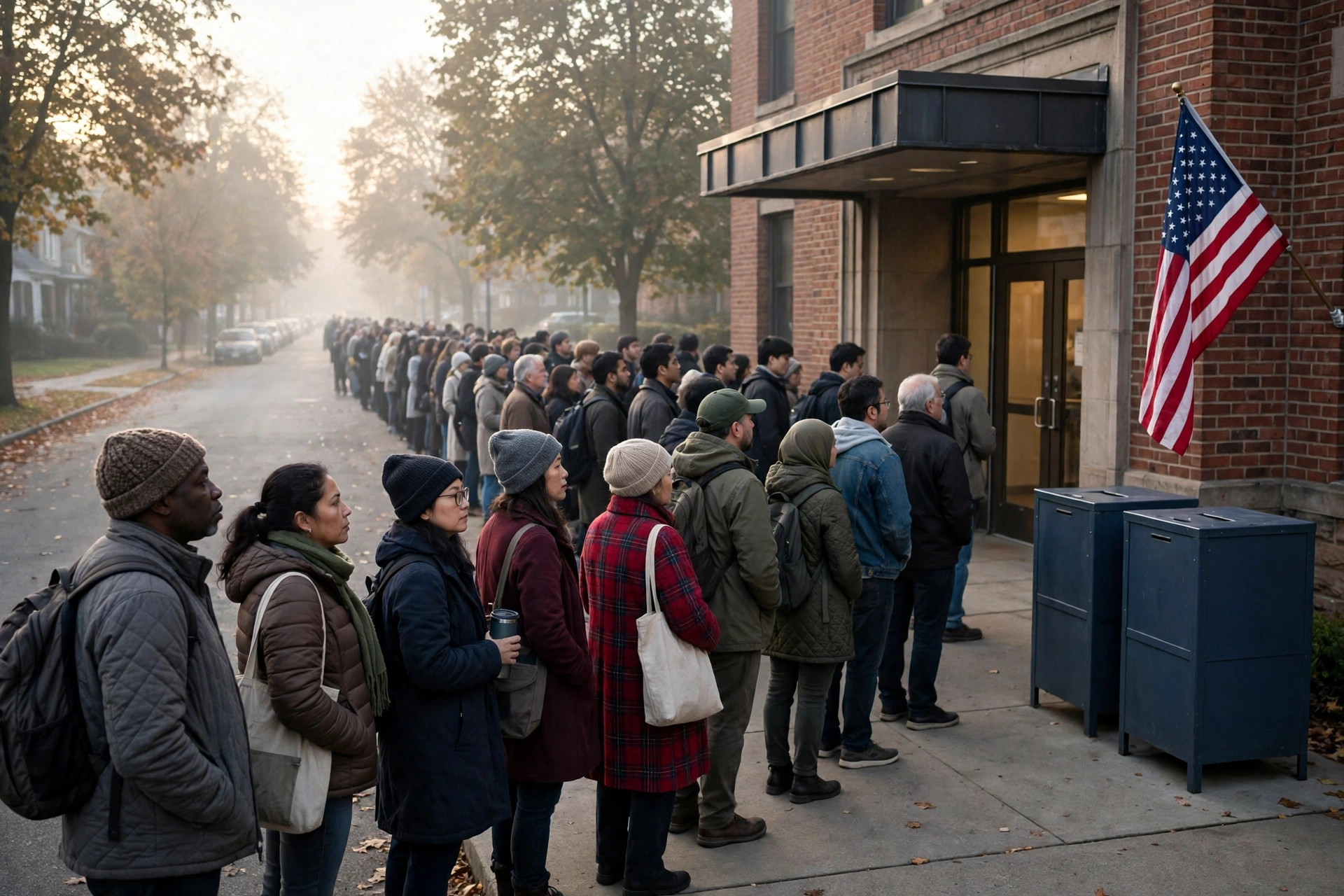
The 2026 midterm elections early voting record is already settled before a single Election Day ballot has been cast. More than 59 million Americans voted early, in person or by mail, before Election Day in the 2026 midterms, according to the University of Florida Election Lab — whose figures were reported by USA Today, Reuters and the Associated Press. That total passes the 45.9 million early votes cast before Election Day in the 2022 midterms by about 13 million, making this the largest early vote ever recorded in a midterm election. Early voting has now closed in every state that offered it. The election itself takes place on Tuesday 3 November 2026, when voters will decide all 435 seats in the House of Representatives and 35 seats in the Senate, determining which party controls each chamber for the second half of President Donald Trump's second term.
What the 2026 Midterm Elections Early Voting Record Means
The record matters because it changes how Americans vote, not only how many vote. In 2022, about half of all midterm ballots were cast before Election Day. In 2024, the share was about 60 percent, according to survey data cited by No Labels. Early voting has moved from a convenience used by a minority to the normal way a large share of the electorate now takes part. The 2026 figure confirms that shift: the early vote alone, before Election Day, is already larger than the entire early vote of the last midterm. The Associated Press reported that, measured five days before Election Day, more than 10 million additional voters had taken part in early voting this year compared with the same point in 2022. That is a wide gap, and it was already visible before the final weekend of early voting. The record was first passed on 30 October, when the University of Florida Election Lab recorded 47,922,669 early votes at noon that day, above the 45.9 million recorded in 2022. By 1 November the total had passed 54 million, and it kept rising as the last early-voting windows closed, reaching more than 59 million before Election Day, according to the University of Florida Election Lab, which is the figure used throughout this article. Readers should note the timestamp on any early-vote number they see elsewhere, because figures from different cutoffs should not be mixed together.
What the record does not do is predict the result. Early-vote totals show how many people have voted, not who they voted for. In the states that report early voting by party registration, Democrats led the early vote in the figures reported on 31 October, but only 27 states report early voting by party, so that is a partial picture, and a voter's party registration does not reveal which candidates they supported. Republicans have historically recorded stronger participation on Election Day itself in some recent elections, and tens of millions of Americans are still expected to vote on Tuesday 3 November. A record early vote also does not necessarily mean record overall turnout, because some voters may simply be choosing to vote earlier than they did in previous years rather than adding to the total. The University of Florida political scientist Michael McDonald, who oversees the Election Lab, has said overall turnout could surpass 2022 and potentially rival 2018, when turnout reached 49 percent, but that is a possibility, not a forecast of the final result.
How the 2026 Midterm Elections Early Voting Record Was Counted
Early voting in the United States is not one system but 50 state systems, plus the District of Columbia, each with its own rules on when voting opens, how mail ballots are returned and when they are counted. The University of Florida Election Lab gathers the figures state by state and publishes a running national total, which is why its tally is the one most news organisations cite. Early voting consists of two parts: mail ballots returned before Election Day, and in-person voting at early voting centres. In 2026, 47 states and Washington, D.C., offer early in-person voting to all voters. Connecticut, Michigan and New York are offering expanded early voting options in a midterm for the first time. Michigan is holding its first midterm with early in-person voting statewide after voters approved it in November 2022, and the state had about 409,000 more early votes than at the same point in 2022, a 32 percent increase, according to the Associated Press.
The state-level figures help explain where the national record came from. Texas had more than 6.3 million early votes by 28 October, with in-person turnout running about 50 percent ahead of the same stage in 2022, and the state had already passed its 2018 early-vote record of 5.5 million. Florida had about 4.5 million early votes and North Carolina about 2.4 million, according to figures reported by OnPoint Politics. Georgia recorded a milestone of its own, with early in-person voting surpassing the state's previous midterm record on the Thursday before Election Day. Early voting has now ended in every state that offered it, and the final early-vote total reached more than 59 million before Election Day, according to the University of Florida Election Lab. The full picture will only be known once Election Day votes are added. A Reuters/Ipsos poll found that 76 percent of voters were confident their ballots would be counted accurately, a useful piece of context at a time when the mechanics of voting attract close attention.
Why Early Voting Rose in 2026
No single cause explains a rise of this size, and the honest answer is that several factors point in the same direction. First, access has widened. More states now offer early in-person voting to every voter, and states such as Michigan have added it for the first time in a midterm, so millions of voters who once had to vote on a single Tuesday now have days or weeks to do so. Second, habit has taken hold. Voters who tried early voting or mail voting in 2020 and 2022 have kept using it, and campaigns on both sides now spend heavily on encouraging their supporters to vote early, treating the early-vote period as the first phase of the election rather than a warm-up. Third, the stakes are unusually visible. Control of the House and the Senate is genuinely in play, and the final days of the campaign have been dominated by rallies and advertising in the most competitive states, which tends to bring forward voters who might otherwise have waited. Trump's rallies in Kansas and Iowa are part of that final push, and the campaign's closing schedule shows how much effort is going into the last days before 3 November.
There is also a practical reason that should not be overlooked. Voting early removes the risk of a long queue, bad weather or a work commitment on Election Day itself, and for voters in states with long early-voting windows it is simply the easier option. Election officials generally welcome the spread of voting across many days because it eases pressure on polling places on the day itself. None of this means that early voters are more enthusiastic than Election Day voters, or that one party has an advantage. It means the electorate is voting on a different timetable, and anyone reading the early-vote figures as a prediction of the outcome is reading more into them than they can support.
What the Polls and Forecasts Say Before 3 November
The polls and forecasts published in the final days before the election point to a close contest, with the Democrats ahead on the national generic ballot but the House outcome still uncertain. RealClearPolling's generic ballot average put the Democrats at 51.4 percent and the Republicans at 43.2 percent, a lead of 8.2 points, based on polls conducted between 8 and 26 October. A generic ballot lead of that size would normally suggest gains for the Democrats, but the House is decided in 435 separate districts, not in a single national vote, so a national lead does not translate directly into seats. The Cook Political Report, in its projection published on 30 October, projected a range of 227 to 240 Democratic seats in the House. A party needs 218 seats for a majority, so the lower end of that range would give the Democrats a narrow majority, while the upper end would give them a comfortable one. The range itself is the honest point: the forecasters are confident about the direction but not about the exact size of the shift.
The Senate picture is different, because only 35 seats are on the ballot and the Republicans hold the chamber by 53 seats to 47. The Democrats need a net gain of four seats to take control, which is a steep climb in a map where many of the seats at stake are in states the Republicans won comfortably in recent elections. That is why most attention has focused on the House, where the margin is much tighter: the Republicans hold the House by about 218 seats to 214, and a small swing in a handful of districts could change control. Voters should treat every forecast as a snapshot with a margin of error, not as a result. Polls measure opinion at the time they are taken, and forecasts combine polls with fundraising, candidate quality and past results. Both can be wrong, and both have been wrong in recent elections, which is why the early-vote record and the polls should be read together as background, not as a substitute for the count itself. For readers who want the practical side of taking part, our guide explains how to vote in the 2026 midterms, including registration checks and polling-place details.
What Happens on Election Day and After
On Tuesday 3 November, polling places open across the country and the remaining tens of millions of voters cast their ballots. Counting then begins, but the speed of results will vary widely by state. Some states count mail ballots as they arrive and report results quickly; others do not begin counting mail ballots until Election Day, and close races may take days to call. In 2026, as in recent elections, the first results on election night will be partial, and the balance of the House and Senate may not be known until later in the week. That is normal, not a sign of a problem, and it reflects the fact that different states count at different speeds. Election officials have repeatedly said that accuracy matters more than speed, and the Reuters/Ipsos finding that 76 percent of voters are confident their ballots will be counted accurately suggests most voters accept that.
Once the results are known, the consequences will be immediate. If the Democrats win the House, they will control the chamber's committees and its legislative agenda for the final two years of the president's second term. If the Republicans hold both chambers, the administration will keep a freer hand. Either way, the new Congress will take its seats in January, and the first test will be the routine business of funding the government and setting the legislative calendar. The record early vote will then be studied by both parties as evidence of how the electorate now behaves, and by election administrators as a guide to how much capacity early voting needs in future elections. The platforms have also prepared for the aftermath: OpenAI's election war room for the 2026 midterms is one example of how technology companies are monitoring the vote. For now, the one fact that is settled is the turnout story: more Americans voted early in this midterm than in any midterm before it, and the final chapter will be written on 3 November.