
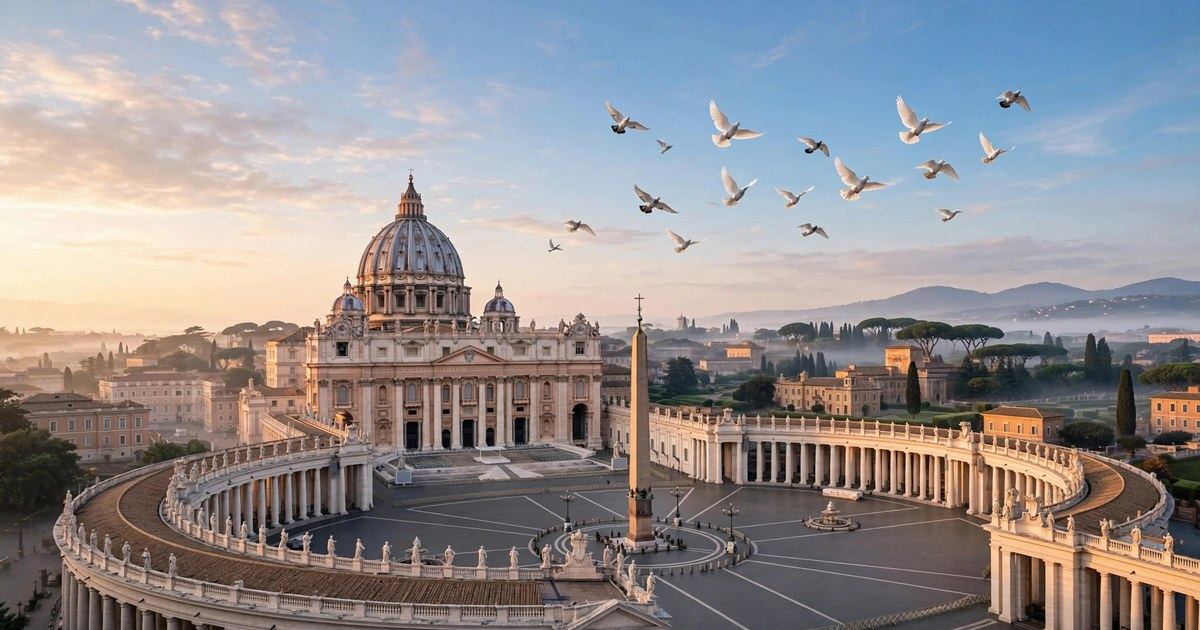
Pope Leo XIV has announced he will undergo surgery this week to remove a small nodule found on his lung, the Vatican said on Sunday, in the first health scare of the American pontiff's 17-month tenure. The 71-year-old pope revealed the finding himself during his traditional noon Angelus prayer in St. Peter's Square, telling the crowd he had already scheduled the operation on his doctors' advice.
"Doctors found a small, localized nodule in my lung. It was detected at a very early stage and is circumscribed," Leo told the faithful in Italian on 11 October 2026. "The doctors believe it's best to take action, so, following their advice, I've decided to have surgery to remove it."
Vatican spokesman Matteo Bruni said the surgery is set for the first days of this week at Rome's Gemelli Hospital — the facility that has long treated popes — with an estimated recovery of about one week. Leo thanked the crowd for their "spiritual closeness" and entrusted himself to their prayers, according to news coverage from the Vatican.
What the Vatican announced
The announcement came with no prior warning. Leo, who has no previously known health problems, made the disclosure at the end of his Sunday noon blessing, the most public moment of his weekly calendar. He did not say whether the nodule was malignant, but stressed it was caught early and well localized.
The Vatican later clarified the logistics: the pope would be hospitalized at the Gemelli for roughly a week, and during that period the Holy See would continue to function normally — though decisions requiring the pope's personal signature would be placed on hold.
The one major casualty of the schedule is Wednesday's closing of a weeklong conference on family ministry, marking the 10th anniversary of Amoris Laetitia, which Leo had been due to lead on 14 October. His participation now looks unlikely, and per news reports it remains unclear whether the surgery will take place before or after that date.
What is a lung nodule?
A lung nodule is a small mass of dense tissue on the lung, generally defined as an abnormal area measuring less than 3 centimeters across that shows up on a CT scan. They are, in the words of lung specialists quoted across the coverage, fairly common — especially in older adults — and most prove benign.
According to the American Thoracic Society, fewer than 5% of lung nodules turn out to be cancerous. "The majority of lung nodules are benign," Dr. Panagis Galiatsatos, a pulmonary physician at Johns Hopkins University School of Medicine, told NPR, jokingly calling them "the lungs' wrinkles." Dr. Stephen Liu, a lung cancer expert at Georgetown's Lombardi Comprehensive Cancer Center, told the New York Post that even when nodules do prove cancerous, the prognosis is "excellent" if they are removed at an early stage, with surgery often the only treatment needed.
The fact that Leo's medical team recommended surgery suggests at least one test crossed a threshold of concern, as Galiatsatos noted: once doctors decide a nodule should be removed rather than simply monitored, "the suspicion and concern for cancer became a little bit higher." The pope himself emphasized that the lesion was "detected at a very early stage" and "well-defined."
Why this matters for the Catholic Church
Pope Leo XIV — the former Cardinal Robert Prevost, born in Chicago — was elected in May 2025 as the first pope ever born in the United States. He is relatively young for a pontiff at 71 and is generally seen to be in robust health: he plays tennis weekly and swims at the papal summer retreat in Castel Gandolfo.
That backdrop is one reason the announcement carried such weight. Papal health has loomed large in recent memory: Leo's predecessor, Pope Francis, spent an extended period in hospital in the final months of his life, dying on 21 April 2025 of a stroke following a long hospitalization brought on by a respiratory crisis that developed into double pneumonia. Francis suffered from chronic lung disease and had part of one lung removed as a young man — a history that made every respiratory ailment of his papacy a source of global anxiety.
By announcing the finding personally, early, and with a concrete plan, Leo's Vatican appears determined to avoid the kind of opacity that fueled speculation around previous pontiffs' hospitalizations. The message was deliberately calm: a small nodule, caught early, surgery advised, recovery expected.
The schedule ahead: a major Latin America trip
The most closely watched item on Leo's calendar is his planned 11-day apostolic visit to Latin America from 6 to 17 November, covering Uruguay, Argentina and Peru. A one-week recovery would, on paper, leave him fit in time — and Leo himself said during his remarks that he still planned to go.
The trip matters beyond logistics. Leo has been an outspoken voice for international peace during his tenure, and the Nov 6-17 journey to South America is one of the most significant journeys planned of his papacy. Medical schedules are notoriously unpredictable, however, and the Vatican will be watched for any adjustment to the itinerary in the coming days.
Italian Premier Giorgia Meloni was among the first to publicly offer support, sending her backing to the pope "as he faces this challenge in the coming days," according to CNN's reporting.
A pontificate under global scrutiny
Leo's papacy has played out under unusual political scrutiny. He has openly criticized US President Donald Trump's ongoing war with Iran, including during a four-country African tour in April, declaring: "Woe to those who manipulate religion and the very name of God for their own military, economic and political gain." Trump and Vice President JD Vance — a Catholic — each responded critically, drawing backlash from parts of America's conservative Catholic community, as recent reporting on Trump's foreign moves has highlighted the administration's aggressive posture.
Against that backdrop, Leo's hospitalization will be followed far beyond the Catholic world. The Vatican's modern communications machine — daily briefings, a spokesman, and the pope's own social media accounts — means the surgery will likely be documented in near-real time, a far cry from the era when pontiffs vanished behind palace walls.
What happens next
Per the Vatican's stated timeline, the surgery should take place in the first days of this week, with the pope hospitalized at the Gemelli for roughly seven days afterward. Key markers to watch:
- The operation itself: whether the Vatican confirms it promptly, as it has done for previous popes.
- The recovery bulletin: the first medical update from Gemelli, including whether the pope is expected back on his feet within the week.
- Wednesday's conference: whether the closing Mass of the family ministry meeting proceeds without him.
- The November trip: any word on whether the Uruguay–Argentina–Peru journey remains on schedule.
For now, per news coverage trending across global outlets, the headline is reassurance: a localized finding, an early catch, and a pope who walked out into St. Peter's Square to say it himself.
Update: following the surgery, the Vatican confirmed a lung-cancer diagnosis — see the diagnosis coverage.
In other Vatican news, Pope Leo has urged Putin to open an aid corridor for starving Oleshky in Ukraine.