
Pope Leo XIV telephoned Russian President Vladimir Putin on Friday 16 October 2026 and asked him to open the way for food and medical aid to reach the besieged Ukrainian town of Oleshky, where residents are reported to be facing a deepening hunger crisis. The Vatican said the pontiff urged Putin to agree to a truce that would allow first aid and food supplies into the town and permit the voluntary evacuation of its remaining civilians. The Kremlin said Putin backed the Vatican initiative and agreed to cooperate — but its statement made no mention of a ceasefire.
The call, which is trending per news coverage across international outlets, was the second known conversation between Leo and Putin. The two leaders had previously spoken in June 2025. This time, according to the Vatican's Secretary of State, Cardinal Pietro Parolin, the call was the pope's own initiative: Leo wanted, in Parolin's words, "to plead the cause of this besieged city."
What the Vatican and the Kremlin each said
The Vatican's account of the call was direct. Pope Leo expressed "deep concern" over the humanitarian situation in Oleshky and asked Putin to arrange a ceasefire so that aid and food could enter the town, which Russian forces have held since February 2022. The pope also reaffirmed the Holy See's commitment to any initiatives for peace.
The Kremlin's account was narrower. Its statement said: "The Vatican's intention to help create the conditions necessary to ensure the safety of the town's population and to organise vital supplies has been supported. It has been agreed to cooperate on this matter." The statement did not mention a ceasefire or a truce, and it gave no timeline or mechanism for how aid would be delivered. The Kremlin added that Putin had wished Leo a speedy and full recovery.
That gap between the two readouts matters. A promise to cooperate on aid is not the same as a ceasefire, and in a frontline town where movement is dangerous, the practical question — who delivers the aid, along which route, and under whose protection — remains unanswered. As of the evening of the call, there was no independent confirmation that any new supplies had reached Oleshky.
Where is Oleshky, and why is it cut off?
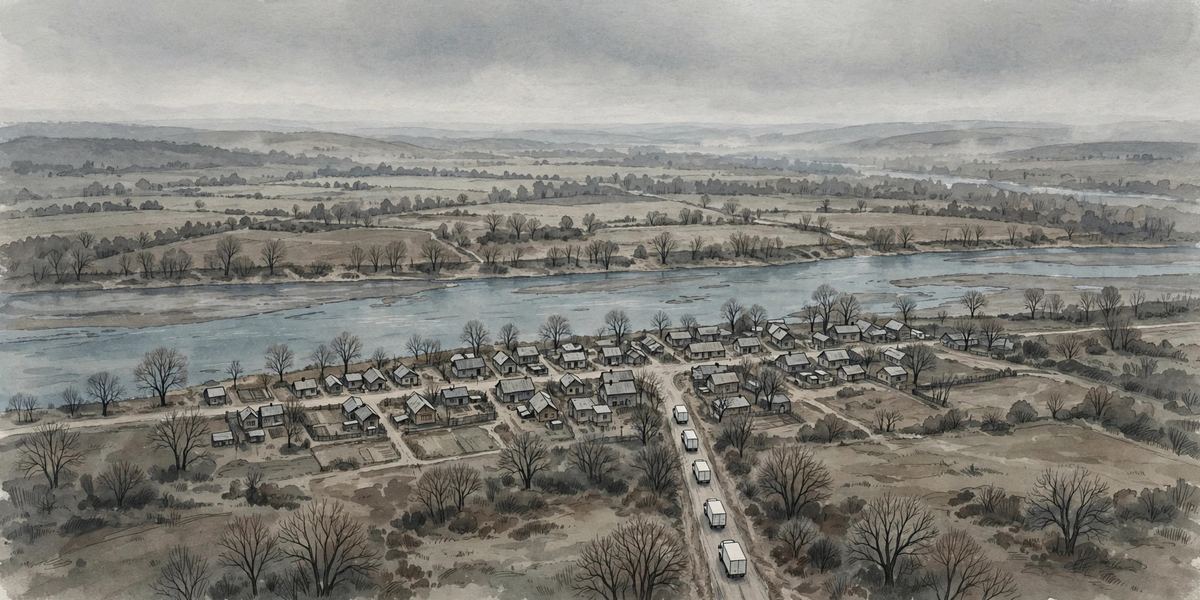
Oleshky is a small town in Ukraine's Kherson region, on the southern (left) bank of the Dnipro River. Russian forces seized it in the first days of the full-scale invasion in February 2022, and it has been under Russian occupation ever since. It sits close to the front line: Ukrainian forces hold the opposite bank, and the town has effectively been a frontline settlement for much of the war.
Before the war, Oleshky was home to about 24,000 people. Today, according to the United Nations Human Rights Monitoring Mission in Ukraine, around 1,700 residents remain, including 47 children. Ukrainian officials put the figure at roughly 2,000. The difference reflects how hard the town is to count: communications are scarce, movement is dangerous, and many residents are elderly or have limited mobility.
The town's isolation has deepened over time. After the destruction of the Antonivskyi Bridge, Oleshky found itself on the front line, and when Russian-installed authorities withdrew from the city, most public services ceased. Residents who needed to reach a bank, a social service office or a pension fund had to travel tens of kilometres to other towns — journeys that became steadily more dangerous as mines and drone threats spread.
The flooding that devastated the town
Oleshky's crisis was made far worse in June 2023, when the massive Kakhovka dam on the Dnipro was destroyed. Ukraine blamed Russia for blowing up the dam; Russian forces were in control of the dam at the time. The breach unleashed floodwaters across the Kherson region and almost completely submerged Oleshky.
According to Ukrainian estimates, at least 500 people died in the flooding in the town and thousands more went missing. The occupying administration acknowledged only 59 deaths. The exact toll remains unknown, in part because the scale of the disaster was concealed, and because cemeteries, hospitals and morgues were themselves flooded. The town never fully restored basic services after the flood: electricity, gas, drinking water and communications all suffered lasting damage.
A town running out of food
In recent weeks, reporting from the town has described conditions that aid workers call a "total blockade". Ukrainian volunteer Iryna-Ester Vratareva, a spokesperson for the civic organisation Humanity, told Radio Free Europe/Radio Liberty that Oleshky's situation was no longer just critical: "It is hell." She said that, in the best case, a person might eat a clear soup and a few spoons of porridge in a day — if anything was left at all.
According to Ukrainian authorities, the last time supplies were delivered to the town from the Russian side was around four months ago. Former residents in contact with people still inside have told Agence France-Presse that residents have "forgotten what bread is" because there is not even flour left. People survive on what little they can grow in their gardens, and even pigeons — eaten in the early days of the shortage — are now hard to find.
The medical situation is equally grave. With no functioning health services, injuries that would normally be treatable can become life-threatening. The UN Human Rights Monitoring Mission in Ukraine reported that at least 29 civilians were killed and 54 wounded in Oleshky and the neighbouring town of Hola Prystan in 2026, mostly due to drone attacks. Civilians attempting to obtain food or leave the town have been targeted by first-person-view drones, according to Ukrainian officials and the Holodomor Museum's statement of 16 September 2026.
Who is blocking the aid?
Russia and Ukraine each blame the other. Moscow has acknowledged critical problems with food and medical supplies in Oleshky and said its military was working to resolve them — but it blames Ukraine for obstructing supplies from getting into the town. Kyiv says it is Russia that is thwarting food deliveries and preventing civilians from leaving.
That dispute is precisely why the pope's intervention matters. A humanitarian corridor needs both sides to stop shooting along an agreed route, and neither side trusts the other to do so unilaterally. The Vatican, which is not a party to the fighting, is one of the few actors that can publicly ask for a pause on purely humanitarian grounds and be heard in both capitals.
Ukraine's Council of Churches had already appealed to Pope Leo to help save occupied Oleshky from starvation, and Ukrainian human rights commissioner Dmytro Lubinets said in August that Ukraine had completed all necessary measures for the evacuation of civilians from Oleshky and adjacent settlements, while Russia continued to obstruct people from leaving.
Why the pope made the call now
The timing is striking. Pope Leo, 71, is himself recovering at Rome's Gemelli hospital after surgery for lung cancer. The Vatican said earlier on Friday that he was showing steady improvement and was able to work and carry out normal daily activities. Despite his own health situation, the pontiff chose to place the call personally — a sign of how urgent the Vatican considers the Oleshky crisis.
The call also came against a grim wider backdrop for Ukraine. Russian strikes have been hitting Ukrainian energy infrastructure as winter approaches, and the diplomatic picture is tense: the energy ceasefire announced by US President Donald Trump has unravelled, with Ukraine resuming strikes on Russian refineries and Russia continuing its bombardment of Ukrainian cities. In that context, a narrow humanitarian appeal — food and medicine for one besieged town — may be the kind of step that can still find common ground even while the wider war continues.
What happens next
Three questions will decide whether the call changes anything on the ground. First, will the Kremlin's agreement to cooperate translate into a concrete delivery plan — a route, a date, and a guarantee of safe passage? Second, will there be a local pause in fighting along that route, even if neither side calls it a ceasefire? And third, will civilians who want to leave be allowed to do so safely, as the pope requested?
Humanitarian organisations and the Vatican will be watching for the first convoy. Until aid actually arrives, the people of Oleshky remain where they have been for months: cut off, short of food and medicine, and waiting for a promise to become a delivery. The pope's call has put their plight on the international agenda; whether it puts food on their tables depends on what happens in the days ahead.
The diplomacy around Oleshky has since widened: Melania Trump brokered a local ceasefire to allow a humanitarian evacuation of the besieged city.
Sources: Reuters (Vatican City and Moscow reporting, 16 October 2026); Vatican press statements; United Nations Human Rights Monitoring Mission in Ukraine; Radio Free Europe/Radio Liberty; Agence France-Presse; National Museum of the Holodomor-Genocide statement, 16 September 2026.