
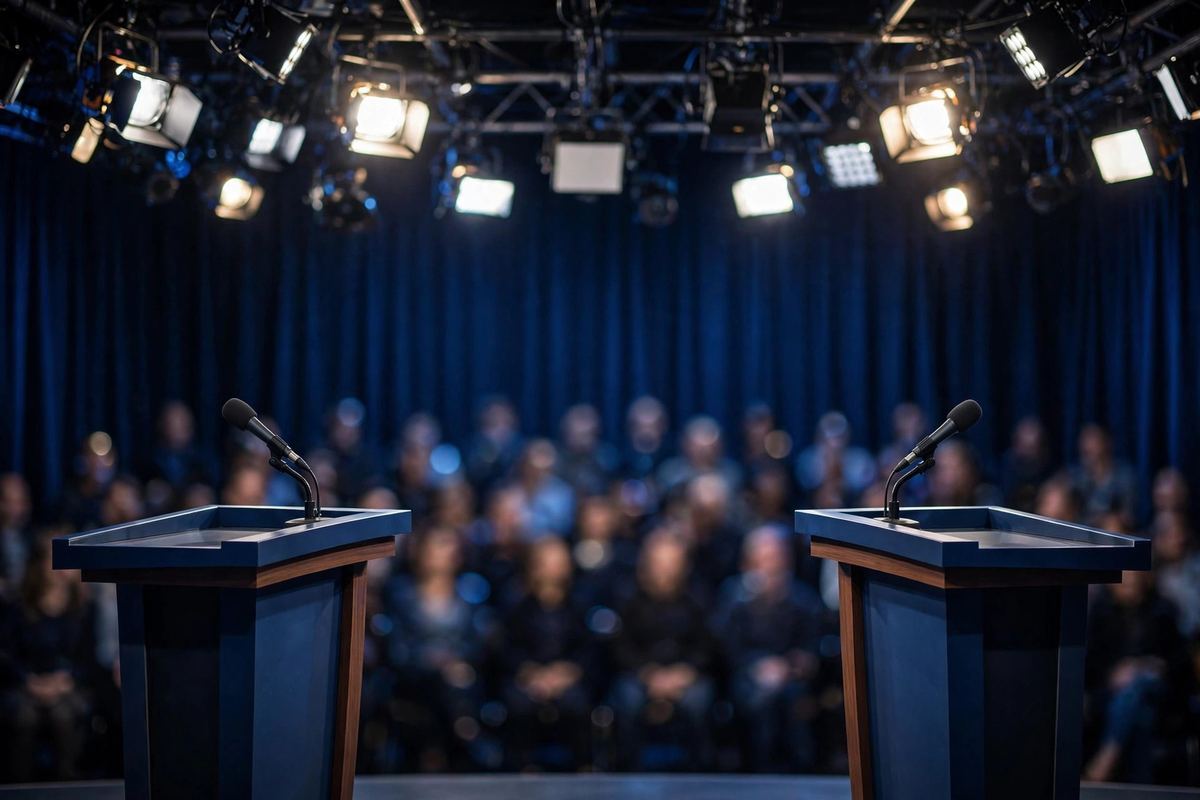
A debate in a deadlocked race
New Zealand's election campaign reached its second leaders' debate on Wednesday evening, with Prime Minister Christopher Luxon of the centre-right National Party and Labour leader Chris Hipkins meeting in the NZ Herald-hosted debate. The election is on November 7, and the race could hardly be tighter: the latest TVNZ-Verian poll puts National and Labour both at 28 percent, their lowest combined level since they emerged as New Zealand's major parties in the 1930s. The left and right blocs are deadlocked, with the Opportunity Party a likely kingmaker. Against that background, the debate was a chance for one of the two Chrises to break the stalemate. By most accounts, neither did.
The post-debate panel declared the debate a tight draw. "They filled me with no hope," analyst and social activist David Letele said on the panel. "There is no X-Factor here with these two leaders," said right-aligned public relations expert Trish Sherson. National still claimed the win, pointing to a reader poll on the NZ Herald's website. But the broader verdict in coverage was that the debate taught voters little they did not already know about either man — and that the sense of diminishing returns from a rematch of the 2023 contest is becoming the campaign's defining mood.
The minimum-wage moment
The sharpest exchange came on the minimum wage. The moderator asked both men to pledge to lift it at the rate of inflation. Hipkins agreed. Luxon said, in substance, "Yes, and that's what we've more or less been doing." Hipkins immediately interjected: "No you haven't." Fact-checkers backed Hipkins: Newsroom's fact-check rated Luxon's claim false, noting that every April increase from 2024 to 2026 came in below the previous year's consumer price inflation. The moment became the debate's most replayed exchange, and it was given extra weight by what had come just before: when asked whether he had ever "told porkies" as a politician, Luxon had said that politicians do not always express themselves clearly — "You don't always express yourself clearly or well enough, and sometimes you can do better. I'm a case in point of that."
The substance behind the exchange matters more than the gaffe. The minimum wage is one of the clearest points of difference between the two leaders. Hipkins argues that a high-wage economy cannot be built by paying people poorly; Luxon argues that wages should rise through economic growth rather than legislation. "We don't believe you just legislate it. We actually believe you grow an economy," Luxon said. "You don't grow an economy by paying people poorly," Hipkins retorted. Both leaders agreed New Zealand should be a high-wage economy, and Luxon afterwards ruled out a freeze to the minimum wage — an ACT Party policy — but the exchange showed how differently they would get there.
Jobs, cost of living and the economy
Hipkins had his strongest stretch on jobs. He told the audience there are 48,000 more unemployed people today than when Luxon became prime minister, a figure Newsroom rated mostly true: Stats NZ data show unemployment rising from 122,000 in the December 2023 quarter to 171,000 in the June 2026 quarter. "You celebrate cutting jobs," Hipkins told Luxon. "I want to create them." On pay equity, he accused National of thinking women should settle for being paid less than men. Luxon countered that the economy is now growing faster than Australia, the United States and Britain, a claim Newsroom rated mostly true on annual figures but not on the latest quarter.
The cost of living ran through the whole debate, as it has through the whole campaign. Both parties have framed this as a cost-of-living election. Luxon pointed to his government's economic management and a "no new taxes" pledge, while Hipkins argued that life has not improved for most New Zealanders under National and that Labour's policies in aged care and public transport would help, fully funded. Luxon also attacked Labour's capital gains tax, warning it would "kill our economy" and add costs, while Hipkins accused him of misrepresenting its reach. Luxon's claim that Labour has an "$18 billion hole" in its plans was rated mostly false by Newsroom, which found the costing table it rested on relied on contestable assumptions.
A rematch campaign
The 2026 contest is, in effect, a re-run of 2023. Then, Luxon won and formed a three-party coalition that turfed out the two-term Labour-led government Hipkins had inherited from Jacinda Ardern. The familiarity is part of the problem for both leaders: voters know what each man offers, and the polling suggests many are looking elsewhere. The minor parties' debate the previous evening was widely described as livelier and more thought-provoking than the main leaders' event, and the sense that the two major parties are shrinking has become a theme of the campaign. The combined 28-28 polling is the statistical expression of that mood.
The debate's texture also reflected the imbalance of the evening. RNZ's analysis of the transcripts found that Luxon spoke 6,255 discernible words, up from 6,031 in the previous week's TVNZ debate, while Hipkins spoke 3,958, down from 4,270. Luxon took 150 turns to Hipkins' 118. Hipkins, however, made eight successful interruptions and tried 15 more times when Luxon kept talking, while Luxon interrupted Hipkins once. The numbers suggest a debate in which one leader dominated the airtime and the other fought to be heard — and in which neither landed the decisive blow.
What else was on the table
Beyond the headline clashes, the debate covered the supermarket sector — Luxon promised that New World and Pak'nSave would be split apart next term "for sure," before the moderator reminded him that National's policy depends on a Commerce Commission recommendation — and the rule-in/rule-out round on possible policies, in which Luxon answered "no" to scrapping the Climate Commission and Hipkins backed a lower voting age, a rainbow affairs ministry and compulsory te reo, while ruling out making Waitangi Tribunal recommendations binding and hiking corporate tax. The debate also touched on the Greens' visit to the Mongrel Mob and on Luxon's refusal to work with the Opportunity Party, a stance that could matter greatly in coalition negotiations if the polls hold.
The broader context for the election includes New Zealand's sluggish economy, rising unemployment and a cost-of-living squeeze that has left voters sceptical of both major parties. For readers following New Zealand's policy shifts, our earlier coverage of New Zealand's visa overhaul gives useful background on how the government has tried to reshape the country's settings, and our report on Australia's immigration debate shows how similar pressures are playing out across the Tasman.
What happens next
With the debate judged a draw and the polls deadlocked, the campaign now turns to the final weeks before November 7. The minor parties' performance — and whether the Opportunity Party can convert its kingmaker position into real leverage — may matter more than any further head-to-head between the two leaders. The question the debate left hanging is the one New Zealanders will answer at the ballot box: whether they want the economic management Luxon promises, or the fairness and jobs agenda Hipkins is offering — or whether, in record numbers, they will choose something else entirely. Election debates are shaping runoffs on the other side of the world too — in Brazil, Lula and Flávio Bolsonaro have faced off in their first head-to-head debate.
Key facts
- New Zealand's general election is on November 7, 2026.
- The NZ Herald leaders' debate was the second of the campaign, moderated by Ryan Bridge.
- Latest TVNZ-Verian poll: National 28 percent, Labour 28 percent — their lowest combined level since the 1930s.
- Newsroom rated Luxon's minimum-wage claim false; unemployment is up by about 48,000 since Luxon became PM (mostly true).
- The Opportunity Party is a likely kingmaker in coalition negotiations.
Trade forms part of the backdrop to the campaign: the free trade agreement with India has just taken effect, one of the biggest economic deals of the term.
Policy is shifting in the courts as well as on the campaign trail: New Zealand's High Court has overturned the puberty blocker ban.
The campaign has also been rocked by scandal at the top of the military: NZDF chief Tony Davies resigned over an undisclosed relationship.