
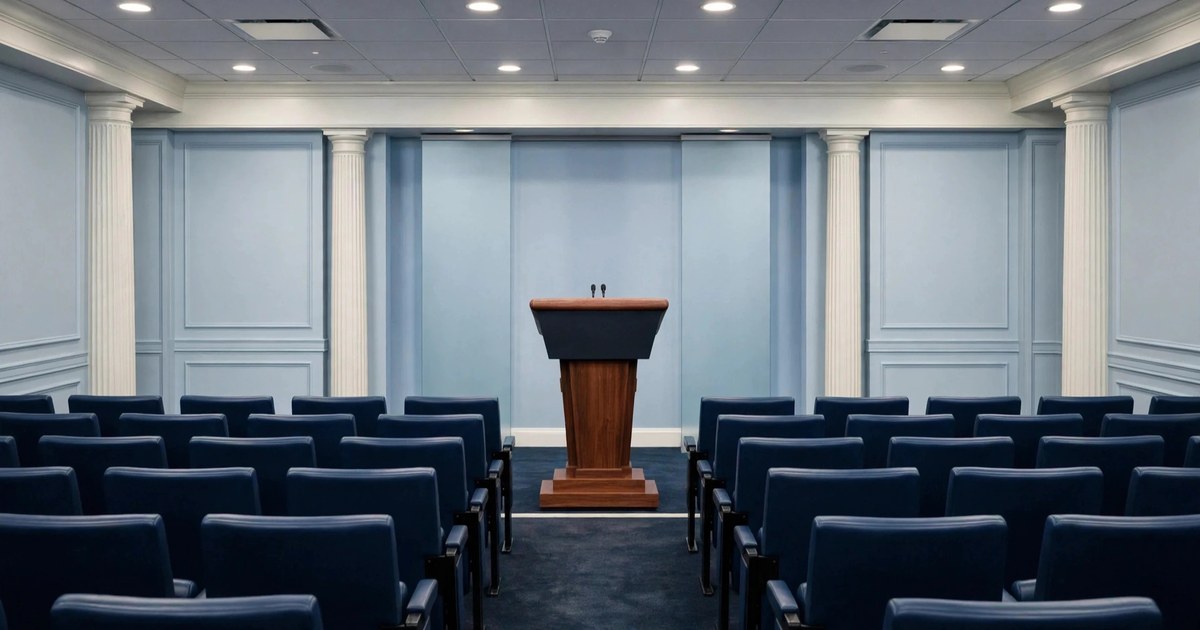
Katie Zacharia is out as White House press secretary after about five days in the job, a departure that is trending per news coverage across major American and international outlets. Her exit, confirmed on Friday 16 October 2026, ends one of the shortest tenures ever recorded for a senior White House spokesperson and closes a week in which the new press secretary herself, rather than the administration's message, became the story.
The White House described Zacharia as "transitioning out" of the role, while several news organisations, citing advisers and senior officials, reported that President Donald Trump had decided to remove her. Trump himself, speaking to reporters, framed the departure as her choice. He said he had told her she did not have to stay in the job, that he would leave the decision to her, and that he was in no rush to name a replacement. Whatever the precise label, the outcome is the same: after a single briefing, the podium has a vacancy again.
What happened on Friday
The end came quickly. On Friday morning, as Trump prepared to leave the White House for a campaign trip to Georgia, he told reporters he had spoken with Zacharia and advised her to reconsider the role. He said the media had treated her very unfairly, praised her as a loyal supporter and a good person, and added that the job might not be for her. He said they would talk again after his return, but his remarks left little doubt about where the decision was heading.
Within hours, multiple outlets reported that her tenure was over. A White House official said she was "transitioning out" of the press secretary role, and other officials indicated she was expected to move into a different role to be announced later. One report said five sources familiar with the decision had confirmed the ouster, including three senior White House officials. Another noted that Zacharia and her family were due to have dinner on Friday evening with Vice President JD Vance and his family at the vice president's residence, a detail read by many in Washington as a sign that the administration still held her in personal regard even as it ended her time at the podium.
Trump's public tone was notably sympathetic. He said he had met her family, described them warmly, and said he wanted her to have a good life rather than endure the kind of week she had just been through. He also said she had been treated roughly and nastily by the press. The gentleness of that framing stood in contrast to the abruptness of the outcome: a press secretary appointed one week, gone the next.
The briefing that set the tone
Zacharia's difficulties began almost immediately with her first briefing on Tuesday 13 October. The appearance lasted about 14 minutes, during which she read falteringly from prepared notes and took questions from only three news outlets. For a job whose core skill is fielding unscripted questions from a large and adversarial press corps, the performance drew swift and wide criticism.
There was also an awkward verbal slip during the debut appearance, when she appeared to confuse her husband with the president while speaking. On its own, a single slip would have been a footnote. Coming in a debut briefing that was already under intense scrutiny, it became part of a broader impression of unreadiness that followed her for the rest of the week.
Within the administration, the deeper problem was not one bad afternoon at the podium. According to reporting on the decision, figures inside the White House quickly began asking whether there would be a second briefing at all. A political strategist with ties to the administration put it bluntly: she had become a distraction, and in that building, nobody else is allowed to be the distraction. The first rule of the job, as one analysis put it, is simple: do not become the story. Within days, Zacharia had.
The questions about her credentials
Running alongside the briefing criticism was a second, more damaging line of scrutiny: questions about how Zacharia had described her legal background. Zacharia graduated from Pepperdine University's law school in 2011. During her first week, reporting established that she had failed the California bar exam, had never retaken it, and was not licensed to practise law.
That mattered because Zacharia had repeatedly described herself in ways that suggested she had practised law. In interviews during the week, she acknowledged the failed exam and said she had consulted lawyers about whether she could describe herself as a lawyer on the basis of her law degree. She said she had been advised she could call herself a "lawyer" but "not an attorney at law", a distinction that did not settle the controversy. In a television interview, she was pressed on the point and conceded she had failed the bar exam and never retook it.
Her defence was that the distinction should not matter for the job she held. As she put it, she was hired as White House press secretary, not as White House counsel. That is true as far as it goes: the press secretary does not need a law licence. But the episode fed a larger credibility problem. A press secretary's authority rests on the trust that what she says from the podium is accurate. Once reporters and the public began questioning the accuracy of her own biography, every future answer would have been filtered through that doubt.
Why five days is a record
Zacharia's tenure is being reported as the shortest ever for a White House press secretary. The exact count varies slightly depending on how it is measured. She was named to the role on 9 October, began work the following Monday, gave her only briefing on Tuesday 13 October, and was out by Friday 16 October. Most outlets put the stint at five days; some describe it as four and a half days of actual service.
Either way, it breaks the previous mark for short White House communications tenures. Anthony Scaramucci served ten days as White House communications director in 2017 before being fired, a stay so brief that "one Scaramucci" became Washington shorthand for a short-lived appointment. Zacharia's stay was roughly half that. The comparison is not exact, since Scaramucci held a different title, but it captures why the story travelled so widely: it reset a record many assumed would stand.
For context, other short press secretary tenures look long by comparison. Jerald terHorst served about a month under President Gerald Ford in 1974 before resigning over Ford's pardon of Richard Nixon. Jonathan Daniels served about 48 days across the Roosevelt-to-Truman transition. In Trump's first term, Sean Spicer served 182 days, Stephanie Grisham 281 days, and Kayleigh McEnany 288 days. Zacharia's five days sits apart from all of them, and the gap is the reason historians of the presidency will remember this week.
What the press secretary actually does
The White House press secretary is the administration's most visible spokesperson. The job involves briefing reporters, usually on camera, explaining the president's positions, responding to breaking news, and shaping how the day's events are covered. The press secretary also fields questions on subjects ranging from foreign policy to the president's schedule, often with little warning and no opportunity to check every fact in advance.
That is why the qualities that matter most are not oratorical flair but steadiness, accuracy, and command of detail. A press secretary who is unsure at the podium invites the press corps to test her further. A press secretary whose own background is under question invites reporters to treat every claim as a story in itself. And because the briefings are televised and clipped endlessly online, a weak debut does not fade; it becomes the clip that defines the tenure.
The job has also grown harder as the media environment has fragmented. A press secretary today answers not only the reporters in the room but also a live online audience that replays every pause and stumble. The tensions between the White House and the press corps have added another layer of friction in recent weeks. In that environment, the margin for a shaky start is close to zero, and Zacharia's first week used up all of it.
Who was Katie Zacharia?
Before the White House, Zacharia, 41, was a conservative commentator and a former spokesperson for the Department of Homeland Security. She is a mother of four. She succeeded Karoline Leavitt, who Trump said left the role to focus on her family. When Trump announced Zacharia's appointment, he praised her as a loyal and brilliant supporter from the beginning of his movement.
That loyalty was genuine, and it may have been part of the problem. Loyalty is a prized quality in a White House, but the press secretary's job requires a different skill set: the ability to absorb hostile questioning without becoming flustered, to correct the record without becoming defensive, and to project calm authority on the administration's hardest days. Loyalty alone does not supply those skills, and the vetting process is supposed to test for them before the appointment is announced, not after the first briefing has aired.
What happens next
As of Friday evening, no replacement had been named. Trump said he was in no rush to choose one, and officials said Zacharia was expected to move into another role to be announced later. That leaves the briefing room without a permanent occupant and the administration without its chief on-camera spokesperson at a moment of intense political activity ahead of the midterm elections.
The vacancy also raises a question about personnel turnover in the second Trump administration more broadly. Trump went through four press secretaries in his first term, and the communications operation has seen repeated churn. Supporters argue that the president values loyalty and acts quickly when an appointment is not working. Critics argue that the churn itself is the problem: a revolving door at the podium makes it harder to build the credibility that the job requires.
For Zacharia personally, the immediate future is uncertain but not bleak. The Friday dinner with the Vance family, and Trump's public praise, suggest she retains relationships inside the administration. Whether the other role she is said to be moving into will be senior, public, or behind the scenes remains to be seen. What is clear is that her name is now permanently attached to a record nobody seeks: the shortest press secretary tenure in White House history.
Why it matters beyond one person
It would be easy to treat this as a colourful Washington anecdote, and in one sense it is. But the episode carries three lessons that go beyond one appointment. The first is about vetting. The questions that ended Zacharia's tenure were answerable before she was appointed: a bar exam record is a matter of public record, and a debut briefing can be rehearsed. That they surfaced only after the announcement suggests a process that moved faster than its own checks.
The second lesson is about the difference between campaigning and governing. A commentator's job is to argue a case; a press secretary's job is to answer for a government. The skills overlap but are not identical, and the briefing room exposes the gap within minutes. The third lesson is about the speed of the modern news cycle. A decade ago, a struggling press secretary might have had weeks to find her footing. Zacharia had days, and arguably only one briefing, before the verdict was in.
None of that diminishes the human cost. Whatever the rights and wrongs of the appointment, a five-day tenure that ends in a blaze of public mockery is a bruising experience, and Trump himself acknowledged that she had suffered through the week. The story will be remembered in Washington as a record. For the person at its centre, it was a very long five days.
Media careers can unravel fast online too: Ethan Klein's H3 Podcast went on indefinite hiatus amid affair claims against its host.
Sources: CNN; USA TODAY; The Times; New York Post; Washington Examiner; PEOPLE; Fox News reporting on the transition.