
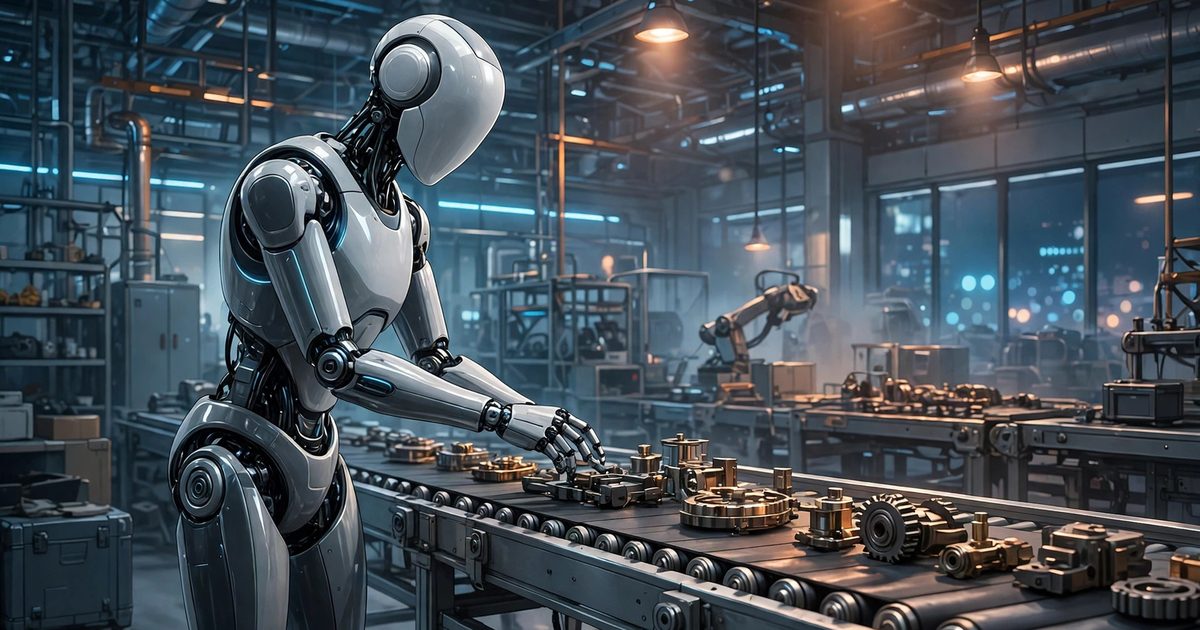
Humanoid robots in 2026 have reached an honest milestone: they work, but only at narrow jobs, only in carefully arranged places, and only for employers who can afford to babysit them. The week's news captures that moment exactly. On 26 October, Agility Robotics announced that logistics giant GXO will deploy its Digit robot at two more American facilities, while reports from the Japan Mobility Show described Toyota and Honda testing humanoids in Japanese factories. Neither story is about a robot that can do your job, clean your house, or walk into a shop and start work. Both are about machines doing one repetitive task, over and over, where everything around them has been arranged to help. That is the real state of humanoid robots in 2026: factories first, homes later — and a long way from general-purpose.
What humanoid robots are and how they work
A humanoid robot is a machine built roughly in the human body plan: a head, a torso, two arms, and usually two legs, so that in theory it can use workspaces, tools, doors, and shelves built for people. Not every machine called humanoid actually walks; some use wheels instead of legs, and the distinction matters, as Toyota's case below shows. The working loop is sense, think, act, repeated many times a second: cameras, lidar, and tactile and force sensors perceive the surroundings; artificial intelligence models interpret what they see and plan a movement; motors and actuators carry it out. Newer systems increasingly use vision-language-action models — sometimes called physical AI — that learn from demonstration and experience rather than having every movement hand-programmed in advance.
Where humanoid robots actually work in 2026
The strongest evidence comes from logistics, where the task is moving boxes. Agility Robotics' Digit has moved more than 100,000 totes at GXO's facility in Georgia, under a multi-year commercial agreement that began in June 2024 and which Agility describes as the first formal commercial deployment of a humanoid in live operations, with more than 65,000 hours of combined real-world operation claimed by the company. In February 2026, Toyota Motor Manufacturing Canada signed a commercial agreement for seven Digit robots to unload parts totes at its RAV4 plant in Woodstock, Ontario, after a year-long pilot. On 26 October 2026, Agility announced that GXO will deploy Digit at two additional American facilities, in Statesville, North Carolina and Lebanon, Tennessee, starting in early 2027, alongside three unnamed paid manufacturing customers and more than 30 prospective customers. It also disclosed more than $300 million in committed multi-year orders for its next model, Digit 5 — explicitly potential value subject to milestones, not current revenue — with early access in the first half of 2027 and general availability targeted for the end of 2027.
In car manufacturing, Figure AI's Figure 02 ran an 11-month pilot at BMW's Spartanburg plant in South Carolina, loading sheet-metal parts into welding fixtures: more than 90,000 parts, more than 1,250 runtime hours, placement accuracy above 99%, contributing to more than 30,000 BMW X3 vehicles, on 10-hour shifts. Figure 03 arrived at Spartanburg in June 2026 for logistics and sequencing work. Apptronik's Apollo is piloting at Mercedes-Benz facilities in Germany and Hungary, carrying components to assembly workers, delivering kitted totes, and supporting quality inspection; its Apollo 3 model is described as its first true commercial product, pointed at 2027 rather than available in 2026.
Boston Dynamics' electric Atlas, owned by Hyundai, is further from commercial work. In September 2026 the company opened a training centre inside Hyundai's Metaplant in Georgia, where Atlas is being trained on real parts, fixtures, and workcells, with a first job of preparing and sequencing parts for assembly lines. Component assembly is targeted by 2030. Hyundai plans 25,000 Atlas units across its plants over the next few years, with an American factory able to make up to 30,000 a year by 2028 — but those are plans and targets, not units already deployed, and Boston Dynamics still describes Atlas as in development, giving no deployed unit count. Tesla's Optimus follows a similar pattern: the company said on its first-quarter 2026 earnings call that it would begin Optimus production at Fremont in the second quarter of 2026, with a Texas facility targeting 10 million units a year in long-term capacity. Those are capacity targets and production-start plans, not confirmed output or external sales, and unverified secondary claims about thousands of units already working should not be treated as fact.
What humanoid robots cannot do yet
The limits are as informative as the successes. In narrow, structured settings, humanoids can walk on flat surfaces, navigate obstacles, pick and place objects, follow verbal commands, and repeat manufacturing and logistics tasks. What they cannot yet do reliably is fine dexterity at speed: hammering nails, threading, handling flexible materials, wiring harnesses at production speed, or watch and jewellery work. They struggle in cluttered, unpredictable, or outdoor environments, with novel problem-solving and common-sense judgement, and with sustained general work in homes without human teleoperation or supervision. Battery life is commonly reported at two to four hours per charge across models, mitigated in pilots by swappable packs and charging rotations.
The Beijing World Humanoid Robot Games in August 2026 illustrated both sides at once. Tiangong Ultra ran 100 metres in 8.64 seconds in the final, faster than Usain Bolt's 9.58-second human world record, under robot-class competition rules. The same event exposed failures: crashes, falls, dropped barbells, missed balls, and robots unable to hammer nails or fold laundry reliably. Sprint speed is athletic peak performance, not work capability — and the gap between the two is the story of humanoid robotics in 2026. Researchers quoted in June 2026 put it plainly: even in relatively structured settings, humanoids still face problems with reliability, speed, safety, cost, and recovery from unexpected situations, and mass rollout is unlikely soon because they are not yet more efficient or less error-prone than current manufacturing methods.
Humanoid robots 2026: what Toyota is actually doing
No company better illustrates the gap between headlines and evidence than Toyota, so its record deserves a careful check. Toyota is testing humanoid-type robots in its Japanese factories, and it is already using other companies' humanoids — but it has no verified commercial humanoid robot for sale in 2026.
The history is research, not product. Toyota revealed its third-generation humanoid, T-HR3, in November 2017: a teleoperated platform that mirrored an operator's movements, intended to explore safe physical interaction for homes, medical care, construction, disaster response, and space. It was a research platform, and Toyota stated no immediate plans to sell it. In August 2025, Boston Dynamics and Toyota Research Institute demonstrated a large behaviour model powering Atlas for autonomous whole-body manipulation — packing, sorting, and organising, adapting when a box lid was closed mid-task — under a joint research partnership begun in October 2024. Atlas is Boston Dynamics' robot; Toyota's role is AI research partnership, not ownership of Atlas as a Toyota product. In April 2026, Toyota's basketball humanoid CUE7 debuted at Toyota Arena Tokyo, dribbling and moving around the court as well as shooting: a demonstration and entertainment platform whose technology may one day shape other work, not an industrial product.
The current factory story comes from trade-press reporting, not a Toyota product launch. Automotive News reported in October 2026 that Toyota and Honda are trialling humanoids in Japanese factories, on tasks from wire-harness installation to final inspection, with machines shown at the Japan Mobility Show. Toyota's ELEY system is described as battery-powered, wheeled, about 50 kilograms, built in-house: it picks parts from boxes, places them, folds fabric, and learns from workers wearing finger-shaped attachments modelled on its hands. Toyota says humanoids will be added as factories are upgraded and will work alongside people, not replace them. Two cautions apply: ELEY is wheeled, so it must not be described as a walking bipedal factory robot, and no Toyota press release confirming ELEY by name, with a price, production volume, or launch date, was found in this research.
Two further corrections matter. First, Toyota as a customer: the seven Digit robots at its Canadian RAV4 plant prove Toyota is deploying humanoids in a real plant — via Agility, not via its own robot. Second, the widely repeated "400,000 robots" figure: starting in 2028, Toyota plans to operate up to 400,000 robots of all kinds, including about 150,000 at its headquarters plants. That is a total-automation figure, not 400,000 humanoids, and any headline claiming otherwise misstates the source. Honda offers a useful contrast: it retired its ASIMO humanoid in 2022, is focusing on dexterous hands rather than walking robots, plans large-scale testing at Yorii starting with sorting incoming parts, aims to sell the technology in the early 2030s, and its chief executive has said Honda is "very far" from humanoids working throughout a factory.
Can you buy a humanoid robot in 2026?
For most people, the honest answer is: not a useful one. Unitree of China sells research and education platforms — the G1 listed at $13,500, the H2 at $29,900, and the R1 Air from $4,900 — but the base G1 is a research platform, not a turnkey factory or home worker. The Norwegian-American company 1X opened pre-orders for its NEO home robot at $20,000 outright or $499 a month, with United States deliveries in 2026 and other markets from 2027 according to the company; early units still depend on human teleoperators for tasks the robot's own policy cannot complete, and the scale of deliveries in October 2026 is unverified from a primary company source. Figure, Atlas, Optimus, and Digit have no public consumer price or order page. In Australia, guides updated in October 2026 report no home-helper humanoid on sale, with Unitree resellers serving research buyers only. The market in 2026 is therefore split: research platforms you can buy, pilots you can watch, and consumer products still mostly promised.
How humanoid robots could affect future jobs
The jobs question needs the same discipline as the technology question. The credible research position is task automation first, not occupation erasure. Associate Professor Oliver Obst of the University of New South Wales, quoted in June 2026, argued that humanoids are unlikely to see mass rollout soon because they are not yet more efficient or less error-prone than current methods, that "we are much closer to the selective automation of some tasks" than to mass replacement, and that repetitive physical work in structured environments is most at risk. A May 2026 report counted an estimated 49,135 United States layoffs in 2026 attributed to AI in general — that figure covers AI broadly and must not be attributed to humanoid robots. Forecasts cited second-hand, such as a Barclays view of a first wave through 2030 in manufacturing, logistics, agriculture, and construction followed by a post-2030 wave into healthcare, elderly care, education, and hospitality, are forecasts, not measured outcomes. What the evidence supports today is narrower: some repetitive tasks in structured workplaces will increasingly be done by machines, while whole occupations change more slowly, and the workers most affected will be those doing the most repetitive physical work in the most structured settings.
Humanoid robots in 2026 are best understood as a technology crossing from demonstration to deployment — but only for narrow tasks, only in prepared environments, and only where an employer has done the hard work of fitting the workplace to the machine. Digit moving totes, Figure loading fixtures, Apollo kitting parts, and Atlas learning to sequence components are real achievements, and they justify attention. They do not justify claims that general-purpose robots are here, that Toyota sells a humanoid, or that mass job replacement is imminent. The factories are first. The homes are later. And the difference between a target and a deployment — between 400,000 robots of all kinds and 400,000 humanoids, between a production-start plan and a product on sale — is where honest reporting lives.
Evidence note: this article reflects developments verified as of 26 October 2026. Several figures cited are company targets, plans, or trade-press reports rather than independently verified deployments, and are labelled as such in the text.
Sources: Agility Robotics via GlobeNewswire (26 Oct 2026); Automotive News (19 Oct 2026, updated 22 Oct 2026) via TradingView / Seeking Alpha summary (26 Oct 2026); SiliconReport on Financial Times Toyota coverage (26 Oct 2026); Toyota Global Newsroom on T-HR3 (21 Nov 2017); Toyota USA Newsroom on TRI–Boston Dynamics Atlas research (20 Aug 2025); Toyota Times / DEMM on CUE7 (Apr–Jun 2026); The Robot Report on Tesla Optimus (22 Apr 2026); ValueAddVC Figure AI deep-dive; TechTimes (13 Oct 2026); Robotica Guide price check (19 Oct 2026); Cointelegraph researcher interviews (3 Jun 2026, updated 10 Jun 2026); World Humanoid Robot Games summary (Aug 2026); Jalopnik Japan Mobility Show summary; Aju Press on Atlas hand (2 Oct 2026); Mitsubishi Electric announcement via OpenPR (21–23 Oct 2026). Full links: https://www.globenewswire.com/news-release/2026/10/26/3388115/0/en/agility-robotics-highlights-commercial-momentum-and-growing-enterprise-demand-for-digit-humanoid-robot.html · https://www.autonews.com/toyota/an-toyota-honda-humanoid-robots-ai-eley-avatar-1019/ · https://www.tradingview.com/news/seekingalpha:743b6faa4094b:0-toyota-and-honda-test-humanoid-robots-in-japanese-factories/ · https://www.siliconreport.com/toyota-plans-to-deploy-400-000-robots-in-6-4b-annual-push-ft-reports · https://global.toyota/en/newsroom/corporate/19841525.html · https://pressroom.toyota.com/ai-powered-robot-by-boston-dynamics-and-toyota-research-institute-takes-a-key-step-towards-general-purpose-humanoids/ · https://www.therobotreport.com/from-evs-to-robotics-tesla-targets-10m-optimus-units-with-new-texas-plant/ · https://cointelegraph.com/news/ai-humanoid-robots-years-away-from-replacing-human-workers · https://www.roboticaguide.com/best-humanoid-robots-2026/ · https://www.ajupress.com/view/20261002102642532
Related reading: Waymo Picks Toronto for Its First Canadian Robotaxi Service · Elon Musk Says a Tesla–SpaceX Merger Could Work. Here's What It Would Mean · OpenAI's AI Discovers New Math Results: What It Really Means