
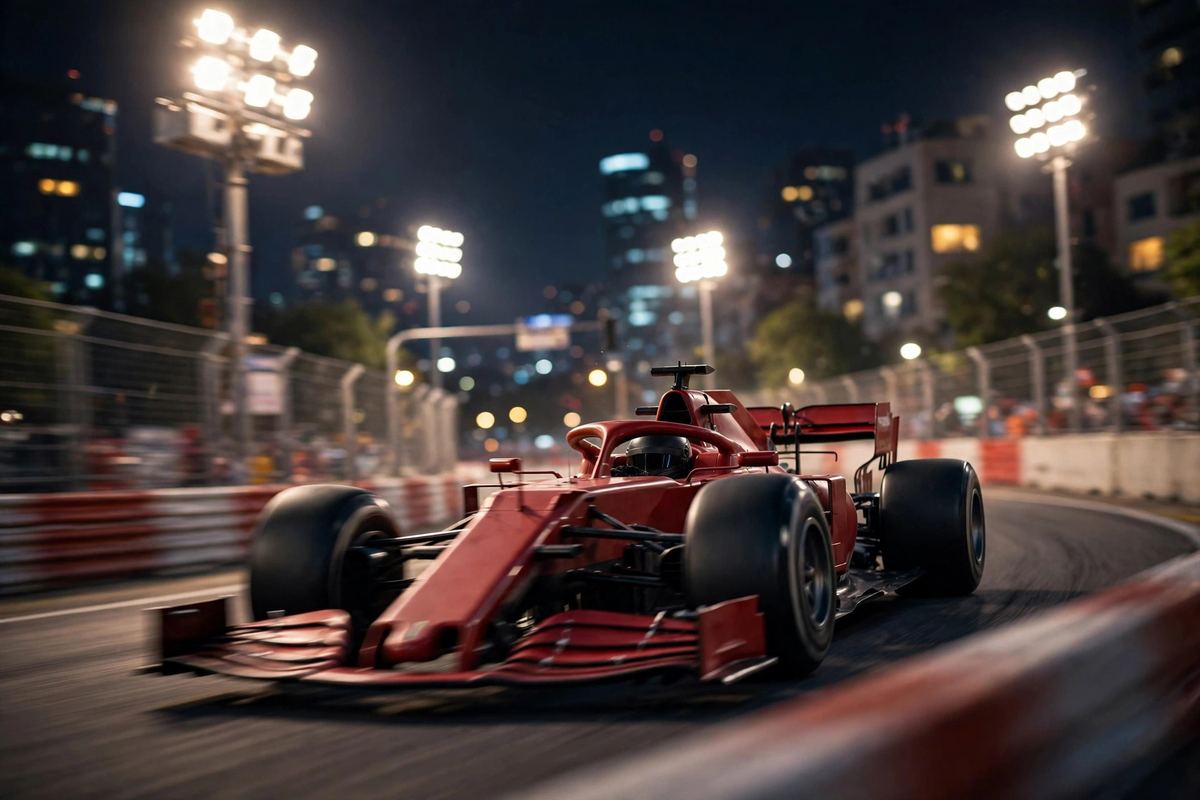
The Singapore Grand Prix weekend of 10 October 2026 delivered one of the most dramatic Saturdays Formula 1 has seen in years. Max Verstappen won a rain-soaked sprint race that saw nine cars retire, and then, only hours later, took pole position for the Grand Prix at the Marina Bay Street Circuit. It was the first Singapore pole of his career at a track where he has never won — and it came at the end of a day that began with torrential tropical rain and ended under the floodlights with the championship fight tighter than ever. Here is everything you need to know, from what a sprint weekend actually is to what this means for the title race.
A sprint weekend, explained
A Formula 1 sprint weekend changes the normal rhythm of a Grand Prix. Instead of the usual three practice sessions, the schedule is compressed and a shorter race — the sprint — is added to Saturday. The sprint covers roughly 100 kilometres, about a third of a full Grand Prix distance, and it has its own qualifying session to set the sprint grid. Points are awarded to the top eight finishers: eight for the winner, seven for second, six for third, and so on down to one point for eighth place. Crucially, the sprint is a standalone contest — its result does not set the grid for Sunday's Grand Prix. That job is done by a separate, full-length Grand Prix qualifying session, which happens after the sprint. Regulations require at least three hours between the sprint and Grand Prix qualifying, which became important in Singapore: because the sprint started more than 30 minutes late after heavy rain, qualifying had to be pushed back by 30 minutes as well.
Why Marina Bay is special
The Marina Bay Street Circuit is one of the most distinctive venues on the Formula 1 calendar. It was the sport's first night race when it debuted in 2008, and the race is run entirely under floodlights, with more than 1,500 lamps illuminating the circuit. It is a true street circuit, threading between the walls of downtown Singapore at roughly 5 kilometres per lap, with tight corners, bumpy surfaces and almost no margin for error. It is also one of the most physically demanding races of the season: in tropical heat and humidity, drivers lose several kilograms of sweat over a race that regularly runs close to the two-hour time limit, even though the distance is shorter than many other Grands Prix. Overtaking is notoriously difficult because the circuit is narrow and twisty, which makes qualifying position especially valuable — starting near the front is half the battle. For Verstappen, Marina Bay has been a personal bogey track: before 10 October 2026, he had never won the Singapore Grand Prix, one of the few circuits on the calendar to elude him. Taking pole there for the first time was a significant milestone in itself.
The sprint: rain, crashes and nine retirements
The day began with the one thing a street circuit night race does not want: heavy tropical rain. So much water fell on Marina Bay before the sprint that the start was delayed by more than 30 minutes while officials waited for conditions to improve. When the race finally got underway, every driver started on intermediate tyres — the green-marked wet-weather tyres designed for a damp or drying track that is too wet for slicks but not flooded enough for full wet tyres. On a street circuit with walls on every corner, a wet start is about survival as much as speed. Verstappen had started from sprint pole but lost the lead on the very first lap to George Russell, who made the decisive move immediately. Russell's joy was short-lived: he later crashed out at the final corner, ending his sprint and handing the advantage back to Verstappen, who controlled the race from there to take the win. Lewis Hamilton finished second and Charles Leclerc third. The biggest drama came behind them: McLaren teammates Lando Norris and Oscar Piastri collided on the final lap. Piastri retired from the race, and Norris limped home in eighth — still scoring a single point. Rookie Kimi Antonelli inherited fourth place. In total, nine cars retired from the sprint, setting a new record for retirements in a Formula 1 sprint race. A wet street circuit with 20 cars fighting for position proved just as chaotic as it sounds.
Qualifying: Verstappen's first Singapore pole
After the required three-hour gap, Grand Prix qualifying finally began, 30 minutes later than originally scheduled. Once again, Verstappen was the man to beat. He secured pole position for the Singapore Grand Prix with a lap of 1:31.373 — his first pole at Marina Bay. Charles Leclerc was second with 1:31.427, just over five hundredths of a second behind, and Lewis Hamilton was third with 1:31.496. Kimi Antonelli continued his strong day in fourth, Lando Norris recovered from his sprint collision to take fifth, and George Russell — despite his sprint crash — qualified sixth. The gaps at the front were tiny, with the top three separated by little more than a tenth of a second, which is remarkable on a long, technical street circuit. For Verstappen, the pole carried extra meaning: Singapore had been one of the few circuits where he had never taken pole or won a Grand Prix, and conquering qualifying there on a day when he had already survived the wet sprint was a statement of intent ahead of Sunday.
Why it matters
A sprint weekend offers drivers two chances to score in a single weekend, and Verstappen maximised both. Winning the sprint earned him eight points, and pole position gives him the best possible starting slot for the Grand Prix, where points are awarded on the usual 25-for-the-win scale. Every point matters in a championship fight, and collecting the maximum available on Saturday is exactly what title contenders must do. The day was also revealing about his rivals: the McLaren collision between Norris and Piastri cost the team dearly — Piastri scored nothing and Norris salvaged only a single point from a sprint that should have been a strong one for them. Hamilton and Leclerc, meanwhile, quietly banked strong results in both the sprint and qualifying, keeping themselves in the conversation. And then there is the Singapore factor. Verstappen has dominated modern Formula 1, but Marina Bay had remained the one place that resisted him — until Saturday. Breaking that drought at the qualifying stage, in the wet and the dry, on the same day, suggests that the final piece of the jigsaw may finally be falling into place.
Key facts at a glance
The sprint was delayed by more than 30 minutes because of heavy pre-race rain, with all 20 drivers starting on intermediate tyres. George Russell overtook polesitter Verstappen on lap 1 but crashed out at the final corner. Verstappen won the sprint ahead of Lewis Hamilton and Charles Leclerc, with Kimi Antonelli fourth after McLaren's Lando Norris and Oscar Piastri collided on the final lap — Piastri retired and Norris finished eighth for one point. Nine cars retired in total, a sprint-race record. In qualifying, delayed 30 minutes by the mandatory three-hour gap after the sprint, Verstappen took pole with 1:31.373, his first Singapore pole at a circuit he has never won at. Leclerc was second at 1:31.427 and Hamilton third at 1:31.496, with Antonelli fourth, Norris fifth and Russell sixth.
What happens next
Sunday completed the weekend. On 11 October 2026, Verstappen won the Singapore Grand Prix from pole, leading all 62 laps and finishing 7.335 seconds ahead of Charles Leclerc, with Kimi Antonelli third. It was his first Singapore Grand Prix victory, his 73rd career win, in his 250th Grand Prix start and from the 50th pole position of his career. Added to Saturday's sprint win and sprint pole, it completed a clean sweep: pole and victory in both the sprint and the Grand Prix. The wider Formula 1 map is shifting too — the sport is heading back to Africa under a 10-year Rwanda Grand Prix deal.