
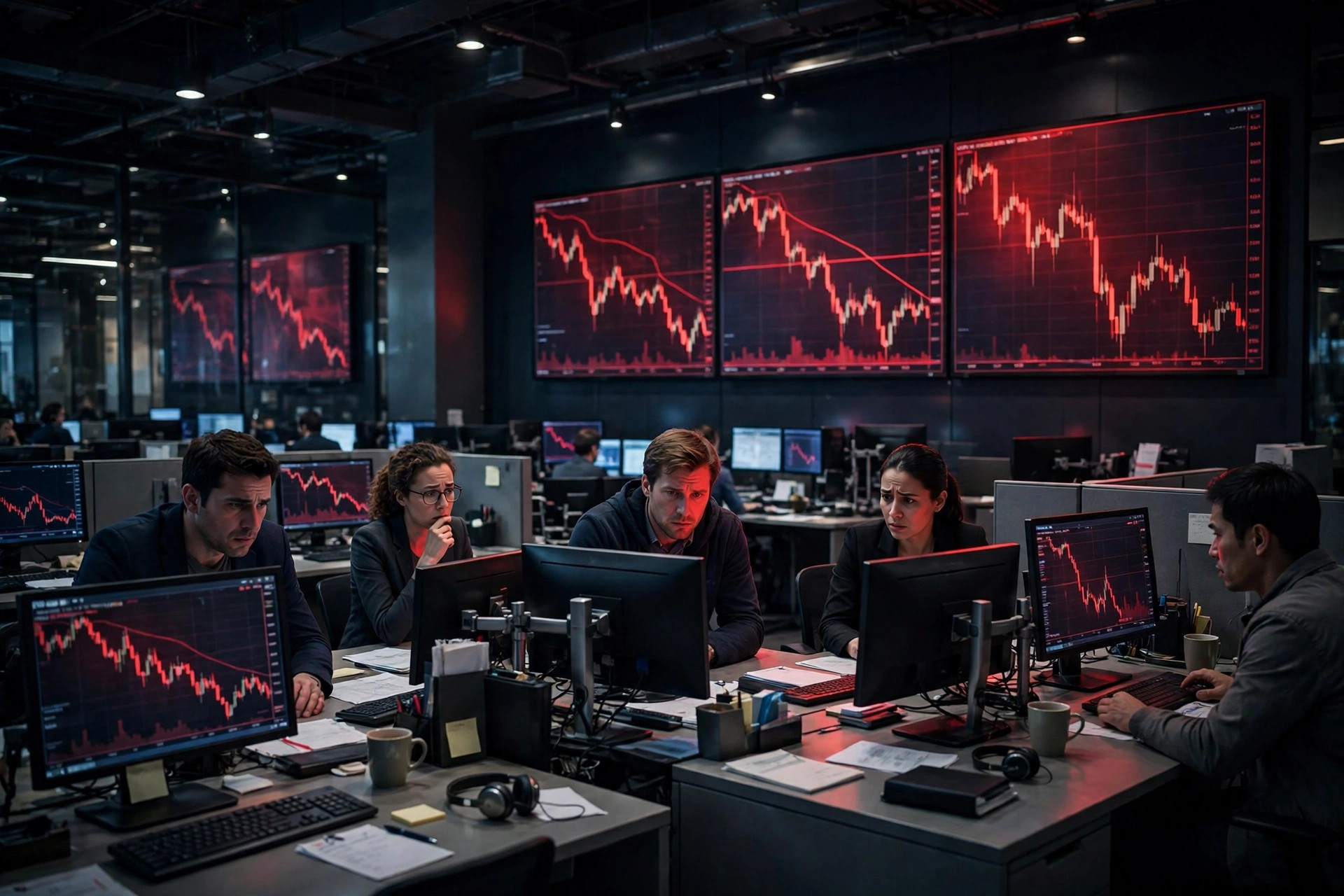
The Dow Jones falls November 20 story is the one investors will remember from a brutal week on Wall Street. On Friday, November 20, 2026, the Dow Jones Industrial Average dropped 949.73 points, or 1.93%, to close at 48,147.33, as a sell-off in artificial intelligence stocks gathered speed and dragged the whole market down with it. The S&P 500 fell 3.70% to 6,910.39, and the Nasdaq Composite tumbled 5.28% to 22,617.73, erasing its gains for the year. By the closing bell, both the Dow and the S&P 500 had fallen more than 10% from their recent highs, the textbook definition of a market correction. The trigger was a reported SEC accounting inquiry into Nvidia, the chipmaker at the centre of the AI boom, and the selling spread from there. This article explains what happened on Friday, why it happened, what a correction actually means, and what investors should watch next.
Dow Jones Falls November 20: What the Numbers Show
The closing numbers on Friday, November 20, 2026, were stark, and they are worth stating plainly because they come from the market closes reported by the Wall Street Journal and the Associated Press. The Dow Jones Industrial Average finished at 48,147.33, down 949.73 points, or 1.93%, on the day. The S&P 500 closed at 6,910.39, down 3.70%, or 265.44 points. The Nasdaq Composite closed at 22,617.73, down 5.28%, or 1,261.47 points, in a single session, which Investopedia described as the second-largest one-day points drop in the history of the tech-heavy index. The Nasdaq's fall wiped out its gains for 2026 entirely, leaving it in negative territory for the year.
Friday was not a one-day event. It was the fifth straight losing session for the Dow, which closed at roughly a seven-month low, and the seventh straight daily decline for the S&P 500, its longest losing run since February 2020, according to the Motley Fool. The week as a whole was punishing: the Dow fell 8.0% over the week, the S&P 500 declined 8.6%, and the Nasdaq tumbled 10.0%, the worst week for the market since April 2025, figures reported by Investopedia. For the Dow, the five-session slide carried it more than 10% below its August record close, which is what put it in correction territory alongside the S&P 500. The Nasdaq, which is made up largely of technology stocks, fell further still, and the Associated Press noted that it ended the day near bear-market territory, the label markets use when an index sits close to 20% below its peak.
Individual stocks told the same story. Nvidia, the AI chipmaker whose shares anchor much of the market's recent rally, fell 14.01% to $125.53 after a reported SEC accounting inquiry, its seventh straight loss, breaking below its 52-week low. Broadcom fell 12.2% on unconfirmed reports that Google will cut its chip shipments next year. Anthropic, the AI company that had gone public only the day before, fell 8.5% to $88.91 on its second day of trading. The selling ran through the whole chip sector: AMD fell 13.3%, Micron fell 13.9%, and the Philadelphia Semiconductor Index dropped 10.7%. The Russell 2000 index of smaller companies fell 2.76% to 2,581.79. When the names most associated with the AI boom all fall sharply on the same day, the market is sending a message about the trade itself, not about any single company.
Why Nvidia Led the Sell-Off
Nvidia sits at the centre of this story because it sits at the centre of the AI trade. The company's chips power the data centres that train and run AI systems, and its share price had become a shorthand for confidence in the whole AI boom. Reuters first reported that SEC enforcement staff are examining Nvidia's accounting treatment, and the Wall Street Journal reported the inquiry on Tuesday, November 17. The SEC declined to comment, and there is no evidence of wrongdoing. Investors did not wait for detail. The stock fell 14.01% in a single session, its seventh straight loss, breaking below its 52-week low, and the Wall Street Journal's market coverage recorded the 14.01% fall to $125.53 at the close.
The fall did not come from nowhere. Nvidia's shares have lost about one-third of their value over the past two weeks, according to Investopedia, as investors reassess the impact of Jensen Huang's departure from the chief executive post. Huang's resignation, covered in our report on Nvidia's Q3 earnings, removed the leader most associated with the company's rise, and the market has been repricing the stock ever since. The reported SEC inquiry added a new, specific worry on top of that uncertainty: not just whether AI spending will keep growing, but whether the numbers behind the boom's leading company will stand up to scrutiny. Neither the SEC nor Nvidia has confirmed the substance of the reports, the SEC has declined to comment, and there is no evidence of wrongdoing. What matters for the market is that the report was enough to break the confidence that had held Nvidia's price up.
Broadcom's 12.2% fall followed a similar pattern. The chipmaker dropped on unconfirmed reports that Google, one of its biggest customers, will cut chip shipments next year. The reports are unconfirmed, and that distinction matters: the market sold first on the possibility that a major AI customer is pulling back on orders. Anthropic's 8.5% fall to $88.91 on its second day as a public company completed the picture. The company had listed on Thursday to enormous attention, and its slide on Friday showed that even the newest and most celebrated AI name could not escape the selling. When the market turns on the theme itself, individual stories stop mattering for a day.
What a Correction Means — and What It Does Not
The word "correction" gets used loosely in market coverage, so it is worth pinning down. A correction means an index has fallen at least 10% from its most recent high. Both the Dow and the S&P 500 crossed that line on Friday, November 20, 2026, each ending the day more than 10% below its recent record close, according to Reuters. A bear market is the next line: a fall of 20% or more from the peak. The Nasdaq ended Friday near bear-market territory, which means it has fallen close to, but not yet reached, that 20% mark. These labels describe how far prices have fallen. They say nothing, by themselves, about how far prices will fall next.
Corrections are common, and that is the part of the story that often gets lost on a day when screens are red. Markets that rise for years routinely fall 10% or more along the way, and many corrections end without becoming bear markets. What makes this one different is its speed and its cause. The Dow gave up 8.0% in a single week, the worst week for the market since April 2025, and the selling was concentrated in the very stocks that had led the market higher: AI chipmakers, AI software companies, and the newly listed Anthropic. This was not a broad economic scare. It was a repricing of one theme, the AI trade, after months in which investors had paid ever-higher prices for it.
The other side of the coin is that the selling spread beyond technology by Friday. The Dow, which holds banks, healthcare companies, industrials and consumer names alongside Nvidia, still fell nearly 1,000 points. That spread is what turns a sector rotation into a market event. When investors sell the leaders and then sell the rest as well, it usually means they are raising cash, reducing risk, or both. It does not mean the economy has changed overnight. No major economic data release drove Friday's fall. The drivers were the Nvidia report, the Broadcom report, and the momentum of a week of selling that had already taken the Dow below 50,000 on Thursday for the first time since June.
Why the AI Trade Unwound
To understand Friday, it helps to remember what the AI trade was. For much of 2025 and 2026, investors bought AI stocks on a simple story: demand for AI computing would keep growing, the companies building it would keep earning more, and the share prices would follow. That story carried the Nasdaq to record highs and pulled the Dow and the S&P 500 up with it. It also carried valuations to levels where any doubt about the story would hurt. When a stock is priced for years of rapid growth, even a small change in expectations can mean a large fall in price.
Three doubts arrived at once. First, the reports about Nvidia's accounting raised questions about the leading AI company itself. Second, the unconfirmed reports about Google cutting Broadcom chip shipments raised questions about whether the biggest AI buyers are slowing their spending. Third, the market had already been falling for a week, and each day of losses made the next day's selling easier, as investors who had bought on the way up decided to protect what was left of their gains. The Anthropic listing, which many had hoped would revive confidence in AI stocks, did the opposite: the stock fell on its second day, and the disappointment added to the selling.
None of this means the AI boom is over. Companies are still building data centres, and demand for AI computing has not vanished in a week. What Friday showed is that the market is no longer willing to pay any price for AI growth. Investors are now asking harder questions: how much are these companies actually earning, how fast is spending really growing, and what happens if the biggest customers slow down. Those are reasonable questions. They are also the questions that should have been asked earlier, when prices were still rising. Markets often ask them all at once, and when they do, the answer arrives as a week like this one.
Dow Jones Falls November 20: What Happens Next
The first thing to watch is Nvidia. If the reported SEC inquiry is confirmed, or if Nvidia responds in detail, the stock will move on that news, and the rest of the AI trade will move with it. If the reports fade without confirmation, the selling pressure may ease, though the stock's one-third fall over two weeks suggests confidence will take time to rebuild. The second thing to watch is the chip supply chain: any confirmation or denial from Google or Broadcom about next year's chip shipments will matter to every chipmaker, not just Broadcom.
The third thing to watch is the Federal Reserve. Minutes from the Fed's latest meeting had already put a half-point December rate rise on the table, as covered in our report on the Dow's third straight daily fall, and interest-rate expectations shape how investors value growth stocks. Higher rates make future earnings worth less today, which hits fast-growing technology companies hardest. Any signal from the Fed about December will land in a market that is already nervous.
For ordinary investors, the practical lesson of Friday is unglamorous: corrections are the price of owning shares, and the worst decisions in a correction are usually the rushed ones. The Dow has fallen 10% from its high, the Nasdaq has given up its gains for the year, and the AI trade that drove the market is being repriced in public. What happens next depends on facts that are not yet known — the SEC reports, chip orders, and the Fed's December decision. Until those facts arrive, the market will keep doing what it did on Friday: selling first and asking questions later. Readers who want the context for the week's earlier falls can read our coverage of the Dow's third straight daily decline and of the earlier sell-off, and those following the AI listing boom can read our report on Anthropic's market debut.
Sources: Wall Street Journal, Associated Press (via FinChannel), Investopedia, Motley Fool, Morningstar, November 2026.