
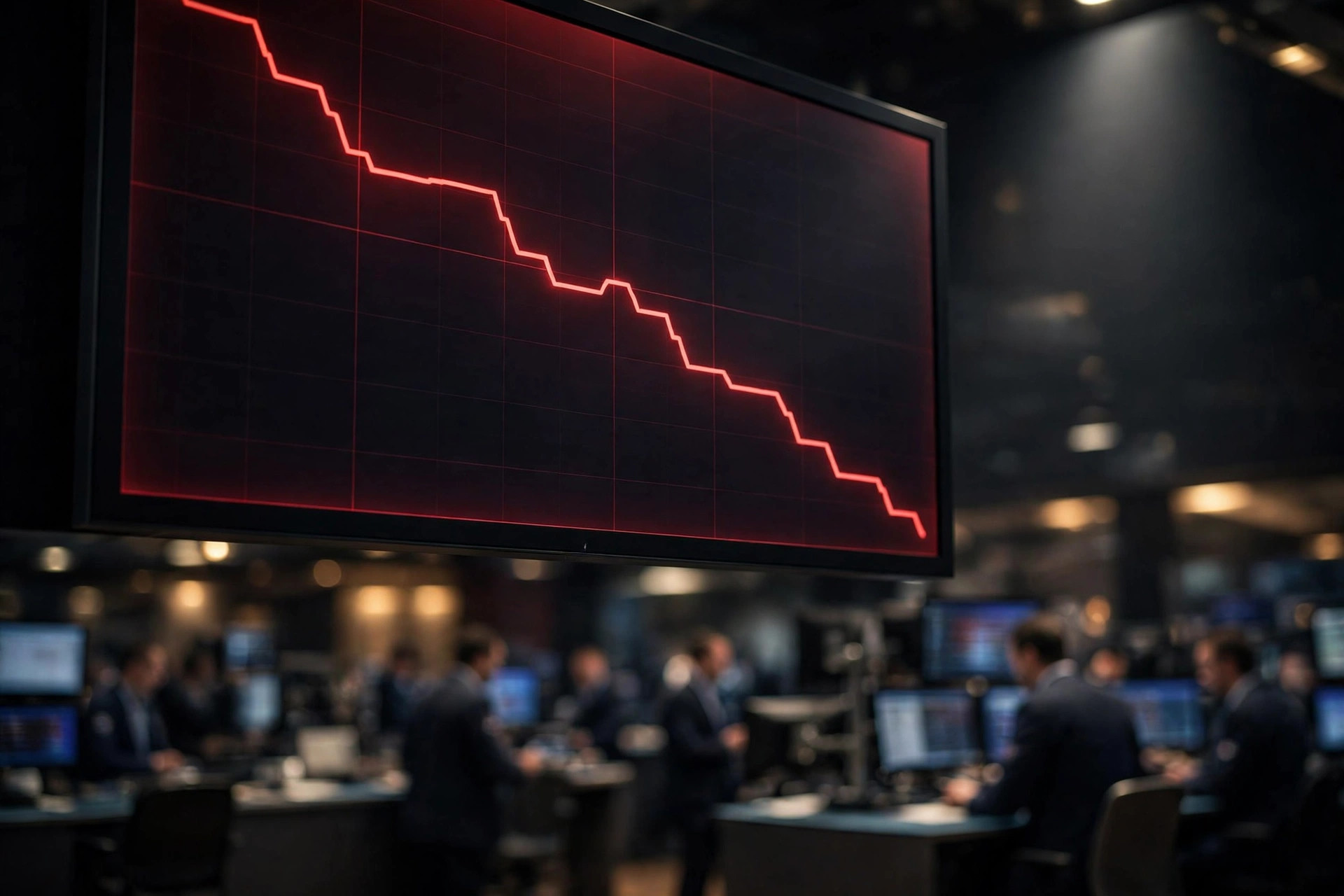
Dow falls for a third straight day: that is the plain summary of Wednesday 18 November on Wall Street, and the numbers behind it are sharp. The Dow Jones Industrial Average fell 561.25 points, a drop of 1.11%, to close at 50,198.17, according to final closes reported by InvestingLive on 18 November. It was the third straight daily fall for the Dow, and it followed a fall of about 849 points on Tuesday, leaving the index down roughly 2,100 points over the three sessions. The S&P 500 slipped 0.24% to 7,322.53, its fifth straight loss, while the Nasdaq Composite rose 0.39% to 24,429.89. The split between the Dow and the Nasdaq is the first thing to understand about the day: the market did not fall across the board, and the reason it split lies in the document that landed at 2:00 p.m. ET — the minutes of the Federal Reserve's 27–28 October meeting. Some early reports carried preliminary Reuters figures of a 566.39-point fall to 50,193.03, but the final closes above are the figures to use, and this article uses them throughout.
Dow falls: what the final numbers show
The Dow falls described in the final closes are the third in a row, and the scale of the three-day slide is what gives the day its weight. Wednesday's fall of 561.25 points to 50,198.17 came after Tuesday's fall of about 849 points, and the two days together with Monday's fall add up to roughly 2,100 points over three sessions, according to the market research. The S&P 500, which slipped 0.24% to 7,322.53, recorded its fifth straight loss, so the weakness in the broader market is not a one-day event. The Nasdaq Composite, up 0.39% to 24,429.89, moved the other way, and that contrast is part of the story rather than a footnote. Nvidia, the stock that has come to stand for the market's enthusiasm for artificial intelligence, jumped as much as 2.7% early in the session on its $115.8 billion quarter, then closed down 2.89% at $150.96. That reversal — a strong early rise on a very large revenue figure, followed by a close lower on the day — captures the mood of the session: even good news about a single company could not hold against the wider worry about interest rates. The 10-year Treasury yield ended at 5.07%, down from 5.10% on Tuesday, and gold stood near $3,700, according to XTB. Those two figures sit alongside the stock moves as part of the same picture of a market repricing what the Fed might do next.
Why the Dow falls while the Nasdaq rose
The Dow falls and the Nasdaq rises on the same day because the two indexes hold different kinds of companies, and the Fed minutes hit those kinds of companies differently. The Dow is weighted towards older industrial, financial and consumer companies whose borrowing costs and whose customers' spending respond quickly to the prospect of higher interest rates. The Nasdaq is weighted towards technology companies, and on Wednesday it was helped by the early strength in Nvidia, even though Nvidia itself gave up its gains and closed down 2.89% at $150.96. The S&P 500, which sits between the two and covers the broad market, slipped 0.24% to 7,322.53 for its fifth straight loss, which shows that the weakness was broad even if it was not universal. The trigger was the same for all three indexes: the minutes of the Federal Reserve's 27–28 October meeting, released at 2:00 p.m. ET on Wednesday. When minutes suggest that rates may rise further, and by more than the market had assumed, the companies most exposed to borrowing costs fall first, and the Dow, with its weight of rate-sensitive names, fell furthest. The Nasdaq's rise of 0.39% to 24,429.89 does not mean technology escaped the worry; it means the balance of the day's trading in those names still ended higher, helped by the early Nvidia move on its $115.8 billion quarter. The three-day Dow slide of roughly 2,100 points, including Tuesday's fall of about 849 points, shows that the pressure had been building before the minutes arrived, and the minutes gave it a fresh reason to continue.
What the Fed minutes actually said
The minutes of the Federal Reserve's 27–28 October meeting, released at 2:00 p.m. ET on Wednesday, said that almost all officials judged further rate increases would likely be appropriate. That is the central sentence of the document, and it is the sentence that moved the market. A few officials argued that a move larger than 25 basis points could be warranted in December if incoming inflation data proved unfavourable. A basis point is one hundredth of a percentage point, so 25 basis points is a quarter of a percentage point and 50 basis points is half a percentage point. The minutes therefore put two possibilities on the table for December: the quarter-point rise the market had largely assumed, and a half-point rise if the inflation data comes in badly. The Fed held its target range at 3.75–4.00% in October, with a vote of 10–2, and the two dissenters were Lisa Cook and Beth Hammack, who dissented in favour of a hike. That vote is worth reading carefully: the two dissenters wanted a rise at the October meeting itself, while the majority held rates steady, and the minutes now show that almost all officials thought further increases would likely be appropriate. Inflation stood at 3.6%, and October CPI rose 0.4% overall and 0.3% on the core measure, which strips out food and energy. Those inflation figures are the data the minutes point to: if incoming inflation data proves unfavourable, the case for a larger December move grows stronger, and that conditional wording is what traders spent Wednesday afternoon pricing in.
The half-point question: 25 or 50 basis points in December?
The question the market is now asking is whether the Fed raises rates by 25 basis points or by 50 basis points at its meeting on 9 December. Fed Governor Christopher Waller said the bank may need to "shock people" with a half-point hike, and he told CNBC that a 50-basis-point hike is "probably" needed in December. That is a direct statement from a Fed governor, and it carries weight because Waller is speaking about the December meeting by name. The pricing before the minutes told a different story: CME FedWatch pricing cited on 17 November put a 92% chance on a 25-basis-point hike on 9 December and 8% on a 50-basis-point hike, and markets assigned about a 95% probability to a quarter-point December hike. The gap between that pricing and Waller's words is the tension in the market now. The minutes add a conditional case for the larger move — a few officials argued a move larger than 25 basis points could be warranted in December if incoming inflation data proved unfavourable — while Waller goes further and says the half-point hike is "probably" needed. The next piece of evidence is the November CPI, due on 10 December, the day after the Fed decision, which means the Fed will decide on 9 December with the October CPI figures — up 0.4% overall and 0.3% core, with inflation at 3.6% — as its latest hard data. The Dow falls on Wednesday show how the market reacts when the expected path for rates shifts upwards, even by a quarter of a percentage point.
Inflation, the vote, and the October meeting
The October meeting that the minutes describe ended with the Fed holding its target range at 3.75–4.00%, on a vote of 10–2. Lisa Cook and Beth Hammack dissented in favour of a hike, which means they wanted rates to rise at that meeting rather than stay where they were. The minutes show that their view was not isolated: almost all officials judged that further rate increases would likely be appropriate, so the majority that voted to hold in October still expected rises to follow. Inflation stood at 3.6%, and the October CPI rose 0.4% overall and 0.3% on the core measure. Those are the figures the officials were looking at when they met on 27–28 October, and they are the figures that sit behind the conditional language about December. If inflation data proves unfavourable, a few officials argued, a move larger than 25 basis points could be warranted in December. The 10-year Treasury yield, which ended Wednesday at 5.07%, down from 5.10% on Tuesday, is the market's own reading of where rates and inflation are heading over the longer term, and its small fall on the day sits alongside the stock moves rather than contradicting them. Gold near $3,700, according to XTB, is another part of the same picture: when the path for rates is uncertain, investors look at assets that do not depend on the Fed's next decision. The October vote, the inflation figures and the minutes together describe a central bank that held steady in October, expected to move later, and is now openly discussing how large that move should be.
What markets expect next
What markets expect next is a decision on 9 December, and the pricing around that decision is now the number to watch. CME FedWatch pricing cited on 17 November put a 92% chance on a 25-basis-point hike on 9 December and 8% on a 50-basis-point hike, with markets assigning about a 95% probability to a quarter-point December hike. Those figures were recorded before the minutes were released, so they describe the market's view going into Wednesday rather than its view after the minutes. The minutes and Waller's comments are the new information that will move that pricing, and the direction of the move is towards a larger hike being more likely than the 8% the market had assigned to it. The November CPI, due on 10 December, arrives the day after the Fed decision, so it will not be in the officials' hands when they vote, but it will shape how the decision is read. The S&P 500's fifth straight loss, to 7,322.53, and the Dow's third straight daily fall, to 50,198.17, show that the market had already been falling before the minutes, with about 849 points lost on Tuesday and roughly 2,100 points over three sessions. The Nasdaq's rise to 24,429.89 shows that not every part of the market is moving the same way. Nvidia's day — up as much as 2.7% early on a $115.8 billion quarter, then down 2.89% to close at $150.96 — shows how quickly a single stock can turn when the wider rate outlook changes. For background on the companies and the wider market, see Nvidia's third-quarter earnings and $115.8 billion revenue, the Anthropic IPO in 2026, and the surge in US stocks after the midterm results.
Why it matters and what happens next
The Dow falls matter because they show what happens when the expected path for interest rates moves, and the Fed minutes are the document that moved it. Almost all officials judged further rate increases would likely be appropriate, a few argued a move larger than 25 basis points could be warranted in December if inflation data proved unfavourable, and Governor Christopher Waller said a 50-basis-point hike is "probably" needed in December and that the bank may need to "shock people" with a half-point hike. Those are the words the market spent Wednesday pricing in, and the result was a 561.25-point fall in the Dow to 50,198.17, a 0.24% slip in the S&P 500 to 7,322.53, and a 0.39% rise in the Nasdaq to 24,429.89. What happens next is dated and specific: the Fed decides on 9 December, and the November CPI follows on 10 December. Between now and then, the pricing that put 92% on a 25-basis-point hike and 8% on a 50-basis-point hike will move as traders read the minutes and Waller's comments, and the inflation figures — 3.6% overall, with October CPI up 0.4% and core up 0.3% — will be the data every commentator returns to. The three-day slide of roughly 2,100 points, including Tuesday's fall of about 849 points, is the context for that decision: the market has already fallen hard, and the December meeting will show whether the Fed thinks that fall was a warning or an overreaction.
Sources: InvestingLive, TickerGrove, ApexWire/Reuters, Investopedia, XTB, November 2026.