
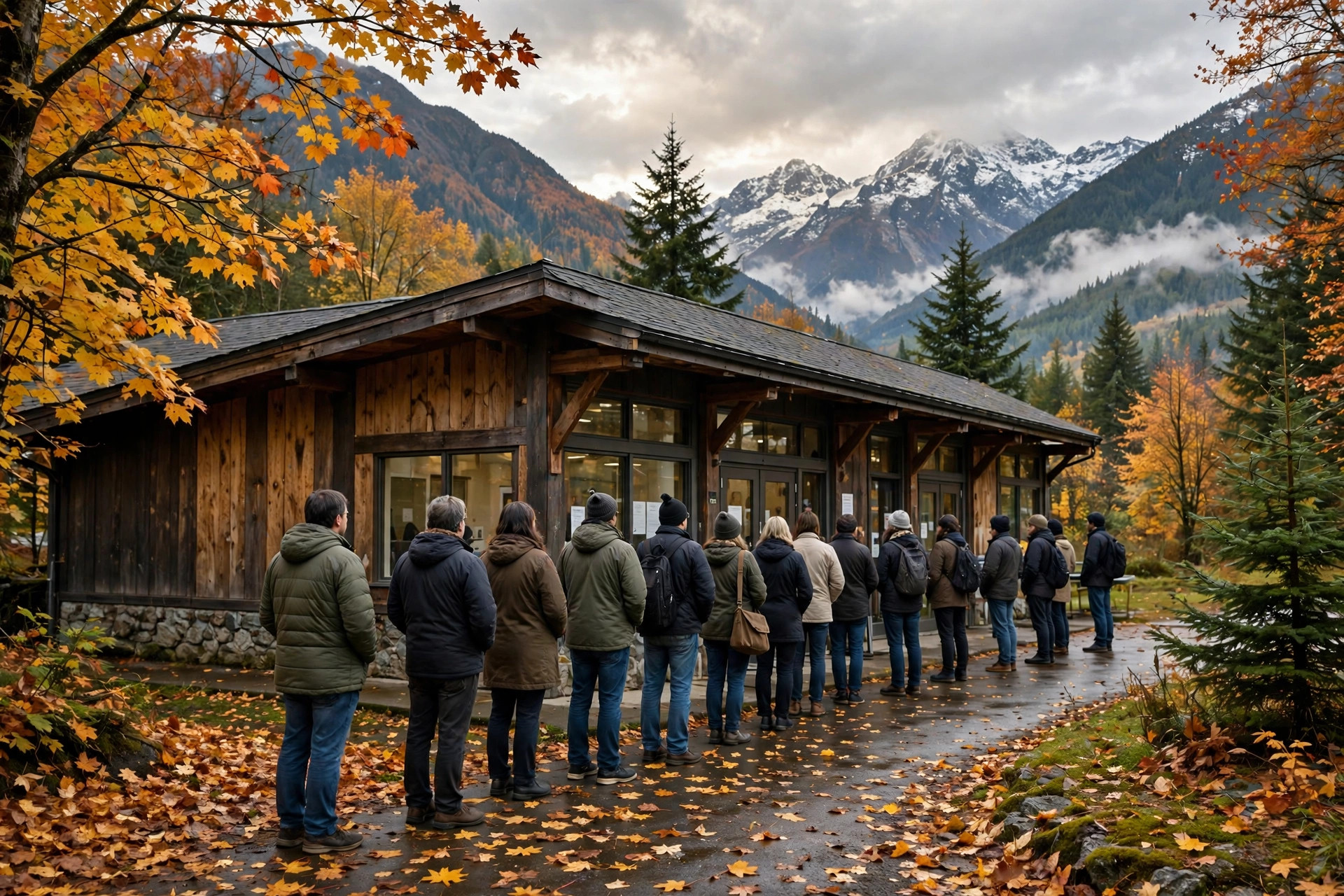
The British Columbia election 2026 reached voting day on Saturday, 24 October 2026, after a short campaign that followed a decision to go to the polls two years earlier than scheduled. Voters across the province were choosing members of the Legislative Assembly in 93 ridings, a contest that could change the direction of provincial government after nine years of New Democratic Party rule. The election was called by Premier David Eby, who has led the province since 2022 and who argued that he needed a renewed and clearer mandate to pursue what he described as big swings in policy at a time of economic uncertainty and tariff threats from the United States. For many voters, the campaign therefore became a test of two competing ideas: continuity under a government that has been in office since 2017, or change under a Conservative opposition that entered the campaign with momentum in the final published polls.
British Columbia Election 2026: Background and Why the Vote Was Called Early
British Columbia has been governed by the New Democratic Party since 2017. David Eby became premier in 2022, succeeding John Horgan, and then led the party into the 2024 provincial election, where it won a slim majority. In that election, the NDP won 47 seats, the Conservatives won 44 seats and the Greens won 2 seats, giving the government only a narrow margin in the legislature. A slim majority can make governing more difficult, because every vote matters and the loss of even a small number of members can change the balance of power. Eby said he wanted a majority mandate that would allow the government to act more decisively, particularly on economic questions linked to trade tensions and tariffs affecting Canadian provinces. That argument framed the early election as a choice about stable and effective government rather than simply a routine renewal of the legislature.
Early elections are not unusual in parliamentary systems, but they carry political risk for the leader who calls them. If voters reward the decision, the government can return with a stronger position. If voters punish it, the government can lose seats it previously held. In this case, the NDP entered the campaign as the incumbent party with a record to defend, while the Conservatives entered as the main challenger, hoping to turn a strong second-place finish in 2024 into a governing majority. The Green Party, with a smaller caucus, also contested the election, arguing that environmental policy, housing and democratic accountability deserved a stronger voice in the legislature. The campaign therefore unfolded as a three-way contest in most ridings, even though the central question for government formation was whether the NDP or the Conservatives would win the most seats.
British Columbia Election 2026: The Parties and Leaders
Premier David Eby led the NDP campaign, presenting himself as an experienced premier seeking a fresh mandate. His message centred on the need for a majority government able to make large policy decisions without being constrained by a narrow margin. Supporters of the government pointed to its nine years in office as evidence of stability, while critics argued that nine years was long enough and that new leadership was needed to address affordability, housing, health care and economic growth. Those themes are familiar in provincial elections across Canada, where the cost of living, access to services and the strength of the local economy often matter more to voters than abstract debates about party ideology.
The Conservative Party entered the campaign under interim leader Lorne Doerkson, after Kerry-Lynne Findlay resigned after four months in the role. An interim leader campaigning in a general election is an unusual situation, and it placed additional attention on the party's broader team, its candidates in individual ridings and its platform rather than on a single long-established leader. The party's supporters argued that change was needed after nine years of NDP government, and that a Conservative government would take a different approach to the economy, taxation and regulation. Emily Lowan led the Green Party, which held two seats going into the election and sought to increase its representation and influence, particularly on climate and environmental issues. For Green voters, the election offered a chance to support a party that has often acted as a conscience voice in the legislature, even when it has not formed government.
What Happened on Voting Day in the British Columbia Election 2026
Voting took place on Saturday, 24 October 2026, across 93 ridings. Each riding elects one member to the Legislative Assembly, and the party that wins the most seats is normally invited to form government. In a system with 93 seats, a party needs 47 seats for a majority, the same number the NDP won in 2024. That arithmetic meant that small shifts in a handful of competitive ridings could determine whether the next government would be a majority, a minority, or a coalition arrangement involving more than one party. Voters in urban centres, suburban communities and rural and northern regions all took part, and the final result would depend on how those different regions voted, not only on the province-wide share of the vote.
Provincial elections in British Columbia, like elections elsewhere in Canada, are decided riding by riding. A party can win the province-wide popular vote and still fail to win the most seats if its votes are concentrated in ridings it already wins by large margins, while its opponent wins more ridings by smaller margins. That is why polling analysts pay close attention to seat projections as well as vote shares. It is also why campaigns spend considerable time in competitive ridings, where a swing of a few percentage points can change the outcome. On voting day itself, the focus shifts from campaigning to turnout: which voters actually cast ballots, and in which communities turnout is highest, can shape the result in close contests.
British Columbia Election 2026 Polls: What the Final Surveys Showed
Final polls before voting day suggested that the Conservatives were slightly ahead of the NDP in decided and leaning voter support. One reported figure put the Conservatives at 45.2 percent and the NDP at 39.3 percent among decided and leaning voters, according to polling reported from Pallas, Ipsos and Research Co. Ipsos polling conducted from 20 to 22 October used a sample of 1,260 respondents. Those figures pointed to a Conservative lead in vote share, but polls are snapshots, not results, and they carry margins of error and methodological differences that mean close races can still move on voting day. Undecided voters, late deciders and differences in turnout can all shift the final outcome away from the last published polls.
Seat projections added another layer to the pre-election picture. One projection, described as a writ projection, suggested that the Conservatives were favoured to win 59 seats, compared with 32 seats for the NDP and 2 seats for the Greens, with an estimated chance of about 81 percent for a Conservative win. That projection should be read carefully: it is a modelled estimate based on polling and past voting patterns, not a result. Projections can be wrong, especially when polls are close in competitive ridings or when turnout differs from expectations. The responsible way to read such a projection before results are known is as an indication of momentum and probability, not as a declaration of who has won. Until votes are counted and reported, no winner can be declared with certainty.
It is also useful to place the British Columbia vote in a wider Canadian context. In the same period, Alberta held a referendum in which voters chose to remain, with a reported 75 percent voting Remain. That result is a separate decision in a separate province, but it forms part of the broader political climate in Western Canada during a period of debate about provincial autonomy, trade and relations with the federal government. For readers following Canadian politics, the contrast is instructive: one province was deciding its governing party, while another was deciding a referendum question, and both outcomes would shape political debate in the months that followed.
Why the British Columbia Election 2026 Matters
The outcome matters because the next provincial government will make decisions that affect daily life in British Columbia, from housing and health care to education, transportation and the environment. A government with a majority can pass legislation more easily, while a minority government must negotiate support from other parties for each major measure. That difference affects how quickly policies can be implemented and how much compromise is required. For a province facing tariff threats and economic uncertainty, the ability to act decisively on trade, investment and jobs may be particularly important to voters and businesses alike.
The election also matters for the future of the parties involved. For the NDP, the result will determine whether nine years in government extends further or comes to an end. For the Conservatives, it will determine whether a strong opposition performance in 2024 can be converted into government, even under an interim leader. For the Greens, it will determine whether their representation grows, stays the same or shrinks. Party leadership questions often follow elections, especially when a party performs below expectations, so the result could also shape who leads each party into the next election cycle. Readers interested in trade policy may also want to follow how tariff debates develop after the vote, including coverage of recent tariff decisions affecting Canada and practical guidance in Canadian jobs and work permit information.
What Happens Next After Voting Day
After polls close, votes are counted riding by riding, and results are reported as they become available. In close ridings, counting may take longer, and final results may not be known on election night. If one party wins a clear majority of seats, that party will normally form the next government, and its leader will be invited to become premier or to continue as premier. If no party wins a majority, negotiations may follow, in which parties discuss whether a minority government can govern with support from another party, or whether a formal arrangement is needed. Those discussions can take days, and they are a normal part of parliamentary democracy when voters do not give any single party a majority.
Once a government is formed, attention will turn to its first priorities: the legislative agenda, the budget and the response to economic and trade pressures that were central to the campaign. Eby's argument for calling the election early was that a majority mandate would allow bigger policy moves, so voters and commentators will watch whether the new government acts on that argument. If the Conservatives form government, attention will turn to how an interim leader and a new cabinet approach the same challenges. Either way, the election result will set the direction of British Columbia politics for the next term, and it will be studied as a signal of voter mood in a province that has seen close contests in recent years. Results, once confirmed, will replace projections as the authoritative record of what voters decided.