
The Blue Lagoon IPO Nasdaq Iceland put one of the world's best-known tourist attractions on the stock market on Thursday 20 November 2026, when shares in Blue Lagoon Corp began trading on the Nasdaq Iceland Main Market. The listing closed a subscription that drew about 4,000 investors and ISK 15.3 billion of orders, oversubscribing the ISK 14.25 billion offer by roughly 7%. Blue Lagoon sold 150 million new shares at ISK 95 each, raising ISK 14.25 billion, about $115 million, and valuing the company at around $787 million. For Iceland, whose main stock market held just 27 listings at the end of 2025, the arrival of its most famous tourist brand is the biggest market event of the year.
The listing is also a comeback. Three years ago, volcanic eruptions near the lagoon forced evacuations and temporary closures, and shelved an earlier attempt to go public. This time the company came back with a prospectus, a subscription window that closed on 13 November, and demand that outran supply. The money raised will fund expansion and acquisitions, including a new highland resort that is already under development.
What happened on 20 November 2026
Shares in Blue Lagoon Corp, listed under the ticker BLUE, began trading on the Nasdaq Iceland Main Market on Thursday 20 November 2026. The first day of trading followed a subscription period that ran from 10:00 GMT on Monday 10 November to 16:00 GMT on Friday 13 November, run by Landsbankinn, Iceland's largest commercial bank.
The offering had two order books. Order Book A took subscriptions from ISK 100,000 to ISK 20,000,000 from retail investors at a fixed price of ISK 95 per share. Order Book B took subscriptions above ISK 20,000,000 at a minimum price of ISK 95 through a Dutch auction. In total, 150 million new shares were offered, 45 million in Order Book A and 105 million in Order Book B, according to Landsbankinn's information memorandum. Results of the offering were published no later than 16 November, payment was due on 18 November, and shares were delivered to buyers no later than 20 November, the day trading began.
Demand beat supply. About 4,000 subscriptions came in, worth roughly ISK 15.3 billion (about $123.7 million), against an offer of ISK 14.25 billion, an oversubscription of around 7%. Retail demand was strong: the fixed-price retail book was the part of the deal most accessible to ordinary Icelandic savers, and it filled. The company will have 1,024,763,489 shares outstanding after the offering, according to Dealroom.
Blue Lagoon IPO Nasdaq Iceland: the offer in numbers
The headline numbers of the deal are simple. Blue Lagoon issued 150 million new shares at ISK 95 each, raising ISK 14.25 billion, about $115 million (Moneywise puts the raise at $115.6 million; Dealroom at $115 million). The offer drew about 4,000 subscriptions worth ISK 15.3 billion (about $123.7 million), so demand exceeded the shares on offer by roughly 7%. At the offer price, the 1,024,763,489 shares outstanding after the offering are worth about ISK 97 billion — roughly $787 million.
The company's own figures show why investors were willing to pay it. Blue Lagoon generated ISK 22.6 billion in turnover in 2025, about $182.7 million, according to its annual report as cited by Moneywise, and revenue has grown by an average of 11% a year over the past decade. More than one million visitors a year now come to the lagoon and the group's other sites. For 2027, the company's budget in the information memorandum puts Blue Lagoon's own revenue at €182–202 million, with EBITDA of €47–51 million, before the contribution of Arctic Adventures, its tour business, which is budgeted at €99 million of revenue and €21 million of EBITDA.
Scale matters here too. Iceland's main market held just 27 listings at the end of 2025, so a company of Blue Lagoon's size joining it is a rare event, and a large one for a market that small. The listing gives Icelandic savers a direct way to own a piece of the country's best-known tourist brand, and it gives the company a currency, its own listed shares, for future deals. Big public offerings have drawn the same kind of retail attention elsewhere this year — Jio Platforms' record Indian IPO in October 2026 is one recent example.
What Blue Lagoon actually is
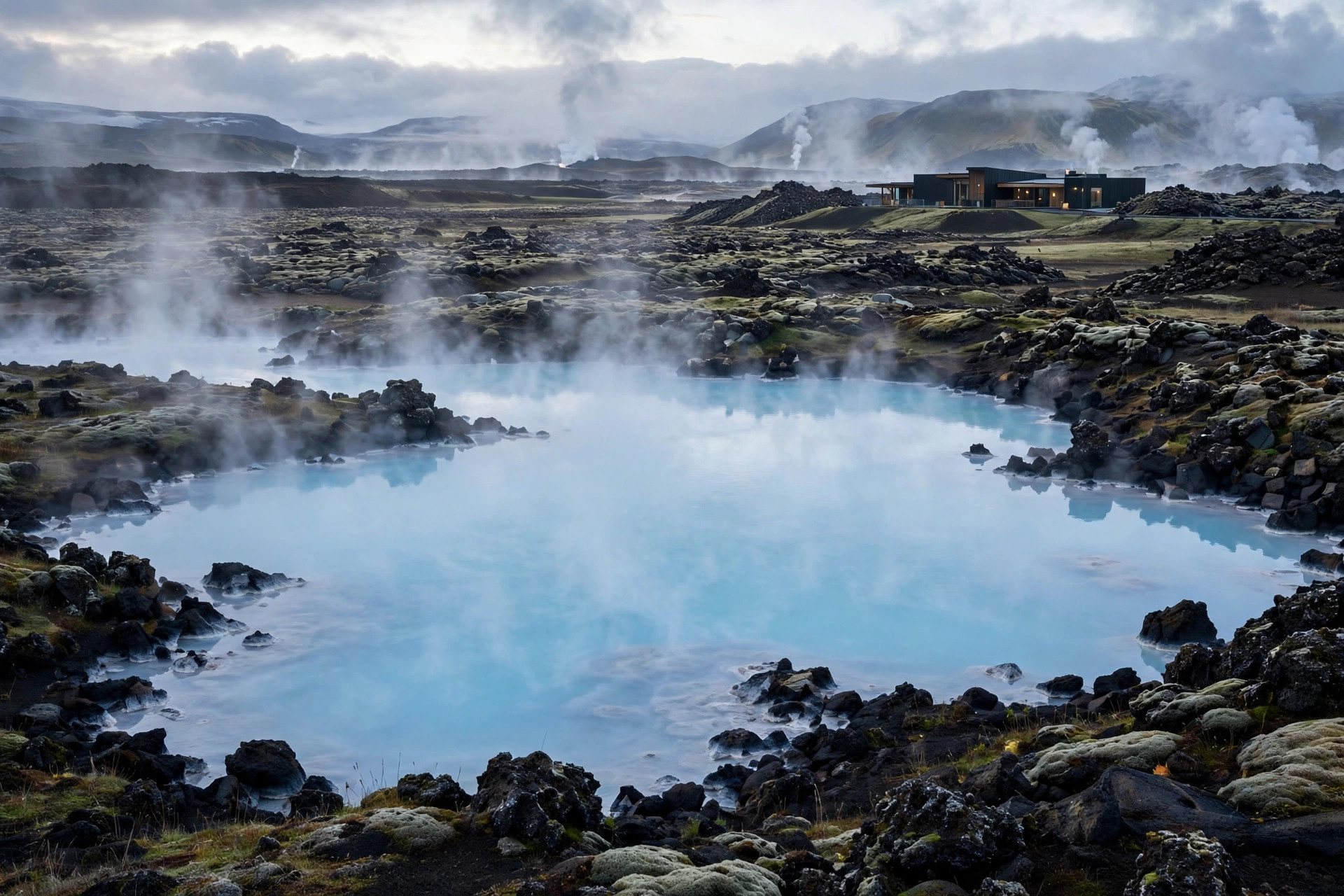
Most people know the Blue Lagoon as a milky-blue geothermal pool near Grindavík on Iceland's Reykjanes peninsula. The company behind it is bigger than the pool. Blue Lagoon Corp runs the lagoon itself, the Retreat hotel and spa, the Silica Hotel, the Blue Lagoon Skin Care skincare brand, Highland Base at Kerlingarfjöll, the Laugarvatn Fontana geothermal baths, and Arctic Adventures, a tour operator. Baltic News listed those businesses when the share offering opened on 10 November.
The lagoon's origin is an accident of engineering. It formed from the wastewater of a geothermal power plant, and the warm, mineral-rich water that was once a byproduct became Iceland's most photographed attraction. The company was founded in 1992, and over three decades it turned a single pool into a group spanning hotels, skincare and adventure travel.
That breadth is part of the investment case. The group is not a single ticket booth: it earns money from bathing, hotels, food, skincare sold around the world, and tours. When one part of the business has a weak season, the others can carry it. The 2027 budget in the information memorandum reflects that mix, combining the lagoon business with Arctic Adventures and €2.6 million of expected cost savings from bringing the two together.
Why the Blue Lagoon IPO Nasdaq Iceland was oversubscribed
Oversubscription happens when investors want more shares than a company is selling, and here the reasons are easy to see. The first is growth: revenue has risen by an average of 11% a year over a decade, according to Moneywise, and the company drew more than a million visitors a year before the listing. The second is scarcity: few publicly traded companies offer direct exposure to a geothermal wellness destination, and Iceland's main market has only 27 listings, so a household-name company going public is unusual.
The third reason is the price. At ISK 95 a share, the minimum subscription in the retail book was ISK 100,000, low enough for ordinary Icelandic savers to take part, and Landsbankinn held an open information meeting for retail investors at Harpa Concert and Conference Centre in Reykjavik on 10 November, with a live webcast. Strong retail demand followed: about 4,000 subscriptions arrived in four days, and the total value of orders, ISK 15.3 billion, ran past the ISK 14.25 billion on offer.
There is also a simpler explanation. Icelanders know this brand. It is the place their visitors ask about first, the image on the postcards, and now a share they can buy on their own exchange. That familiarity, plus a decade of steady revenue growth, made the offer an easy one to fill.
What the money will fund
The proceeds of the IPO are earmarked for expansion and acquisitions. The biggest project already underway is a highland resort at Þjórsárdalur, including a Mountain Retreat hotel, geothermal baths and 40 cabins, at an estimated cost of €138 million, with a planned opening in 2028, according to Dealroom. The group is also developing Mountain Baths, a Mountain Retreat and a Visitor Centre in Þjórsárdalur, as well as Glacier Baths and a Glacier Retreat at Hoffell, according to Baltic News.
Expansion is not new for Blue Lagoon. The group has grown from one pool into hotels, skincare and tours by buying and building, and the listing gives it fresh capital and listed shares to do more of the same. The information memorandum frames the listing as the start of the company's next phase of growth, giving public investors a chance to take part in the next stage of Iceland's tourism and wellness industry.
What to watch is whether the new projects deliver on time. The highland resort is a large build in a remote location, and its 2028 opening date will be the first test of the company's plans as a listed business. Investors will also watch visitor numbers: more than a million guests a year is the base the valuation rests on, and any sustained fall would show up quickly in revenue.
The volcano risk investors priced in
No honest account of this listing can skip the volcanoes. The Blue Lagoon sits near Iceland's active Reykjanes volcanic region, and repeated eruptions and seismic activity in 2023 and 2024 disrupted operations, forced temporary closures, and derailed an earlier attempt to go public, according to Moneywise. The same geology that created the lagoon nearly ended the listing.
The risk has not gone away. The Reykjanes peninsula remains volcanically active, and another eruption near Grindavík could close the lagoon again, as it did in 2023 and 2024. The prospectus, published on 5 November 2026 and approved by the Financial Supervisory Authority of the Central Bank of Iceland, sets out that risk for investors, and anyone considering the shares is expected to read it before deciding.
Investors priced that risk into the deal and bought anyway. The oversubscription suggests they judged the growth story, the brand and the expansion pipeline to be worth the geology. But the volcanoes are the one factor no management team can control, and they will be the first thing to check whenever the ground shakes near Grindavík.
What happens next
Trading is now open, and the first days on Nasdaq Iceland will show what the market thinks of the ISK 95 offer price. If the shares hold or rise, the company has a strong base for the expansion it has promised. If they fall, the questions will come quickly about the valuation and the volcano risk.
For Iceland, the listing is a small-market milestone. Twenty-seven listings at the end of 2025, plus one famous lagoon, makes the exchange a little broader and gives local savers a new place to put money. For visitors, nothing changes at the water's edge: the lagoon stays open, the hotels keep taking bookings, and the Golden Circle and Blue Lagoon remain the first stop on most trips to Iceland, though anyone driving out to the peninsula should check Iceland's road and weather conditions before setting off. What has changed is who owns a piece of it: since 20 November, anyone with a broker that can trade on Nasdaq Iceland can buy in, and 4,000 subscribers already have.
The longer story will be written by the expansion. A €138 million highland resort opening in 2028, new baths and retreats at Hoffell, and whatever acquisitions the IPO money funds will decide whether this listing was the start of a bigger company or the peak of a famous one. For now, the numbers tell the short version: 150 million shares, ISK 95 each, ISK 14.25 billion raised, 4,000 subscribers, and a geothermal spa that began as power-plant wastewater now worth about $787 million on the public market.
Sources: Briefs.co, Baltic News, Landsbankinn, Moneywise — November 2026.