
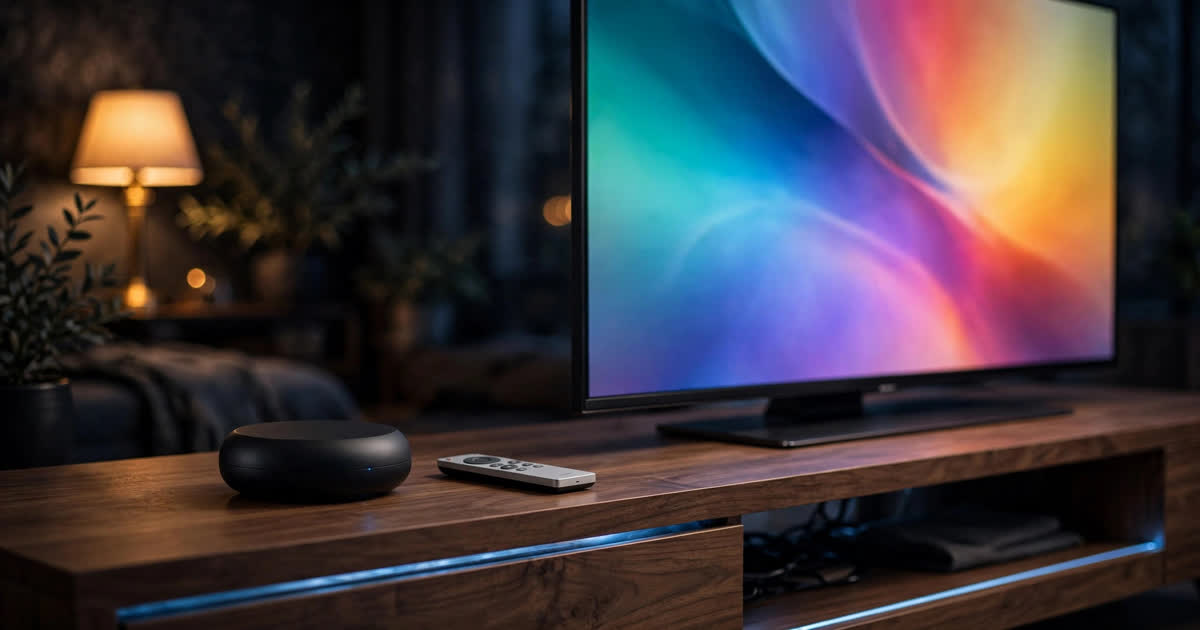
Apple has finally updated the Apple TV 4K after four years, unveiling a fourth-generation model that pushes the streaming box firmly into AI and smart-home territory — at the highest price the company has ever asked for the device. The new Apple TV 4K costs $299, runs on the A19 chip, adds hands-free Siri AI, Wi-Fi 7 and a redesigned Siri Remote with Find My, and will ship on Friday, November 13, 2026, trending per news coverage of the announcement.
The launch was part of Apple's "Welcome Home" event on October 13, which also delivered a refreshed HomePod mini. Pre-orders are open in the United States and 29 other countries and regions, per Apple's announcement.
What Apple announced
The fourth-generation Apple TV 4K replaces the 2022 model that started at $129. Apple has radically simplified the lineup: there is now just one configuration — 128GB of storage with Gigabit Ethernet, Thread support, Wi-Fi 7 and Bluetooth 6 built in. The old two-tier approach (a cheaper 64GB Wi-Fi-only model and a pricier 128GB Wi-Fi + Ethernet model) is gone.
At the heart of the box is the A19 chip, the same silicon family found in the iPhone 17. Apple claims up to 50% faster CPU performance and twice as fast graphics compared with the A15 Bionic in the previous model — a generational leap roughly comparable to moving from an iPhone 13 to an iPhone 17. The new chip also carries twice the RAM of its predecessor and a dedicated hardware decoder for the AV1 video codec, which matters because YouTube and other platforms have aggressively adopted AV1 to deliver high-quality video at lower bandwidth. Older Apple TV boxes had to decode AV1 in software or fall back to less efficient formats like H.264.
Hands-free Siri AI and the always-listening box
The headline feature is hands-free voice control. The new Apple TV 4K has three built-in far-field microphones so users can talk to their TV across the room without pressing anything — Siri AI responds to wake commands directly from the box. It is built around Siri AI, Apple's new version of Siri powered by the next generation of Apple Intelligence.
There is a nuance worth knowing: for questions involving a user's personal context, Siri AI requires an Apple Intelligence-enabled iPhone or iPad. And Siri AI is not exclusive to the new hardware — Apple says it will also come to the second- and third-generation Apple TV 4K models (2021 and 2022) with tvOS 27.2 and later, per news coverage. That detail lands against a backdrop of fierce competition among AI assistants — Google's flagship model Gemini 4 Argon launched just days earlier, and Anthropic has been warning about AI spreading into smart homes.
The new Siri Remote
The redesigned Siri Remote finally addresses the single most common complaint about the device: losing it down the back of the sofa. It now supports Find My with Precision Finding — the same directional locating used for AirTags — and has a built-in speaker that can play a sound to help locate it. Note that Precision Finding support requires an iPhone 17 or newer (excluding the iPhone 17e), iPhone Air or iPhone Duo, per Apple. The remote retains USB-C charging.
Home theatre upgrades
Apple is also pitching the box as the centre of a serious home-cinema setup. The new model supports a four-speaker surround configuration using four HomePod mini 2 speakers, or matching front and rear pairs of HomePod mini 2 and full-sized HomePod 2 speakers. Previous Apple TV models were limited to a stereo pair of HomePods.
Video credentials otherwise stay familiar: Dolby Vision (now with Profile 8.1 alongside Profile 5), HDR10+, HDR10, HLG and Dolby Atmos are all supported, with HDMI 2.1 retained. There is still no resolution beyond 4K at 60 frames per second. New additions include HDMI Quick Media Switching for smoother format changes and 21:9 aspect-ratio support for compatible projectors and displays. The white status light has been centred on the front edge, and the unit weighs 217 grams — about 1% heavier than before.
The $299 question: why the price hike?
The $299 price tag is the most debated part of the launch. When the third-generation model launched in late 2022, the base 64GB Wi-Fi-only version cost $129 and the 128GB variant sold for $149. In June 2026 Apple raised those prices to $199 and $249 respectively, attributing the hike to surging memory and storage component costs driven by global AI data-centre expansion — the same demand that has pushed RAM prices up across the industry.
The 2026 lineup eliminates the cheaper tier entirely, so part of the jump is simply that there is no longer a stripped-down entry model. Even so, at $299 the new Apple TV 4K costs about $150 more than a Google TV Streamer and matches the price of Nvidia's Shield Pro — both of which have also seen price increases in recent months. Tech commentators have called it the toughest-sell Apple TV yet, arguing a cheaper Wi-Fi-only model would have been welcome, and advising owners of the 2022 box who are still happy with it to hold off on upgrading.
Is it worth buying?
For anyone buying their first Apple TV or upgrading from an older model, the 2026 box is a compelling — if pricey — option: the fastest streaming hardware Apple has made, AV1 hardware decoding, Wi-Fi 7, hands-free Siri AI and genuine home-theatre expansion. But the value proposition is weakest for 2022 owners, since the marquee software feature (Siri AI) arrives on their box anyway via tvOS 27.2, and the core viewing specs (4K60, Dolby Vision, Atmos) are unchanged.
Owners of the 2021 and 2022 models who want Find My remote tracking, the four-speaker HomePod surround, AV1 decoding or hands-free voice control will find the upgrade justified. Everyone else can reasonably wait — Apple's own move to push Siri AI to older hardware is the clearest signal that the company does not expect the entire installed base to buy new hardware.
What this signals about Apple's strategy
The launch is Apple's biggest smart-home statement in years. Alongside the HomePod mini 2 and the forthcoming HomeView hub teased at the same event, the Apple TV 4K positions itself as a home hub first and a streaming box second — Thread networking, far-field microphones and deep HomePod integration all point at a living room that Apple wants to own end-to-end. With CEO John Ternus now leading the company, the message is that the home is the next battleground for Apple Intelligence. Sources: Apple Newsroom, MacRumors, Gizmodo, The Mac Observer, Pocket-lint (per news coverage, 13–14 October 2026).
The launch capped a busy hardware season for Apple, whose first foldable, the iPhone Duo, sold out in minutes at $1,999.