
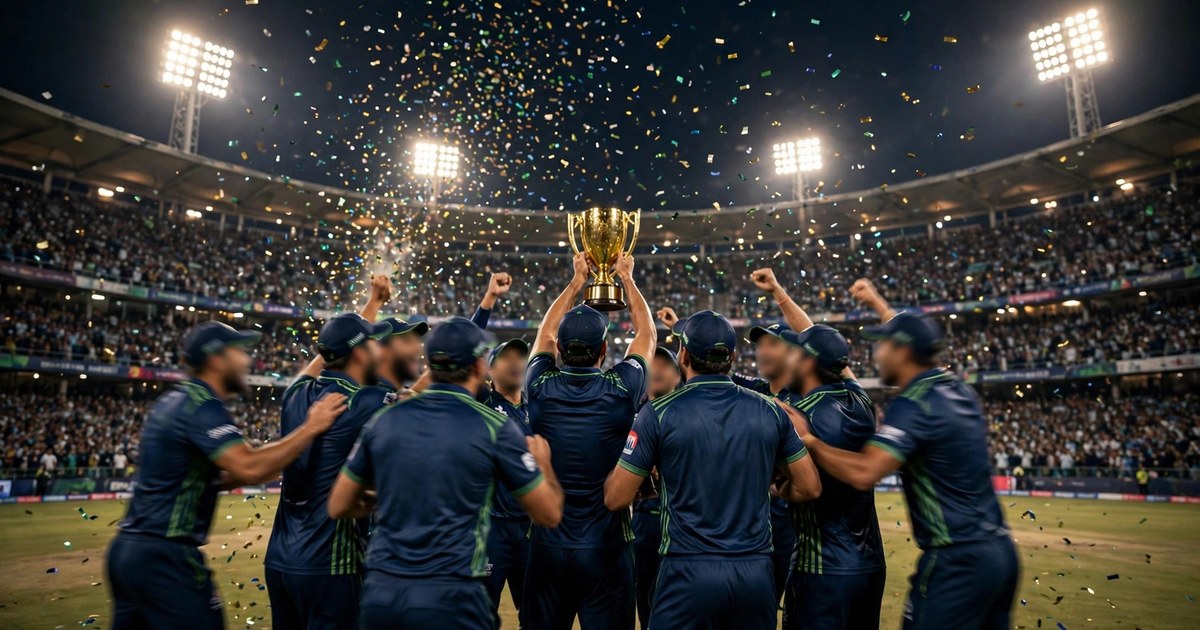
The Afghanistan vs Zimbabwe ODI final ended in a one-sided triumph for Afghanistan, who lifted the UAE ODI tri-series trophy with a seven-wicket win over Zimbabwe at Sharjah Cricket Stadium on Friday, 23 October 2026. Chasing a modest 170, Afghanistan reached 170 for 3 in just 34.3 overs, with 93 balls to spare, after bowling Zimbabwe out for 169 in 43.3 overs.
It was a performance that summed up Afghanistan's tournament: disciplined bowling, sharp fielding and a calm, professional chase. Zimbabwe, who chose to bat first after winning the toss, never found a rhythm on a slow Sharjah surface, and only captain Sikandar Raza's fighting 68 gave their innings any spine.
Afghanistan vs Zimbabwe ODI Final: How the Match Was Won
The tone was set in the powerplay. Left-arm quick Fazalhaq Farooqi struck twice up front, and Azmatullah Omarzai — the world's top-ranked ODI all-rounder — removed Brian Bennett caught and bowled with sharp reflexes in his follow-through. Zimbabwe's top order, which had crumbled similarly in both round-robin matches of the tri-series, was again in trouble early.
Raza walked in to a familiar crisis and rebuilt with patience, hitting three sixes and three fours in his 68 off 83 balls. In doing so he became the first batter aged 40 or older to score a fifty in an ODI tournament final. But he found little lasting support: Ryan Burl contributed 31, and the rest of the batting line-up could not build partnerships against a bowling attack that never released pressure.
Rashid Khan was the pick of the bowlers with 3 for 41 from his ten overs. The leg-spinner's figures made him only the second bowler in ODI history to take at least three wickets in six successive innings — a remarkable streak of consistency from the world's most feared white-ball spinner. Mohammad Nabi took 2 for 25 and, in the process, reached his 300th ODI wicket, a landmark moment for Afghanistan's veteran all-rounder. Bilal Sami (2 for 27) and Farooqi (2 for 41) chipped in with two wickets each, while Omarzai claimed one.
The final scorecard told the story of total control: Zimbabwe 169 all out in 43.3 overs; Afghanistan 170 for 3 in 34.3 overs. Afghanistan won by seven wickets, and the trophy was theirs.
Ibrahim Zadran's 70 Not Out Anchors the Chase
If the bowlers set the game up, Ibrahim Zadran finished it. The opener struck his second half-century of the tournament, an unbeaten 70 off 96 balls, and carried his bat through the chase. Rahmanullah Gurbaz gave the innings early momentum with a brisk 36 off 31 balls, and after two quick wickets, Zadran took control.
The decisive passage was an 82-run third-wicket stand between Zadran and captain Rahmat Shah, who made 43 off 63 balls. The pair absorbed what little pressure Zimbabwe's bowlers could apply, rotated the strike, and punished anything loose. Zadran was still there at the end, unbeaten on 70, when Hashmatullah Shahidi struck the winning boundary in the 35th over.
Zadran was named Player of the Match for his composed innings, while Rashid Khan — with 11 wickets in the tournament — took Player of the Series. It was fitting recognition for the two players who had defined Afghanistan's campaign: one with the ball, one with the bat.
Afghanistan's Dominant Tri-Series Campaign
The final was the exclamation point on a dominant tournament for Afghanistan. Their campaign included a 158-run win over Zimbabwe and a seven-wicket win over Bangladesh, and they finished the competition unbeaten. Bangladesh were eliminated before the final, leaving Afghanistan and Zimbabwe to contest the trophy.
What stood out across the tournament was the completeness of Afghanistan's cricket. The pace trio of Farooqi, Sami and Omarzai provided early breakthroughs, Nabi and Rashid controlled the middle overs, and the fielding — highlighted by Zadran's catch to dismiss Raza off Rashid in the final — was sharp throughout. With the bat, Gurbaz's aggression at the top, Zadran's composure and Rahmat's experience gave the side balance in every phase.
For Zimbabwe, the tournament was a story of promise unfulfilled. Raza's leadership and batting were outstanding — his 68 in the final was his team's only real resistance — but the batting unit repeatedly collapsed at the top, and the bowlers had too few runs to defend. Newman Nyamhuri's 2 for 43 in the final was a bright spot, but Afghanistan's chase was never seriously threatened.
What the Afghanistan vs Zimbabwe ODI Final Means for Both Teams
For Afghanistan, the tri-series title is another marker of their rise in white-ball cricket. A team that once relied almost entirely on its spin attack now wins tournaments with pace, fielding and batting depth to match. The victory also builds momentum and confidence ahead of a busy stretch of fixtures, with the side's next assignments coming quickly in the same country.
For Zimbabwe, the lessons are clear: the top order must find a way to survive the new ball, and the middle order needs more than Raza to build around. Their bowlers, led by Blessing Muzarabani's bounce and Nyamhuri's promise, have tools to work with — but only if the batters give them totals to defend.
The rivalry is far from over. The two sides now stay in the UAE for a longer bilateral contest, and Zimbabwe will get an immediate chance at revenge in a different format.
Afghanistan vs Zimbabwe Next: T20Is and Tests from 27 October
After the tri-series final, Afghanistan and Zimbabwe play three T20Is and two Tests, all at Sharjah Cricket Stadium. The T20Is are scheduled for 27 October, 29 October and 1 November, with the first Test running 5–9 November and the second Test 13–17 November. T20I matches start at 8:00 PM IST, while Test days begin at 11:00 AM IST.
Ibrahim Zadran captains Afghanistan in the T20Is, with Rahmat Shah leading the Test side; Sikandar Raza captains Zimbabwe. Rashid Khan, rested from the Test squad as part of workload management, features in the T20I squad alongside Mujeeb Ur Rahman and Noor Ahmad — a spin trio that will test Zimbabwe's batters on Sharjah's slow pitches. Fans following the recent T20I action elsewhere will find this Sharjah series a fascinating contrast in conditions and tactics, while the tri-series format continues to produce sharp, high-stakes cricket across the region.
For now, though, the trophy belongs to Afghanistan — and the Afghanistan vs Zimbabwe ODI final will be remembered as the night Rashid Khan's spin, Nabi's milestone and Zadran's calm chase combined into a complete team performance.
Sources: ESPNcricinfo; Cricbuzz.