
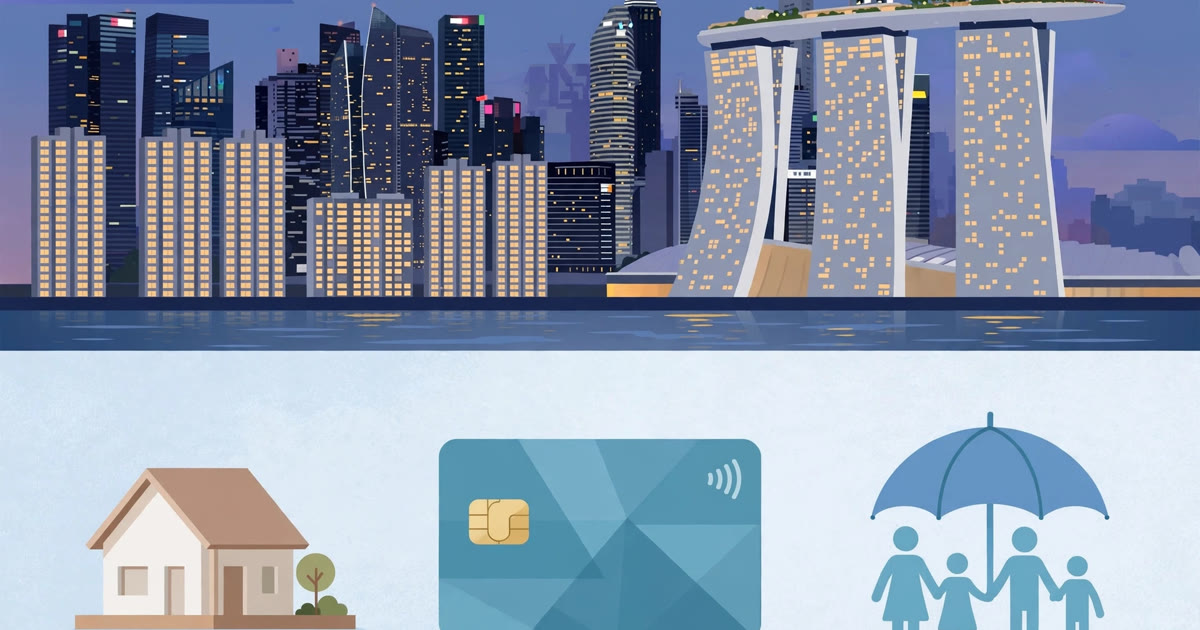
Singapore personal finance touches three big decisions for almost every household: how to pay for a home, how to use credit cards without falling into debt, and how much life insurance a family really needs. Each product looks simple on the surface, but the rules behind them — loan limits, interest-rate structures, reward schemes and policy terms — can change the total cost by tens of thousands of dollars over a lifetime. This Singapore personal finance guide explains all three in plain language, so you can compare options confidently and avoid the most common and expensive mistakes.
Whether you are buying your first HDB flat, weighing a bank loan against an HDB loan, choosing a cashback card, or deciding between term and whole-life cover, the principles are the same: borrow only what you can repay comfortably, pay credit-card bills in full, and buy insurance for protection first and investment second. The sections below walk through each topic step by step, with the key rules, the real costs to watch, and a practical checklist you can use before signing anything.
Singapore Personal Finance and Home Loans: HDB Loan vs Bank Loan
Most Singapore home buyers choose between two kinds of mortgage: the HDB concessionary loan, available for eligible HDB flats, and a bank loan, available for HDB flats, executive condominiums and private property. The HDB loan charges a concessionary interest rate pegged to the CPF Ordinary Account rate plus a margin, which makes repayments predictable, while bank loans may be fixed for a period or float with a benchmark rate, so monthly payments can rise or fall. A Singapore personal finance plan should start by comparing not just the headline rate but the total cost over the loan tenure, including legal fees, valuation fees and any early-repayment penalties.
Two borrowing rules shape every Singapore personal finance decision about housing. The Total Debt Servicing Ratio caps total monthly debt repayments at 55 percent of gross monthly income, counting home loans, car loans, personal loans and credit-card balances. The Mortgage Servicing Ratio caps the monthly mortgage payment for an HDB flat at 30 percent of gross monthly income. These limits protect buyers from over-borrowing, but they also mean that clearing a car loan or credit-card balance before applying can genuinely increase the home loan you qualify for.
Singapore Personal Finance: Mortgages, Rates and Refinancing
When comparing Singapore mortgages, look beyond the first-year promotional rate. Fixed-rate packages offer certainty for one to three years and then usually revert to a floating rate, while floating packages move with market benchmarks and can be cheaper when rates fall but painful when they rise. Ask every lender for the effective rate over the full lock-in period, the repricing options at the end of the fixed term, and the penalty for redeeming early. A Singapore personal finance habit worth building is to review your mortgage at least once a year: refinancing or repricing can save a meaningful amount if rates have moved, but only if the savings exceed the legal and administrative costs of switching.
Also budget for the costs around the mortgage, not just the instalment itself. Buyers pay stamp duty, legal conveyancing fees and valuation fees, and owners face property tax, maintenance and insurance on top of the loan. A common rule of thumb is to keep total housing costs — mortgage, tax and maintenance — comfortably below one-third of household income, leaving room for emergencies, retirement savings and the insurance discussed below. Remember that a longer tenure lowers the monthly payment but raises total interest paid, so choose the shortest tenure whose instalment still leaves breathing room.
Singapore Personal Finance: Credit Cards Done Right
Credit cards in Singapore are powerful tools when used well and expensive traps when used badly. The best card depends on your spending pattern: cashback cards suit people who spend heavily on groceries, petrol and dining; miles cards suit frequent travellers who can redeem flights at good value; and no-annual-fee cards suit light users who simply want convenience. Before applying, check the annual fee and whether it is waived, the minimum spend needed to earn the headline rebate, and which categories are excluded. A Singapore personal finance review should always compare the effective rebate on your actual spending, not the advertised maximum.
The single most important credit-card rule is to pay the full statement balance every month. Interest on unpaid balances is very high, and once interest starts compounding, even a modest balance can grow quickly — which is why learning how inflation affects your money and how compound interest works matters for everyday decisions, not just investing. Set up automatic full payment or a calendar reminder, keep utilisation low relative to your credit limit, and never use a credit card to pay for something you could not afford in cash. If you already carry a balance, a balance-transfer plan or a personal loan at a lower rate may help, but only alongside a plan to stop new card spending.
Singapore Personal Finance: Life Insurance and Mortgage Protection
Life insurance exists to replace income and protect dependants if the breadwinner dies or becomes totally and permanently disabled. Term life insurance gives high cover for a low premium over a fixed term — often to age 65 or to the end of the mortgage — and suits most young families. Whole-life and endowment policies combine protection with a savings or investment component, cost far more for the same cover, and make sense only if you specifically want that bundled structure. A practical Singapore personal finance approach is to buy term cover first, sized to your mortgage, children's education costs and several years of household expenses, and treat investment as a separate decision.
If you buy an HDB flat with CPF savings, you will normally be covered by the Home Protection Scheme, which pays off the outstanding HDB loan if the insured member dies or becomes totally and permanently disabled. Private-property owners do not get this automatically and usually buy mortgage-reducing term assurance, whose cover falls as the loan is repaid. Either way, review cover after major life events — marriage, a child, a new home, a job change — and make sure your policy's beneficiaries and your CPF nomination are up to date. Insurance bought and then forgotten is one of the most common gaps in household finances.
Singapore Personal Finance Checklist Before You Sign
Before signing any mortgage, card or policy, run through a short checklist. First, confirm the total cost, not just the monthly figure: interest over the tenure, fees, penalties and what happens when a promotional period ends. Second, check eligibility rules and exclusions in writing — loan ceilings, card reward caps and insurance exclusions for pre-existing conditions or hazardous activities. Third, ask what happens if your income drops: does the lender offer restructuring, does the card allow a repayment plan, and does the policy have a grace period or premium holiday?
Finally, keep the three products in balance. A household that stretches for the biggest possible mortgage, carries card debt and has no life cover is fragile, however good each individual deal looked. A sound Singapore personal finance plan keeps housing affordable, cards paid in full, and protection in place before chasing rewards or investment returns. Revisit the whole picture once a year or after any big life change, and get independent advice for complex cases rather than relying on a single salesperson's recommendation.
Sources: Monetary Authority of Singapore; Central Provident Fund Board; Housing & Development Board; general guidance only — verify current rates, grants and policy terms with the provider before deciding.