
The Simple Idea Behind Compound Interest
Compound interest is interest calculated on both the original amount of money and on the interest that has already been added to it. In other words, you earn "interest on your interest." It is one of the most powerful forces in personal finance, and it works quietly in the background of every savings account, investment portfolio, and credit card balance you will ever have.
Here is the core idea. Suppose you put $1,000 in a savings account that pays 10% interest per year. After one year, you have $1,100. In the second year, the 10% is not calculated on the original $1,000 alone — it is calculated on the full $1,100. So you earn $110 in interest, ending the year with $1,210. In the third year, interest is calculated on $1,210, giving you $1,331, and so on. Each year, the base that earns interest gets a little bigger, and the growth accelerates.
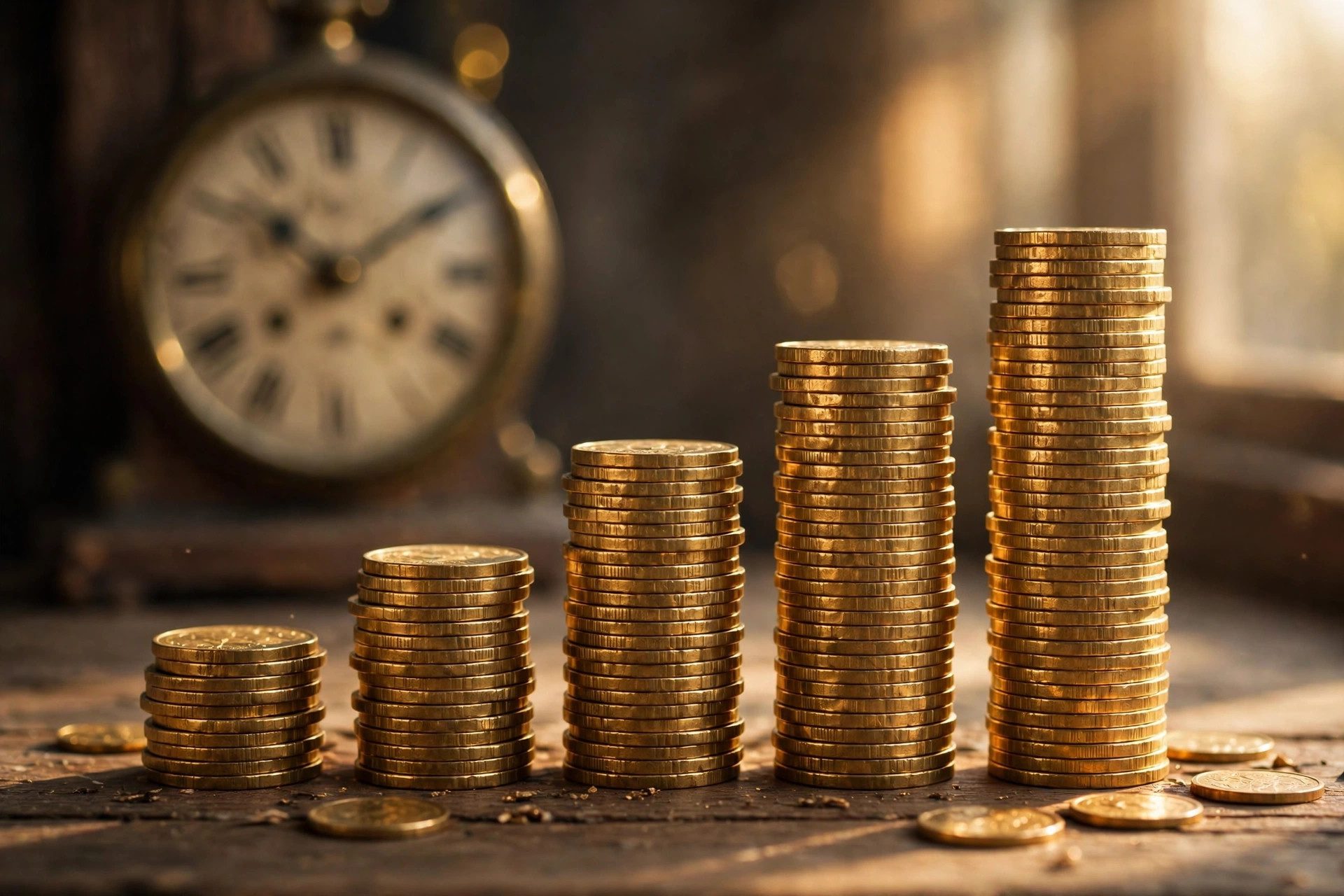
This accelerating growth is what makes compound interest so different from a simple linear increase. At first, the effect looks tiny — a few extra dollars. But over years and decades, the curve bends upward steeply, and the accumulated interest can grow to exceed the original amount you put in. That snowball effect is why compound interest is often called the eighth wonder of the world.
The Compound Interest Formula (And What Each Part Means)
The math behind compound interest is captured in one formula:
A = P(1 + r/n)nt
Every letter stands for something you can control or observe:
- A — the final amount, including everything you put in plus all the interest earned.
- P — the principal, the starting amount of money you invest or save.
- r — the annual interest rate, written as a decimal (so 7% becomes 0.07).
- n — how many times per year the interest is compounded (12 for monthly, 365 for daily, 1 for annually).
- t — the number of years the money stays invested.
Let us walk through a concrete example. You invest a one-time sum of $10,000 at an annual rate of 7%, compounded monthly, and leave it untouched for 10 years:
- P = 10,000, r = 0.07, n = 12, t = 10
- A = 10,000 × (1 + 0.07/12)12 × 10
- A = 10,000 × (1.0058333)120 ≈ $20,097
Your money roughly doubled without you lifting a finger. The more frequently interest compounds (larger n), the slightly faster your balance grows — though the rate r and the time t matter far more than compounding frequency.
Compound Interest vs. Simple Interest: A Side-by-Side Example
To see what compounding really buys you, compare it with simple interest, where interest is paid only on the original principal. Using the same numbers — $10,000 at 7% for 10 years:
- Simple interest: $10,000 + ($10,000 × 0.07 × 10) = $17,000
- Compound interest (monthly): ≈ $20,097
The difference — $3,097 — is money that exists purely because each year's interest went on to earn interest of its own. Over 20 years instead of 10, the gap becomes dramatic: simple interest would give you $24,000, while monthly compounding would grow the same $10,000 to roughly $40,388. The longer the time horizon, the wider the gap.
This is why banks and investment statements quote an APY (annual percentage yield) alongside the plain interest rate: APY already folds in the effect of compounding, so it is the number you should use when comparing savings accounts and bonds.
The Rule of 72: Doubling Time in Seconds
The Rule of 72 is a mental shortcut for estimating how long it takes money to double at a given rate of return. Simply divide 72 by the annual interest rate:
- At 4%: 72 ÷ 4 = 18 years to double
- At 7%: 72 ÷ 7 ≈ 10.3 years to double
- At 10%: 72 ÷ 10 = 7.2 years to double
The rule also works in reverse. If you want your money to double in 9 years, you need a return of roughly 72 ÷ 9 = 8% per year. It is not exact — it is an approximation that works best for rates between about 4% and 12% — but it is close enough for quick planning. The key insight is stark: a few percentage points of difference in return translate into years of difference in how fast wealth accumulates.
This also reveals why inflation is compounding's quiet enemy. If your money grows at 5% but prices rise at 3%, your real purchasing-power growth is only about 2% — meaning it takes roughly 36 years for your real wealth to double. Read more about how inflation erodes savings in our dedicated guide.
Why Starting Early Matters More Than Starting Big
Time is the most important variable in the compound interest formula — more important than the amount you start with. Consider two investors who both earn 7% a year:
- Early Emma invests $5,000 per year from age 25 to age 35 — 10 years, $50,000 total — then stops and lets the money grow until age 65. Her balance at 65: roughly $526,000.
- Late Liam invests $5,000 per year from age 35 to age 65 — 30 years, $150,000 total. His balance at 65: roughly $472,000.
Emma contributed one-third as much money as Liam, yet ended up with about $54,000 more. Her secret was not a better return or a bigger contribution — it was ten extra years of compounding at the start. Every year your money is invested, it does more work; the first years are the hardest-working of all because they compound the longest.
The lesson is practical, not theoretical: waiting for the "right time" to invest is usually a losing strategy. Even small contributions started today beat large contributions started in a decade. This applies whether you are saving in a 401(k) or IRA in the US, an ISA in the UK, an RRSP or TFSA in Canada, or superannuation in Australia.
Where Compound Interest Works for You: Savings and Investing
Compound interest is not just a math curiosity — it is the engine of almost every wealth-building strategy:
- Savings accounts and CDs. High-yield savings accounts compound daily or monthly. Certificates of deposit (CDs in the US, GICs in Canada) lock in a fixed rate for a fixed term, with interest compounding on a schedule.
- Stock and bond investments. When dividends and bond coupons are reinvested instead of spent, they buy more shares and bonds, which generate more dividends — the same compounding mechanism at work. Learn how the two main asset classes differ in our stocks vs. bonds guide.
- Retirement accounts. Accounts like 401(k)s, IRAs, ISAs, and superannuation are compounding machines because they combine decades of time with tax advantages that keep more of your returns working for you.
- Dividend reinvestment plans (DRIPs). These automatically use your dividend payments to buy more shares, accelerating the snowball without any action from you.
To maximize compounding, follow three rules: reinvest every payout rather than withdrawing it, keep fees low (a 1% annual fee quietly compounds against you), and avoid interrupting the process by pulling money out early. Our finance section has more guides on putting these ideas into practice.
The Dark Side: Compound Interest in Debt
Compound interest is neutral — it multiplies whatever it touches, including debt. This is where it works against you, and it works fast. Credit cards in the US routinely charge APRs of 20–25%, compounded daily. A $5,000 balance at 24% APR, left unpaid and untouched, grows to about $6,353 in a year — and the interest keeps compounding on the interest, so the hole deepens every month.
The same math that turns $10,000 into $40,000 over 20 years will turn a modest unpaid balance into an unmanageable one over a few years. That is why financial advisors rank paying down high-interest debt above almost every investment: eliminating a 24% compounding cost is equivalent to earning a guaranteed 24% return, something no investment can promise.
The practical takeaway: let compound interest work for you in savings and investments, and fight it relentlessly wherever it works against you — high-interest debt, late-payment penalties, and balances you carry from month to month. Keeping your credit healthy also matters; see how credit scores work to understand how lenders judge your borrowing habits.