
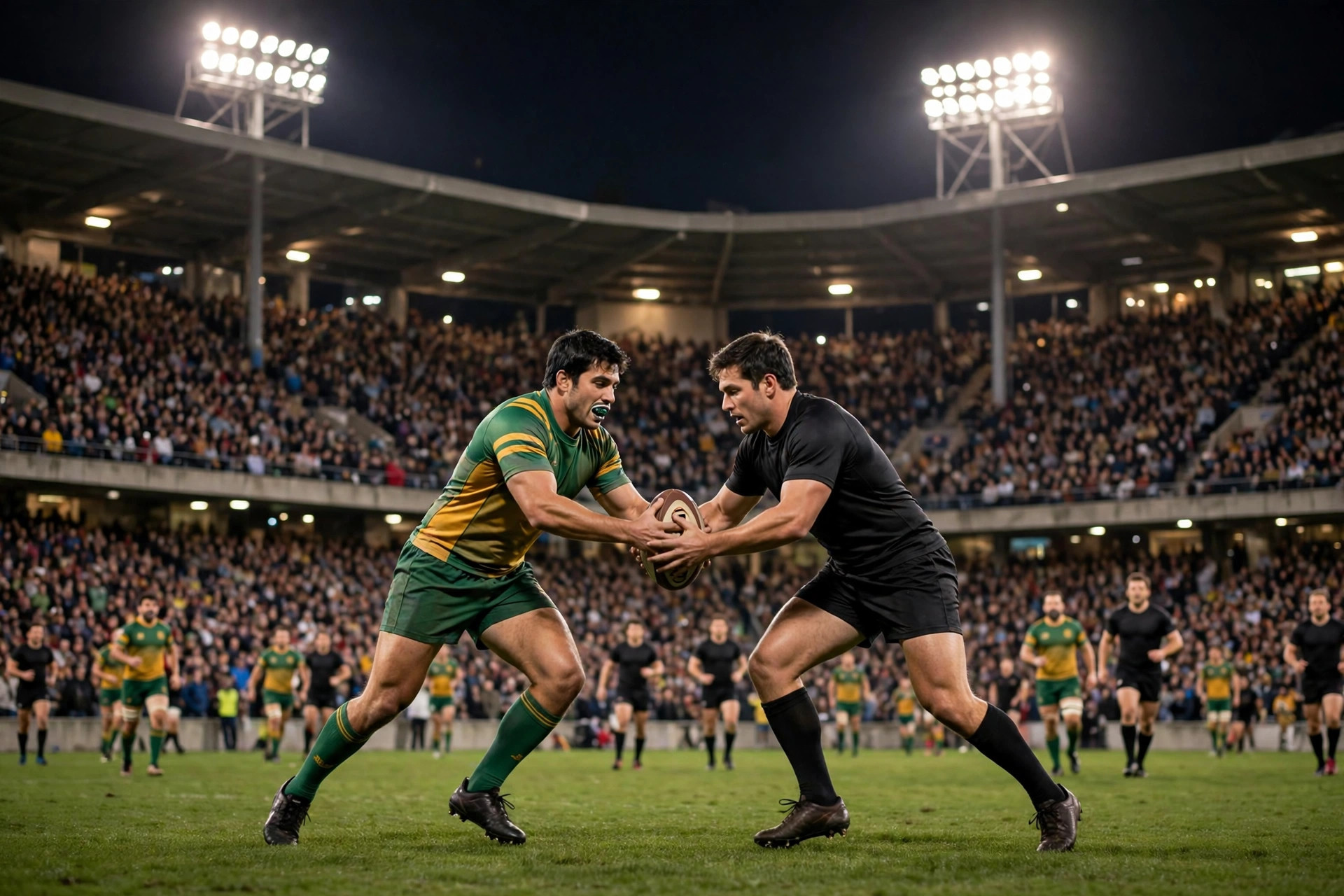
The Rugby League World Cup 2026 semi-final race is heading into its final group round with only one men's team sure of a place in the last four. Australia are the only men's team assured of a semi-final spot heading into that final round, and the remaining places will be decided by the games played on Friday 30 October, Saturday 31 October and Sunday 1 November. The format is unusually direct: there are no quarter-finals in this tournament, so the top two teams from each pool, or from the combined table where pools are combined, go straight to the semi-finals. That means every result in the final round carries a direct consequence, and in some cases a team can win a game and still go out, while in others a single game is a straight contest for a semi-final place. This article explains the Rugby League World Cup 2026 semi-final race as it stands, team by team, including what Australia have already done, why New Zealand v Fiji is a win-or-out game, and why England's hopes now depend on Tonga beating Samoa by 47 points.
Rugby League World Cup 2026 semi-final race: how the format works
The first thing to understand about the Rugby League World Cup 2026 semi-final race is the format, because it explains why the final group round is so decisive. There are no quarter-finals in this format. The top two from each pool, or from the combined table where pools are combined, go straight to the semi-finals. That removes the safety net that a quarter-final round would provide: a team that finishes third does not get another chance, and a team that finishes in the top two goes directly into a semi-final. Head-to-head is the first tiebreaker, then points differential. Points differential is the difference between the points a team has scored and the points it has conceded, so a team that wins by a large margin improves its differential, while a team that loses by a large margin sees its differential fall. Head-to-head coming first means that when two teams are tied, the result of the game between them matters before the size of any wins or losses is considered. That order matters in the games described below, because some teams need not only a win but a win by a specific margin, while others need only to win their own game to go through. The semi-final that Australia have already reached will be played at Allianz Stadium on Sunday 8 November, as part of a double-header with the Jillaroos, the Australian women's team. The women's tournament is a separate competition, and the note about the Jillaroos is included here only because the men's semi-final shares the day with them.
Australia's position is the simplest part of the picture. Australia are the only men's team assured of a semi-final spot heading into the final group round. They beat New Zealand in the opener, and they then beat Fiji 36-22 in Brisbane. That second result is worth looking at in detail, because Fiji led 16-12 after 44 minutes, so Australia were behind in the second half before they recovered to win by 14 points. The final score of 36-22 shows that Australia pulled away in the later stages, but the fact that Fiji led after 44 minutes also shows that the game was competitive for a long period. Australia's final group game is against Cook Islands on Saturday 31 October at 8:05pm AEDT at Queensland Country Bank Stadium in Townsville. The result of that game will not change Australia's qualification, because they are already assured of a semi-final spot. Australia's semi-final is at Allianz Stadium on Sunday 8 November, in a double-header with the Jillaroos, and that date is now fixed in their schedule while the other teams are still fighting for the remaining places.
Rugby League World Cup 2026 semi-final race: Australia, New Zealand and Fiji
The second part of the Rugby League World Cup 2026 semi-final race concerns New Zealand and Fiji, and their game is the clearest of all the remaining fixtures. New Zealand v Fiji is a game in which the winner goes through and the loser is out. The game is on Saturday 31 October at 3:30pm AEDT at Cbus Super Stadium on the Gold Coast. There is no margin calculation and no dependence on another result: win the game and go through, lose it and go out. New Zealand reached this position after a mixed start to the tournament. They lost the opener to Australia, and they then bounced back with an 82-16 win over Cook Islands. That 82-16 result was a large win, by 66 points, and it showed how strongly they responded to the opening defeat. Fiji, by contrast, pushed Australia hard before losing 36-22 in Brisbane, having led 16-12 after 44 minutes, and they then beat Papua New Guinea 40-4. Fiji's win over Papua New Guinea was by 36 points, and it kept them in contention heading into the game against New Zealand. The two teams therefore arrive at the Gold Coast with recent results that point in different directions: New Zealand with a very large win over Cook Islands after an opening loss, and Fiji with a narrow defeat to Australia followed by a comfortable win over Papua New Guinea. The game itself will decide which of them joins Australia in the semi-finals, and which of them goes home.
The women's tournament should not be confused with the men's race described here. In the women's tournament, the Jillaroos are through, and England women lost 6-24 to Samoa on 30 October. That result belongs to the women's competition, and it has no bearing on the men's semi-final places. It is mentioned here only to keep the two competitions separate, because the men's semi-final on Sunday 8 November is a double-header with the Jillaroos, and the women's results are part of the same tournament weekend. The men's race is decided by the men's games alone, and the three men's games that matter most in the final round are Australia v Cook Islands, New Zealand v Fiji, and Samoa v Tonga.
England's path: the 47-point equation
England's position in the Rugby League World Cup 2026 semi-final race is the most complicated, and it changed on Friday 30 October. England beat Papua New Guinea 34-12 on Friday 30 October at WIN Stadium in Wollongong. The half-time score was 24-0, so England were in control from the first half. The tries for England were scored by Ashton, Brimson, Young, Smith, Knowles and Lewis, six tries in total, while the Papua New Guinea tries were scored by Dotoi and Voro. The final score of 34-12 was a win by 22 points. That win, on its own, sounds comfortable, but it was not enough for England's purpose. England entered the match needing a 68-point differential swing on Samoa. A differential swing of 68 points is a very large requirement: it means England needed to improve their points differential relative to Samoa by 68 points, through a combination of their own margin of victory and, in effect, the gap between the two teams. A 22-point win improved their differential by 22 points in their own game, but that was far short of the 68-point swing they needed, so the win did not put them through. England now need Tonga to beat Samoa by 47 points. That is the specific margin that would change the calculation in England's favour, and it is a large margin to ask for in a game between two competitive teams.
The game that will decide England's fate is Samoa v Tonga on Sunday 1 November at 8:05pm AEDT at CommBank Stadium. The stadium is sold out for that game, which underlines how much interest there is in a fixture that decides a semi-final place. For Samoa and Tonga themselves, the position is simpler than it is for England: a win guarantees either side a semi-final berth. That means the winner of Samoa v Tonga will go through regardless of the margin, while the loser will depend on the wider calculation. A Samoa win would also secure top spot on the combined Pools B and C table, so Samoa have an extra incentive beyond qualification itself. For England, however, the margin is everything: they need Tonga to beat Samoa by 47 points. If Tonga win by fewer than 47 points, that will not be enough for England, even though Tonga themselves would go through with any win. If Samoa win, England are out as well, because a Samoa win would secure top spot for Samoa and would not produce the 47-point Tonga win that England need. England's hopes therefore rest on a specific outcome in a game they are not playing in, and on a margin that is large by the standards of a game between two teams who are both fighting for a semi-final place.
What happens next: Samoa v Tonga on 1 November
The final round of the Rugby League World Cup 2026 semi-final race will be completed by the Samoa v Tonga game on Sunday 1 November at 8:05pm AEDT at CommBank Stadium, which is sold out. Before that, on Saturday 31 October, there are two games: New Zealand v Fiji at 3:30pm AEDT at Cbus Super Stadium on the Gold Coast, where the winner goes through and the loser is out, and Australia v Cook Islands at 8:05pm AEDT at Queensland Country Bank Stadium in Townsville, where Australia are already assured of a semi-final place. The order of the games matters for the teams involved, but the overall picture is already clear. Australia are through. The winner of New Zealand v Fiji will join them. The winner of Samoa v Tonga will also go through, and a Samoa win would secure top spot on the combined Pools B and C table. England, who beat Papua New Guinea 34-12 on Friday 30 October at WIN Stadium in Wollongong, will be watching the Samoa v Tonga game and hoping that Tonga win by 47 points, because that is the margin they need after their 22-point win fell short of the 68-point differential swing they required. The semi-final at Allianz Stadium on Sunday 8 November, in a double-header with the Jillaroos, is already in Australia's diary. The other semi-final places will be decided by the games on 31 October and 1 November, and the Rugby League World Cup 2026 semi-final race will then be complete. In other sports, October 2026 also brought Abhishek Sharma's 35-ball century sealing a series win for India, India's record 114 medals at the Asian Para Games 2026, and the India v New Zealand 2nd T20I result in Christchurch, but in rugby league the focus is now on the final group games and the semi-final places they will decide.
Sources: NRL.com, Sky Sports, AAP, Rugby-League.com, October 2026.