
The India Asian Para Games 2026 campaign ended in triumph at the closing ceremony in Aichi-Nagoya, Japan, on Friday 24 October, as India's para-athletes marched with national flags at Paloma Mizuho Stadium, bringing down the curtain on the country's most successful campaign at the continental showpiece. India finished with a record haul of 114 medals: 30 gold, 35 silver and 49 bronze. The tally surpassed India's previous best of 108 medals at the 2022 edition in Hangzhou, and it was achieved by a contingent of just 168 athletes, considerably fewer than the 309 who competed in Hangzhou three years earlier.
The India Asian Para Games 2026 result is remarkable for its efficiency as much as its scale. A smaller team winning more medals means a higher proportion of athletes reached the podium, and it reflects a para-sport system that has become more professional, better funded and more selective in its preparation. Double gold medallist para-shooter Mona Agarwal and athlete Nishad Kumar led the Indian contingent as co-flag-bearers at the closing ceremony, a fitting honour for two athletes whose performances symbolised the campaign: precision, consistency and the ability to deliver under pressure.
India finished fourth in the overall standings, behind the traditional para-sport powers, and the medal spread showed depth across disciplines. Historic performances came in para-athletics, para-badminton, para-archery, shooting, table tennis and swimming. The campaign was not built on a single sport or a single star, but on a broad base of athletes who won medals in events that, a decade ago, India barely contested. That breadth is the most encouraging sign for the future, because it suggests a system rather than a moment.
India Asian Para Games 2026: para-badminton leads the way
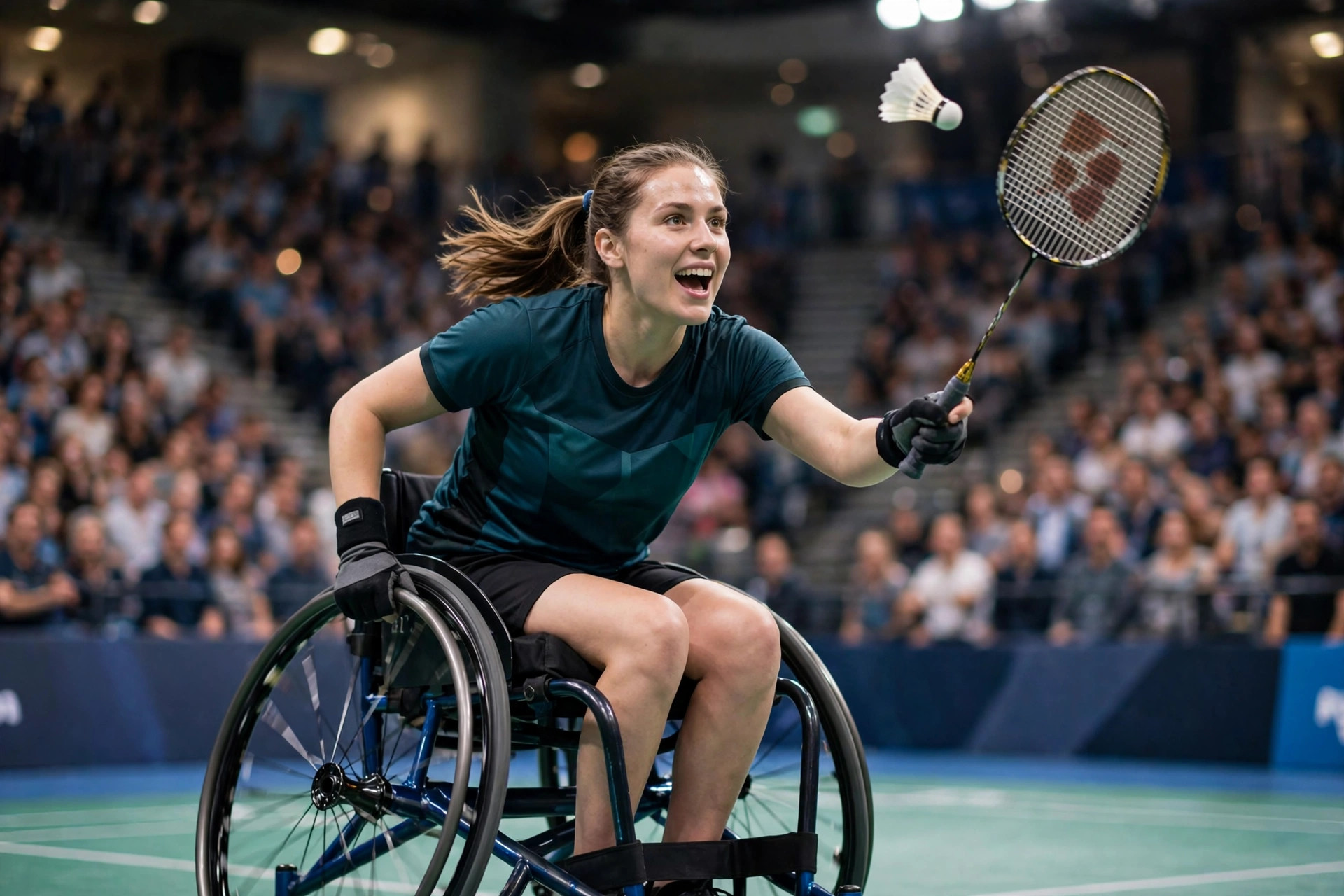
Para-badminton delivered some of the defining moments of the India Asian Para Games 2026 campaign, collecting 16 medals including three golds. The standout was the men's singles SL3 final, in which Paralympic champion Nitesh Kumar defeated compatriot and reigning world champion Pramod Bhagat 21-18, 21-16, to win gold and ensure an all-Indian podium. A final between two Indians, with the Paralympic champion beating the world champion, is a measure of how deep India's para-badminton talent pool has become.
Thulasimathi Murugesan and Manasi Girishchandra Joshi won gold in the women's doubles SL3-SU5, defeating China's Qiuxia Yang and Zuxian Xiao 21-16, 21-13. Thulasimathi also secured silver in the women's singles SU5, while Nithya Sre Sumathy Sivan finished with silver in the women's singles SH6 after losing to China's Fengmei Li. Naveen Sivakumar added gold in the men's singles SL4 on his Asian Para Games debut. Thulasimathi, who reached three finals while balancing her sporting career with veterinary medicine studies, later described the challenge of playing three matches in a day and dedicated her medal to her father, a reminder of the personal sacrifices behind the medal count.
The para-badminton results matter beyond the medal table because badminton is one of India's most popular sports, and para-badminton's visibility helps to normalise disability sport for a mainstream audience. When a final is contested between two Indians, and when the athletes' stories are told in the same breath as their results, the sport gains fans who may never have watched it before. That audience, in turn, supports the funding and facilities that produce the next generation.
India Asian Para Games 2026: archery, shooting and athletics stars
Para-archery produced historic results in Aichi-Nagoya. Sheetal Devi won two gold medals in a memorable campaign, while Harvinder Singh and debutant Vijay Sundi claimed the men's recurve doubles title. Bhawna and Pooja secured silver in the women's recurve doubles, earning India its first-ever medal in the event at the Asian Para Games. For a sport that demands extraordinary precision and composure, and in which India has invested steadily since its Paralympic breakthroughs, the archery results confirm that the investment is paying off.
In para-shooting, Mona Agarwal created history by winning gold in the women's 50m rifle 3 positions SH1 with a score of 357.5, setting world and Asian Para Games records, and becoming the first Indian para-shooter to win a medal in the event at the competition. She also won gold in the women's 10m air rifle standing SH1 event with a Games record. Her double gold, and her role as co-flag-bearer at the closing ceremony, made her one of the faces of the campaign, and her records are a reminder that India's para-shooters are now competing at world-record level, not merely at continental level.
Para-athletics contributed world-record and Games-record performances as well. Sandip Sanjay Sargar completed a sweep with bronze in the men's javelin after recording a Games record of 64.48 metres in the T44 category. Pranav Soorma won gold in the men's club throw F51 with a Games record of 32.87 metres, with Dharambir taking bronze. Navdeep won bronze in the men's javelin F40/F41, and Sandeep claimed bronze in the men's 100m T44, finishing his campaign with one gold, one bronze and a world record. Haney's world-record javelin throw was also among the standout results cited in coverage of the campaign. Together, these performances show an athletics programme that is producing record-breakers across throwing, sprinting and jumping events.
What the India Asian Para Games 2026 result means for Indian sport
The India Asian Para Games 2026 result should be read as a milestone in a longer story. India's para-sport journey, from a handful of athletes competing with minimal support to a 114-medal campaign from a 168-strong team, reflects changes in funding, coaching, classification, sports science and public attitudes. The Paralympic movement in India has grown rapidly since the country's breakthrough performances at Tokyo and Paris, and the Asian Para Games are where that growth is tested against the continent's best.
There are still gaps. India's fourth-place finish, impressive as it is, sits behind China and other established para-sport nations whose systems are deeper and better resourced. The challenge for the next cycle is to convert a record Asian Para Games into sustained Paralympic success, and to extend the depth seen in badminton, archery and shooting into sports where India is still developing. That will require continued investment in grassroots identification, in coaching for athletes with different impairments, and in facilities that are accessible not just for elite athletes but for children discovering sport for the first time.
For the athletes themselves, the closing ceremony in Aichi-Nagoya was a moment of recognition that goes beyond medals. Marching with the flag, led by Mona Agarwal and Nishad Kumar, they represented a country that is increasingly proud of its para-athletes, and increasingly willing to celebrate them as sporting heroes rather than as inspirational exceptions. The India Asian Para Games 2026 campaign, with its record 114 medals, its world records and its all-Indian finals, has given that pride a concrete, countable form. The next test will be whether the system that produced it can do so again, on an even bigger stage.
Sources: IANS, October 2026; MyKhel; The Daily Jagran. Links: India vs New Zealand 2nd T20I, Pakistan beat England in Lahore.