
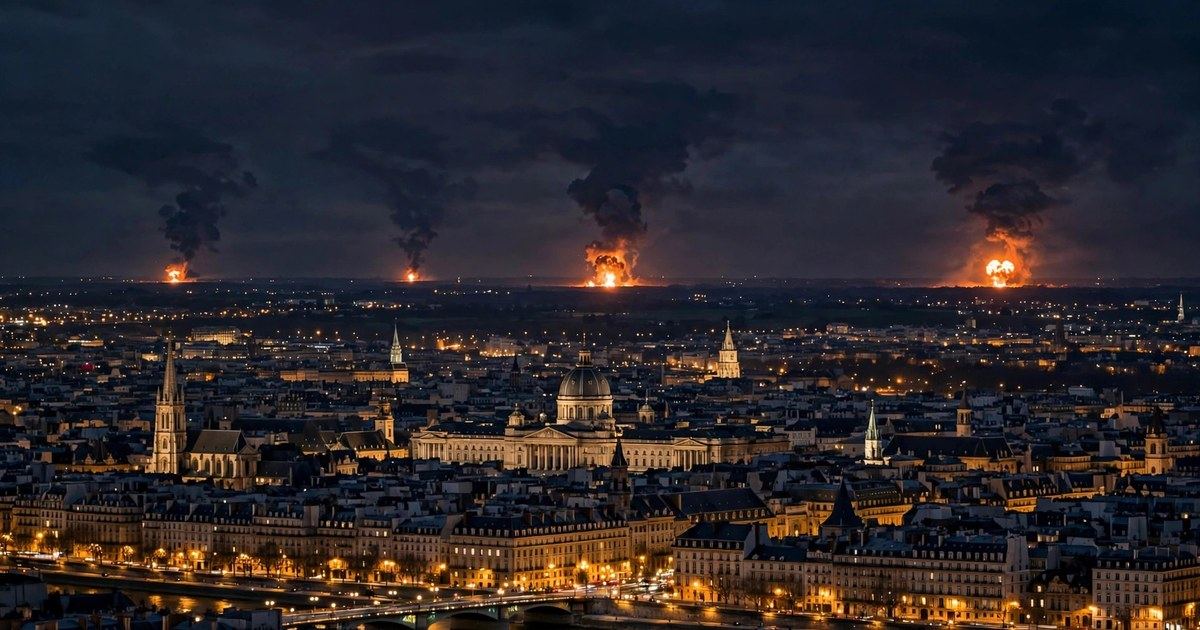
Kyiv came under another wave of Russian missile strikes overnight on Wednesday, just hours after Moscow said it was "in principle" ready to resume US-mediated peace talks — a stark collision of diplomacy and warfare that defined one of the most turbulent nights of the war this year.
Russian forces attacked the Ukrainian capital with ballistic missiles on Wednesday evening, striking private homes and a petrol station on the eastern side of the Dnipro River, according to Kyiv's military administration. Mayor Vitali Klitschko said six people were wounded, four of whom required hospitalisation, and urged residents to remain in shelters as Reuters witnesses reported explosions across the city.
The attacks did not stop there. It followed an earlier October wave of ballistic strikes on the capital. In the early hours of Thursday, missiles struck Kyiv again, a Reuters witness said — following the evening air strike that had already damaged homes, a petrol station and transport equipment. Ukraine's air force posted a warning of "more ballistic missiles towards Kyiv" and instructed residents to stay in shelters through the night.
The Associated Press reported that the overnight wave killed three people and wounded 12 in Kyiv, while attacks elsewhere in Ukraine killed two more people and injured at least 11. Energy infrastructure and residential buildings were among the targets, Ukrainian officials said, as Russia continued its campaign against both civilian and power infrastructure with winter approaching.
The strikes landed in the middle of the most intensive diplomatic push of the year. US special envoy Steve Witkoff had spent about three hours in talks with Vladimir Putin in St Petersburg on Wednesday — with President Donald Trump's son-in-law Jared Kushner joining by video link — after meeting Volodymyr Zelensky and the leaders of Norway and Finland in Oslo the previous day.
Trump described the effort as potentially the "closest we've been" to ending the war. But the Kremlin offered only a qualified response: Putin aide Yuri Ushakov said Moscow was "in principle, ready to resume" trilateral talks involving Russia, Ukraine and the United States after November 10, while warning there was "little substance" in the Ukrainian and European peace proposals the US diplomat had delivered.
The juxtaposition was hard to miss: a diplomatic opening announced in St Petersburg, followed within hours by ballistic missiles over Kyiv. It is a pattern Ukrainians know well — negotiations announced as cities burn — and one that has deepened Western scepticism about Moscow's intentions.
The battlefield, however, was not one-sided. In the Russian city of Lipetsk — home to a major steel plant some 400 kilometres south of Moscow — a man was injured as Ukrainian drones hit apartment buildings and a medical facility, Governor Igor Artamonov said. Russian authorities said they had intercepted more than 160 drones during the night, including waves flying toward Moscow itself.
That exchange underlined why the diplomacy matters: both sides retain the capacity to strike deep into each other's territory, and civilian casualties keep mounting on both sides even as negotiators talk about ending the war.
The peace track itself has seen genuine movement this week. Zelensky said on Wednesday that Kyiv could accept an agreement freezing the war along the current front lines — a significant reversal of his earlier opposition to territorial concessions, which he described as "a real way to end this war." Russia was ready in principle to resume trilateral talks in November after Witkoff's meeting, though no date or venue has been confirmed beyond Russian officials floating Abu Dhabi as a possible host city.
Talks have been stalled since February 2026, during which Russia has steadily increased strikes on Ukrainian cities while Ukraine has faced shortages of Western-supplied interceptors. Moscow launched its full-scale invasion in February 2022 and now controls roughly a fifth of Ukrainian territory; Putin has consistently rejected face-to-face talks with Zelensky and insisted Russia intends to seize the rest of eastern Ukraine.
The timing of any new round matters beyond the battlefield. A November 10 date would place talks after the US midterm elections, and Moscow's explicit linkage of the schedule to American domestic politics has not gone unnoticed in European capitals, where officials question whether the Kremlin is negotiating seriously or simply buying time while its forces hold the initiative along the front — a claim Ukraine and its allies dispute, pointing instead to stalemate.
The release this week of American citizen Stephen Hubbard — freed by Russia after Trump's personal appeal — was the one concrete humanitarian gain from the diplomatic shuttle, and a small signal that Moscow wants the channel to Washington to keep working.
The broader pattern behind the night's strikes is also worth noting. Russia has repeatedly used missile and drone barrages to coincide with diplomatic moments — a way to project strength at home and abroad while talks play out. Ukrainian officials have argued for months that every Russian offer to negotiate arrives alongside a new bombardment, and Western analysts increasingly read the two tracks as deliberate partners rather than contradictions: pressure on the cities, flexibility at the table.
For Ukraine's allies, the overnight attack was also a test of political patience. European leaders who have backed Kyiv through nearly four years of war watched the strikes unfold just as Washington was talking up a breakthrough. Several have warned privately that a deal reached while bombs fall risks rewarding aggression, even as they acknowledge that Zelensky's new openness to a front-line freeze — itself a major shift — creates the first plausible landing zone for a settlement in months.
The energy dimension added urgency to the night's events. Russian strikes have systematically targeted Ukraine's power grid in autumn campaigns for three years running, and the latest wave's reported hits on energy infrastructure fit that playbook exactly. Ukrainian grid operators had already been warning of difficult months ahead; every night like this one shortens the margin for error before winter demand peaks.
Whether the overnight strikes derail the fragile momentum is the open question. Trump has framed the current moment as his best chance yet at a deal, and Witkoff's shuttle between Oslo and St Petersburg shows the White House is investing real effort. But the missiles over Kyiv — and the bodies they left — will harden the resolve of those, including many European leaders, who argue that Russia only negotiates seriously when it cannot gain on the battlefield.
For now, Kyiv is counting its dead and clearing its rubble while the diplomats schedule their next meeting. The gap between those two realities — between "in principle" and in practice — remains the defining feature of this war.
Sources: Reuters, BBC, The Associated Press, ITV News.