
There is exactly one company in the world that makes the machines capable of printing the most advanced computer chips on the planet — and on October 14, 2026, it told the world it cannot build them fast enough. ASML, the Dutch firm behind the extreme ultraviolet (EUV) lithography systems at the heart of the artificial intelligence boom, reported record third-quarter sales of €11.7 billion, raised its full-year outlook, and warned that its planned production for 2027 and 2028 will not fully meet customer demand.
The story is trending per news coverage across international outlets, with The Times, Reuters, Morningstar and trade press all reporting on the results. It matters because ASML sits at the narrowest chokepoint of the global technology industry: every leading AI chip — the processors inside the data centres powering chatbots, image generators and autonomous systems — begins its life inside one of its machines. When ASML says demand is outrunning supply, it is really saying the AI boom is outrunning the physical capacity of the planet to build it.
The numbers: a record quarter by every measure
ASML’s third-quarter 2026 results, published from its headquarters in Veldhoven in the Netherlands, were records on nearly every line. Total net sales reached €11.7 billion (about $13.1 billion), up roughly 55% from €7.5 billion in the same quarter last year and up from €9.3 billion in the second quarter of 2026. Gross margin came in at 57.5%, above the company’s own guidance of 55% to 57%. Net income hit €5.0 billion, with basic earnings per share of €12.95 — more than double the €2.9 billion net income of the previous quarter. Net income included a €500 million gain from the revaluation of an early investment tranche in French AI company Mistral AI.
The company sold 113 new lithography systems in the quarter, up from 86 in the second quarter, plus 8 used systems. Its Installed Base Management business — services, spare parts and productivity upgrades for machines already in customers’ factories — generated €3.3 billion in sales, about €400 million more than guided, and was the main reason the gross margin beat expectations. Chief Financial Officer Roger Dassen described it as a record quarter for both sales and gross margin, crediting strong execution against very strong market demand.
Looking ahead, ASML guided fourth-quarter sales of €14.2 billion to €15.2 billion with a gross margin of around 57%, and raised its full-year 2026 sales outlook to between €44 billion and €45 billion with a gross margin of around 56% — the third upward revision of its forecast this year. Shares rose in Amsterdam and in premarket trading in New York after the announcement. The stock has climbed roughly 64% to 80% over the past year, and ASML became Europe’s most valuable company during 2026.
Why demand is outrunning supply
The driver is artificial intelligence, and specifically the enormous build-out of data centres by the world’s largest technology companies. Every new generation of AI model — from Google’s Gemini 4 Argon to Meta’s Muse Wonder — demands more computing power, which demands more advanced chips, which demand more of ASML’s machines. Chipmakers are not just ordering for next year: ASML said customers are increasing their short- and medium-term equipment demand forecasts and that some are already expressing interest in placing orders for delivery in 2029 and even 2030.
That forward visibility is unusual in an industry famous for boom-and-bust cycles, and it is why ASML’s warning landed so hard. The company had previously planned to increase production capacity by about 30% in 2027, and was already considering a similar expansion for 2028. On Wednesday it said those plans will no longer be enough: supply as currently planned for both 2027 and 2028 will not fully meet customer demand. Management is now investigating ways to expand 2028 capacity beyond the previously communicated 30% increase, and is looking at raising EUV output capacity by roughly 30% in 2027 from a 2026 target of about 65 low-numerical-aperture systems.
One analyst note captured the market’s read: the more important takeaway from the quarter was not any single sales figure, but customers trying to secure production slots four years out. In an industry where orders once ran a year or two ahead, chipmakers are now competing to lock in machine supply for the rest of the decade.
What makes ASML irreplaceable
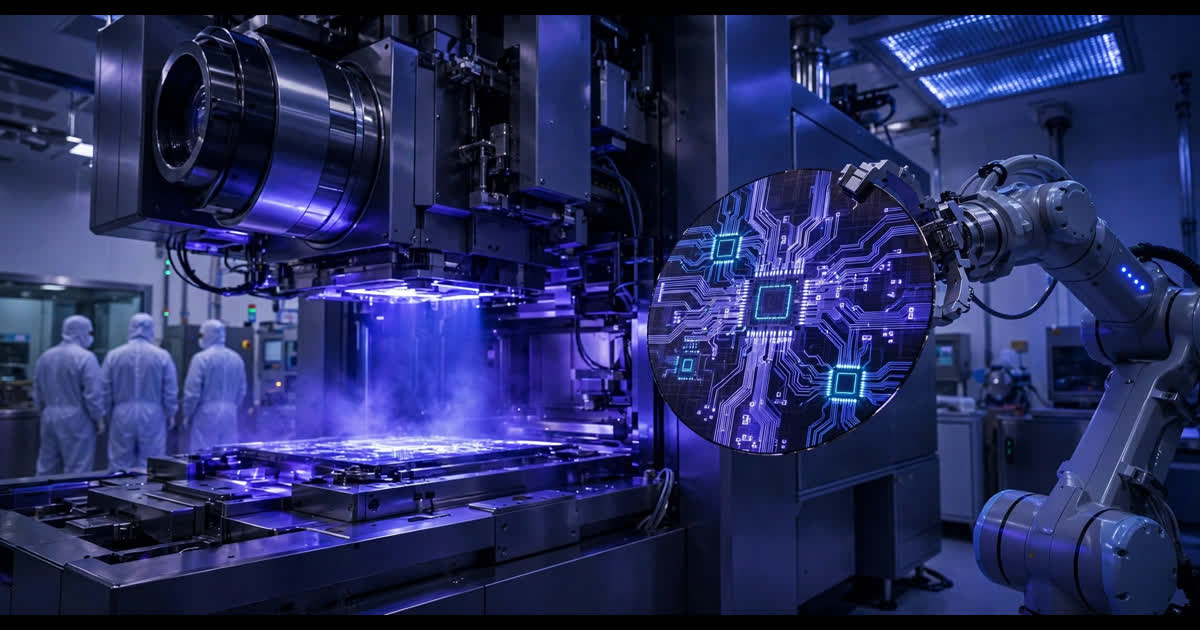
To understand why no rival can simply step in, it helps to understand what an EUV machine actually does. Modern chips are made by projecting extraordinarily detailed circuit patterns onto silicon wafers, then etching those patterns into place with chemicals. The process is repeated, layer upon layer, up to 100 times on the same wafer before it is sliced into individual chips. EUV lithography uses light with a wavelength of just 13.5 nanometres — far beyond visible light — to draw features at a scale roughly twice the width of a strand of human DNA.
Building a machine that does this reliably, millions of times, in a factory, is one of the hardest engineering problems ever solved. Each EUV system is the size of a small bus, contains around 100,000 precision components and about 2 kilometres of cabling, and costs roughly $200 million. ASML is the only company in the world that sells them. Its customers are the three companies that make the world’s most advanced chips: TSMC in Taiwan, Samsung in South Korea, and Intel in the United States. Every link of the AI supply chain — from chip design to chip packaging and encapsulation — ultimately depends on these machines existing in the first place.
That monopoly position explains both the record margins and the record backlog. When demand for advanced chips rises, it flows, sooner or later, into orders for ASML machines. And because each machine takes years of precision manufacturing, supply cannot snap higher the way software can. The bottleneck is physical, and it is measured in factories, components and trained engineers — not code.
The China question
ASML’s record results also come with a geopolitical shadow. The company has been caught in the middle of the technology rivalry between the United States and China. Washington has led efforts to restrict exports of advanced chipmaking equipment to China over concerns the technology could strengthen the Chinese military, and Beijing has reacted furiously, describing the measures as “technological terrorism.”
ASML has previously warned that its sales to China would decline significantly this year as a result of the curbs. On Wednesday, Dassen said China would represent around 20% of the company’s business this year, in line with previous forecasts. The company has also denied reports that one of its advanced machines ended up in China in potential violation of the restrictions. Meanwhile, China is reportedly in the early stages of developing its own EUV technology — a long, expensive effort that, even if it succeeds, would take years to match ASML’s decades of accumulated know-how.
For now, the export curbs have not dented ASML’s growth, because demand from everywhere else has more than filled the gap. But the China question remains the biggest long-term risk hanging over the company, alongside the possibility that the AI spending boom eventually cools.
What it means for the AI boom — and for everyone else
ASML’s warning is, paradoxically, both good news and bad news for the AI industry. Good news, because it confirms that chipmakers see AI demand stretching years into the future — the build-out is not a short-term bubble of orders, but a multi-year construction programme. Bad news, because it means the physical infrastructure of AI will remain constrained: data centres cannot be built faster than the machines that make their chips can be built.
For consumers, the practical effect is likely to be continued scarcity — and continued high prices — at the cutting edge of computing, from AI accelerators to the most advanced smartphones and laptops. For investors, ASML’s results set the tone for the rest of semiconductor earnings season: the first major chip company to report has effectively told the market that demand is not the problem, supply is.
There are risks. ASML trades at a premium valuation that assumes the AI boom keeps growing. If AI spending slows, or if geopolitical restrictions tighten further, the order book could thin. The company is also still digesting a January reorganisation that cut around 1,700 jobs in the Netherlands and the United States, mostly in leadership roles, out of a workforce of roughly 44,700. Scaling production while reshaping management is a difficult balancing act.
What to watch next
Three things will show whether this quarter was a peak or a stepping stone. First, the fourth-quarter results: ASML has guided to €14.2 billion to €15.2 billion in sales, which would cap a year of roughly €44 billion to €45 billion. Second, concrete capacity announcements: whether the company commits to expanding 2028 production beyond the 30% increase already on the table, and how fast it can bring new manufacturing online. Third, the rest of earnings season: if TSMC, Samsung and Intel confirm the same demand picture, ASML’s warning will look less like one company’s bottleneck and more like the defining constraint of the AI era.
For now, the picture is clear. The company that makes the machines that make the chips that power AI has just posted the best quarter in its history — and it is telling its customers that, for the next two years at least, it will not be able to make enough of them.
Worldlession will update this story as ASML’s capacity plans and the wider chip earnings season develop.
Sources: ASML press release via GlobeNewswire, The Times, Morningstar, Reuters via AFP reporting, Unite.AI.