
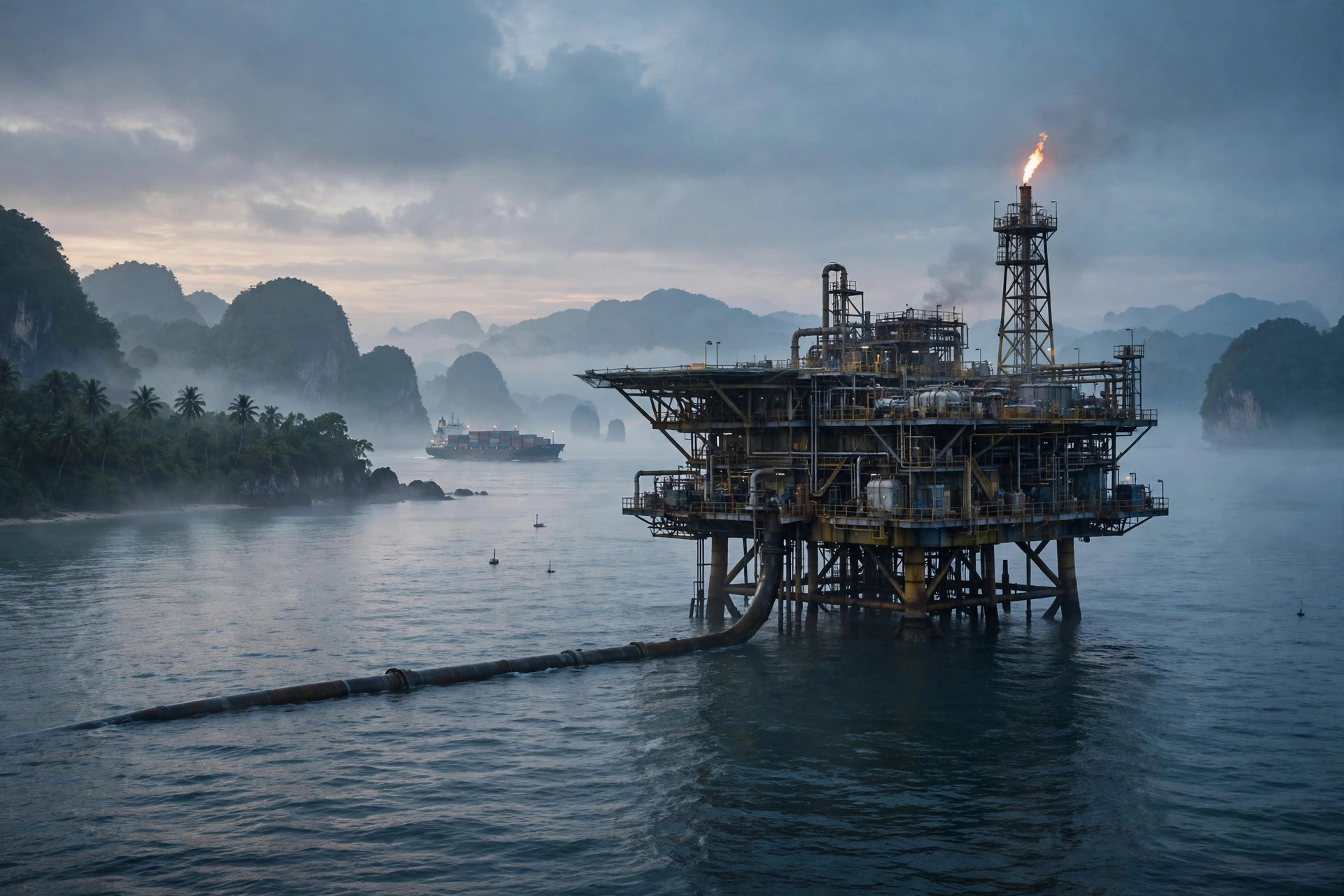
Indonesia gas exports Singapore arrangements changed on Saturday 24 October 2026, when Indonesia reduced the amount of pipelined natural gas it sends to Singapore by 31 million standard cubic feet per day, a unit usually shortened to mmscfd. The reduction was not a complete stop. Gas continued to flow, but at a lower daily rate, and the gas that was held back was redirected to meet electricity needs at home. For readers following energy news in Southeast Asia, the story matters less because of the immediate size of the cut than because of what it reveals about competing demands for gas, the limits written into long-term supply contracts, and the decisions that will shape supply when existing contracts come up for renewal in 2028.
The cut was made up of two parts. Fifteen mmscfd came from the Natuna fields, and 16 mmscfd came from Sumatra. Together, those two reductions add up to the headline figure of 31 mmscfd. Officials linked the decision to two pressures at home. The first was a need to protect domestic electricity supply in Batam, Bintan and parts of Sumatra. The second was maintenance work on wells. The domestic electricity concern followed a 16-hour blackout earlier in October in Batam and the Riau Islands, an event that underlined how quickly a shortage of fuel for power generation can affect homes, businesses and public services. Redirecting gas to domestic power generation was presented as a way to reduce the risk of a repeat disruption while maintenance was carried out.
Indonesia gas exports Singapore: what the cut covers
To understand the scale of the change, it helps to place the 31 mmscfd figure alongside the larger flows it sits within. Indonesia's total pipeline gas exports to Singapore were 409.55 mmscfd, so the cut represents about 8 percent of that pipeline supply. That is a noticeable share of one supply route. Set against Singapore's total daily gas demand, however, the same cut amounts to under 2 percent. The difference between those two percentages explains why officials and analysts have described the immediate impact as expected to be small. A change that looks material when measured against a single pipeline route can look much smaller when measured against a whole national energy system that draws on several different sources.
Singapore's Energy Market Authority made that broader point directly. It said the cut was a small share of Singapore's total daily gas demand and noted that Singapore also imports liquefied natural gas, usually called LNG, from many countries. That distinction between pipeline gas and LNG is central to the story. Pipeline gas arrives through a fixed physical link and is tied to particular fields and contracts. LNG arrives by ship in liquid form, is turned back into gas after arrival, and can be bought from a wider range of suppliers around the world. A country that can draw on both routes has more ways to respond when one route is reduced, even if no single alternative can be switched on instantly or without cost. The presence of LNG imports does not remove all risk, but it does spread risk across more suppliers and more shipping routes.
Why domestic demand came first in Indonesia
Indonesia's decision was framed by its government as a matter of domestic priority. Energy Minister Bahlil Lahadalia said on 26 October that supply still met the contractual minimum, and that a cut of 10 percent would breach the contract. His message was that Indonesia had stayed within the terms it had agreed, while still putting domestic needs first. He also said, in words reported by news outlets, that Indonesia is a nation that honours contracts, and that the country was prioritising domestic needs and reviewing contracts. The combination of those points matters: it suggests a government trying to balance two duties at once, keeping faith with buyers abroad while ensuring that homes and power systems at home are not left short.
The domestic pressure behind that balance was concrete. Batam, Bintan and parts of Sumatra needed gas for electricity, and the earlier 16-hour blackout in Batam and the Riau Islands had shown what happens when power supply fails for an extended period. A blackout of that length disrupts daily life in ways that go beyond inconvenience. Refrigeration, lighting, communications, water pumping, hospitals, small businesses and transport can all be affected. Governments facing that kind of disruption often move quickly to secure fuel for power generation, even when doing so means reducing exports. Well maintenance added a second, practical constraint. Maintenance can temporarily reduce how much gas can be produced or moved, and scheduling it alongside a redirection of supply can make the combined effect larger than either factor alone would produce.
Energy supply decisions of this kind are also shaped by the wider regional picture. A sudden disruption at a major energy facility elsewhere can tighten markets and raise prices, as shown in recent reporting on the Ras Tanura refinery attack and oil prices. Gas markets are different from oil markets in important ways, but the lesson is similar: when one source of energy is interrupted, buyers and governments look harder at the reliability of every other source. In Indonesia's case, the response was to protect domestic electricity first and to signal that contract terms still mattered. In Singapore's case, the response was to point to the small share of total demand involved and to the range of LNG suppliers available.
Indonesia gas exports Singapore and the wider supply picture
Singapore's position in this story reflects a broader feature of its energy system. The city-state imports the gas it uses, so security of supply depends on contracts, infrastructure and relationships with suppliers rather than on domestic production. That dependence is not unusual for a small island economy, but it does mean that decisions taken in supplier countries are watched closely. A cut of under 2 percent of daily demand is unlikely on its own to cause a shortage, especially when LNG can be drawn from many countries. The more important question is what the cut signals about future supply. If a supplier begins to prioritise domestic use more strongly, buyers may ask whether future volumes will be as secure, what price they will pay, and how much flexibility they will have if domestic demand in the supplier country grows further.
Prime Minister Lawrence Wong addressed the contractual side of that question on 25 October. He said he expected all parties to honour commercial commitments, and that Singapore gas importers would protect their contractual rights. That statement did not describe a dispute, but it did set out an expectation clearly. Commercial gas contracts typically set out volumes, prices, delivery points and minimum supply levels. When a supplier reduces volumes, buyers will check the reduction against those written terms, including any minimum that must still be met. The Indonesian energy minister's reference to the contractual minimum and to the 10 percent threshold for a breach suggests that both sides were measuring the cut against the same kind of test, even as they described it from different angles.
Analysts quoted in news coverage looked beyond the immediate numbers to the next major decision point. Prateek Pandey of Rystad Energy said the bigger test would come when existing contracts expire in 2028. That assessment shifts attention from the 31 mmscfd cut itself to the negotiations that will determine what replaces the current arrangements. Contract renewals are moments when volumes, prices, duration and flexibility can all be revisited. A supplier with growing domestic demand may seek lower export volumes or higher prices. A buyer that wants security may seek firmer commitments, more diverse sources, or a larger role for LNG. The outcome will depend on how much gas Indonesia can produce, how fast its domestic demand grows, how much investment goes into new fields and infrastructure, and how competitive LNG remains as an alternative.
The regional context adds further layers. Indonesia also assured the Philippines on coal and gas supplies, according to BusinessWorld reporting linked to Singapore International Energy Week, a reminder that Indonesia's energy decisions affect more than one neighbour. Singapore, for its part, has pursued diversification in other fuels as well, including a memorandum on Singapore-Saudi crude storage in Jurong. Crude oil storage and natural gas supply are different parts of the energy system, but both point in the same direction: spreading supply across more partners and more forms of storage or delivery reduces the effect of a disruption in any single place. For households, the lesson is less direct. Gas supply decisions rarely change a household bill overnight, but over time they influence the cost and reliability of electricity, which in Singapore is closely linked to gas-fired power generation.
What happens next for contracts and supply in 2028
The next steps are likely to be measured rather than dramatic. In the short term, the key questions are whether the reduced flow continues, whether maintenance is completed on schedule, and whether domestic electricity supply in Batam, Bintan and Sumatra remains stable. If the blackout risk eases and wells return to normal operation, the immediate pressure that prompted the cut may ease as well. If domestic demand stays high, however, Indonesia may keep a closer eye on how much gas it can spare for export without risking shortages at home. Singapore's importers, meanwhile, will continue to monitor deliveries against contract terms and to weigh LNG purchases as a buffer.
In the medium term, contract review will matter more than any single day's flow. Indonesia has said it is reviewing contracts, and Singapore has said importers will protect contractual rights. Those two statements are not necessarily in conflict. A review can clarify volumes and minimums, update terms to reflect new production and demand realities, and set out what happens if domestic needs rise again. The 2028 expiry of existing contracts gives both sides a clear timetable. Negotiations that begin well before expiry tend to produce more stable outcomes than talks left until the last moment, because both sides have time to arrange alternative supplies, plan investment, and test prices. Readers should therefore watch for announcements about talks, reviews and renewals rather than expecting a single decisive event.
Longer-term investment will also shape the story. Gas fields need ongoing investment to maintain output, pipelines need maintenance, and power systems need enough capacity to meet demand on hot days and during outages. If Indonesia invests in domestic production and infrastructure, it may be better placed to meet both domestic and export commitments. If investment lags demand, the tension between home and export markets is likely to return. Singapore's diversification through LNG from many countries, and through storage and supply arrangements in other fuels, is part of the same long-term calculation. No single cut, contract or shipment decides energy security on its own. It is the pattern of decisions over several years, measured in volumes, contract terms and investment, that determines whether supply remains reliable and affordable. The 31 mmscfd reduction is best read as an early signal in that longer story, not as its conclusion.
The Indonesia gas exports Singapore cut should therefore be read in two ways at once. Measured against pipeline supply, it is a noticeable reduction of about 8 percent. Measured against total demand, it is under 2 percent, with LNG from many countries providing a buffer while domestic electricity needs and maintenance are addressed in Indonesia.
Looking ahead, the Indonesia gas exports Singapore relationship will be tested less by a single day's flow than by contract reviews, investment in production and infrastructure, and the renewal negotiations that approach as existing contracts expire in 2028.
- The cut was 31 mmscfd from 24 October 2026: 15 mmscfd from Natuna fields and 16 mmscfd from Sumatra.
- The cut was about 8 percent of pipeline gas supply to Singapore, but under 2 percent of Singapore's total daily gas demand.
- Gas was redirected to domestic electricity in Batam, Bintan and parts of Sumatra after a 16-hour blackout and during well maintenance.
- Indonesia said supply still met the contractual minimum; a 10 percent cut would breach the contract.
- Singapore pointed to LNG imports from many countries, and analysts pointed to contract expiries in 2028 as the bigger test.
Debates about household energy costs show how closely supply decisions are watched in other markets too, including the decision reflected in coverage of UK gas standing charges scrapped in the 2026 budget. The details differ, but the underlying concern is familiar: people want energy that is available when needed and priced in a way they can understand. For Indonesia and Singapore, the immediate facts are clear, the contractual positions have been stated, and the more consequential decisions lie ahead in contract talks and investment choices. Following those steps, rather than reacting to a single day's reduction, will give the clearest picture of how gas supply in the region develops.
Sources: Reuters, Channel News Asia, Energy Market Authority, October 2026.