
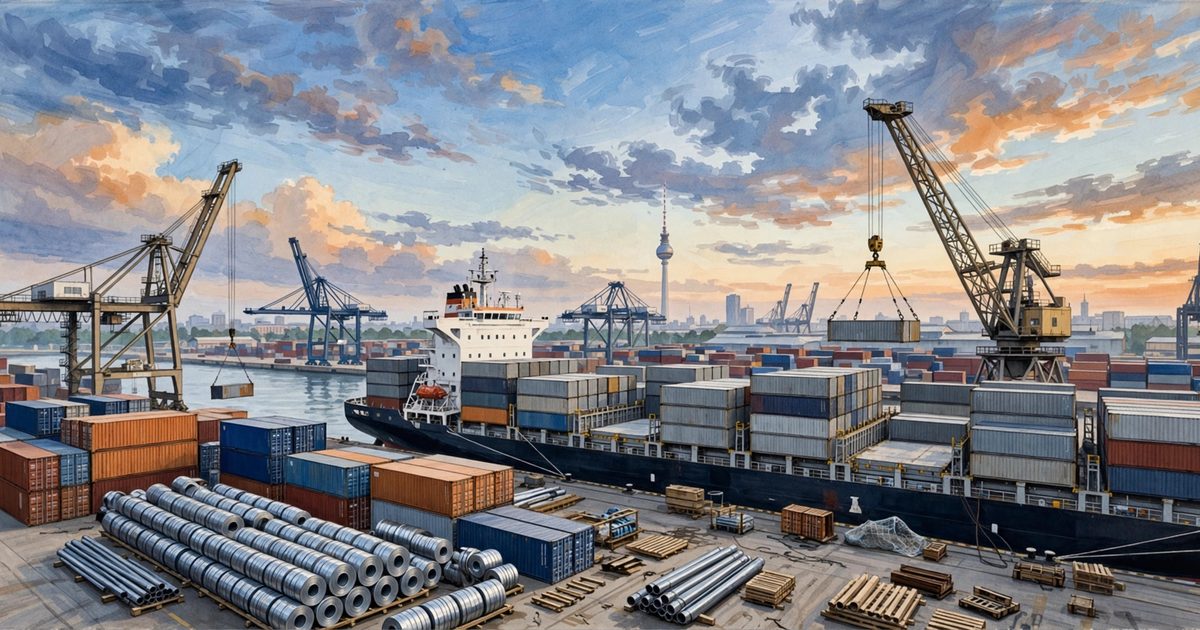
The India EU trade deal was supposed to be the story of Piyush Goyal's trip to Berlin this week. Instead, the headline became a fight — over the EU's carbon border tax. Speaking at the Berlin Global Dialogue during a visit running from 22 to 24 October, India's commerce and industry minister delivered New Delhi's bluntest public attack yet on the Carbon Border Adjustment Mechanism (CBAM): "You're inviting disaster," he told his European audience. The remark landed in the middle of a six-day, 100-company trade mission to Germany and the Netherlands (22–27 October) whose official purpose is to push the long-running India-EU free trade agreement towards the finish line. This explainer sets out what CBAM actually is, why India objects so strongly, which exporters stand in the firing line, and what the clash means for the India EU trade deal in 2026.
What is CBAM, the EU carbon border tax?
CBAM is the European Union's attempt to stop "carbon leakage" — the risk that climate rules at home simply push polluting production abroad. Under the EU's emissions trading system, European factories already pay for every tonne of carbon they emit. CBAM extends a matching charge to selected imports: steel, aluminium, cement, fertilisers, electricity and hydrogen. Importers must report the emissions embedded in each shipment — a requirement in force since the transitional phase began in October 2023 — and, under the definitive regime phasing in from 2026, surrender CBAM certificates priced off the EU carbon market. Goods made with cleaner power pay less; goods made with coal-heavy grids pay more. Brussels presents CBAM as an environmental measure that applies the same carbon price to everyone selling into Europe, and points out that exporters can deduct any carbon price already paid at home.
Why India is fighting the EU carbon border tax
New Delhi's objections operate on three levels. The first is fairness: climate diplomacy has long recognised "common but differentiated responsibilities" — the idea that wealthy economies, responsible for most historical emissions, should move first and fastest. A single EU carbon price applied to a steel mill in Jharkhand and a steel mill in Germany, India argues, ignores the vast difference in income and historical responsibility between the two economies. The second is practical: measuring, verifying and certifying embedded emissions for every consignment is a heavy compliance burden, falling hardest on small firms with thin margins. The third is strategic suspicion — shared by several emerging economies — that CBAM functions as green protectionism, raising the cost of imports precisely where developing countries are most competitive, while EU industry receives transitional shelter at home. Goyal's "inviting disaster" line was aimed at all three arguments at once, and at an audience of European policymakers and chief executives rather than the cameras back home.
How CBAM hits India's exports to Europe
The exposure is concentrated but real. Iron and steel are India's most CBAM-sensitive exports to the EU, with aluminium second; both industries sell into Europe at volumes that make even a few percentage points of added cost commercially significant. Indian mills are, on average, more coal-dependent than European rivals, so their embedded-emissions bills run higher unless producers invest in cleaner power, scrap-based production or hydrogen-based steelmaking — investments that take years and capital. That is why the fight matters beyond this week's headlines: CBAM effectively sets a carbon-efficiency deadline for any Indian exporter who wants to keep selling into the world's richest consumer market, a pressure that also shadows other relationships, as our coverage of India's trade deal with the United States shows.
There is a wider geopolitical undertow. Washington has pressed Europe to deploy trade weapons against India and China over Russian oil purchases — a request European capitals refused, as we reported in Europe's refusal of US secondary-tariff demands. Europe needs India as a partner and a market even as it defends its climate rules; India knows it. That mutual dependence is precisely why the CBAM argument is being conducted at full volume but inside a negotiating room, not a trade war.
Help for the smallest exporters
Alongside the rhetoric, Goyal brought a concrete domestic measure: the government will bear the full certification costs for micro and small exporters under the ₹25,060-crore Export Promotion Mission. Certification — proving a product's embedded emissions to EU standards — is exactly the kind of fixed cost that can shut a small firm out of a market entirely, whatever the tariff rate. Covering it does not answer India's principled objection to CBAM, but it signals that New Delhi is preparing its exporters to live with the mechanism even while it negotiates against it — a hedge that also buys time for Indian industry to decarbonise production.
Where the India EU trade deal stands now
The free trade agreement itself has been decades in the making: first launched in 2007, frozen in 2013, and relaunched in 2022 with fresh political energy on both sides. The current push is the most serious yet. Goyal's delegation — around 100 companies touring Germany and the Netherlands across 22–27 October — is designed to demonstrate the commercial prize: two economies whose trade already runs well past €120 billion a year, with Europe among India's largest partners and India among Europe's fastest-growing major markets. Industrial deals inside the EU show how intricate the bargaining gets — our explainer on the France-Germany EU auto deal is a case study — and cars, wines and spirits, agriculture and services access all remain on the table alongside carbon.
Can the deal close with CBAM unresolved? India's position is that a trade agreement cannot be separated from a carbon regime that taxes the very exports the agreement is meant to expand; the EU insists CBAM is climate law, not a bargaining chip. The likeliest path — transition periods, recognition of Indian carbon pricing, and finance for greener steel — is visible in both sides' talking points. What Berlin made clear is that the argument will be loud, public and central to whatever deal emerges. For Indian exporters, the practical advice is already clear: measure your carbon now, because Europe is going to ask, deal or no deal.
Sources: The Hindu BusinessLine; IBEF; European Commission CBAM guidance, October 2026.