
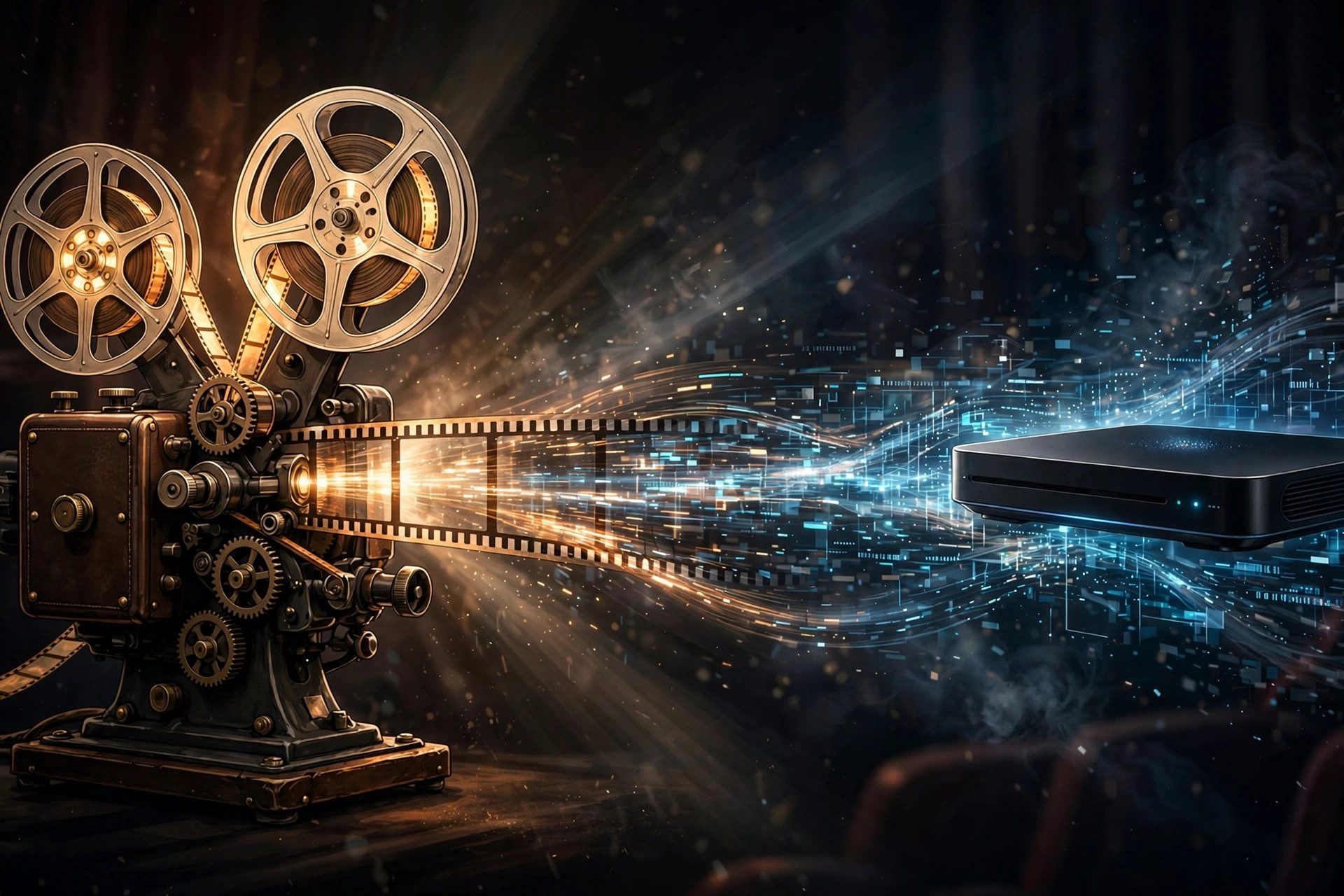
On December 28, 1895, in a Paris basement, the Lumière brothers projected ten short films to a paying audience. The screening lasted about twenty minutes. Nobody in that room could have imagined they were witnessing the birth of the most influential art form of the twentieth century.
From flickering silent shorts to billion-dollar streaming epics, cinema's 130-year journey mirrors the story of modern technology itself. This is the history of how movies were invented, how they learned to talk, how color and sound transformed them, and how streaming rewrote the rules once again.
The Invention of Cinema (1890s)
Motion pictures emerged from a burst of late-19th-century invention. In the United States, Thomas Edison's laboratory developed the Kinetoscope (a peep-show viewer) and the Kinetograph camera. But it was France's Auguste and Louis Lumière who made the decisive leap: the Cinématographe, a single device that could record, develop, and project film.
The Lumières' first public screening featured everyday scenes — workers leaving a factory, a train arriving at a station (legend says audiences flinched). Meanwhile, in America, Edison's company and others raced to project films to larger audiences. Within a year, "movie houses" were opening across Europe and America.
The Silent Era (1895–1927)
For three decades, films had no synchronized sound — but "silent" cinema was anything but. Theaters employed live musicians, from solo pianists to full orchestras, and many prints included tinting and toning for color effects.
The Rise of the Stars and Studios
Hollywood's studio system took shape in the 1910s and 1920s. Filmmakers like D.W. Griffith (The Birth of a Nation, 1915) pioneered editing grammar — close-ups, cross-cutting, flashbacks — that remains the foundation of film language. Charlie Chaplin, Buster Keaton, and Harold Lloyd turned screen comedy into high art, while German Expressionism (The Cabinet of Dr. Caligari, 1920) and Soviet montage (Eisenstein's Battleship Potemkin, 1925) pushed the medium's artistic boundaries.
The First Epic Scale
By the mid-1920s, Hollywood was producing spectacles like Ben-Hur (1925) with casts of thousands. Global film industries flourished: India released its first feature, Raja Harishchandra, in 1913, planting the seeds of what would become Bollywood — today the world's most prolific film industry by output.
The Sound Revolution (1927–1930s)
Everything changed on October 6, 1927, when Warner Bros. released The Jazz Singer, featuring synchronized dialogue — including Al Jolson's famous line, "You ain't heard nothin' yet!" Within two years, silent production had virtually ceased in Hollywood.
Sound transformed the industry overnight. Theaters needed expensive rewiring; silent stars with unsuitable voices saw careers collapse; studios scrambled to build soundstages. But it also enabled new genres — the movie musical exploded with 42nd Street (1933) and Fred Astaire's dance films — and gave us the rapid-fire dialogue comedies of the 1930s.
The Golden Age of Hollywood (1930s–1950s)
The studio system reached its peak: five major studios (MGM, Paramount, Warner Bros., 20th Century Fox, RKO) controlled production, distribution, and exhibition. Stars were under long-term contract, and the studios released hundreds of films a year.
Color Arrives
Technicolor's three-strip process brought vivid color to The Wizard of Oz and Gone with the Wind (both 1939). Color was initially reserved for prestige pictures and musicals; by the 1960s it became the default.
The Fall of the Studio System
Two blows ended the Golden Age: the 1948 Paramount Decree forced studios to sell their theater chains, and television began stealing audiences. Weekly cinema attendance in America collapsed from 90 million in 1948 to under 30 million by the early 1960s. Hollywood responded with widescreen formats (CinemaScope), 3D experiments, and ever-bigger epics.
New Waves and New Hollywood (1960s–1970s)
While Hollywood struggled, the French New Wave (Godard, Truffaut) reinvented film grammar with handheld cameras and jump cuts. Then a generation of American film-school directors — Coppola, Scorsese, Spielberg, Lucas — fused European artistry with Hollywood storytelling. The result: The Godfather (1972), Jaws (1975), and Star Wars (1977).
Jaws and Star Wars invented the modern blockbuster: wide releases, massive marketing, and merchandising empires. The industry reorganized around tentpole franchises — a model that still dominates.
The Digital Revolution (1990s–2000s)
Computer-generated imagery crossed the uncanny valley with Jurassic Park (1993) and Toy Story (1995), the first fully computer-animated feature. Digital cameras gradually replaced film; by the 2010s, even celluloid loyalists were exceptions.
Meanwhile, DVDs created a massive home-video revenue stream — briefly making studios more money than theaters — before the internet began dismantling physical media.
The Streaming Era (2010s–Today)
Netflix's pivot from DVD rentals to streaming (2007), then to original content with House of Cards (2013), detonated the industry's business model. Disney, Warner Bros., Apple, and Amazon launched rival platforms, triggering the "streaming wars."
What Changed
- Distribution: a film can now reach 200 million households overnight, with no prints or theaters.
- Prestige: streaming films like Roma (2018) and CODA (2021) won Best Picture Oscars, ending the theatrical monopoly on legitimacy.
- Data-driven greenlights: platforms use viewing data to decide what gets made — a fundamental shift from gut-instinct studio executives.
- The theatrical question: cinemas survived by betting on spectacle — IMAX, premium formats, and event films that demand a big screen.
Film Preservation: Saving Cinema's Past
Ironically, the industry that records everything has lost much of its own history. An estimated 75% of silent-era films are gone forever — decomposed nitrate stock, studio fires, and deliberate destruction of prints once deemed worthless. The 1965 MGM vault fire alone destroyed hundreds of early titles. Today, archives like the Library of Congress, the BFI, and Martin Scorsese's Film Foundation race to digitize and restore what survives, from painstakingly reconstructed silent classics to fading 1980s color negatives affected by vinegar syndrome. Every restored film is a small victory against cultural amnesia.
Global Cinema Today
Hollywood no longer owns the movies. South Korea's Parasite (2019) became the first non-English film to win Best Picture. India's film industries produce over 1,500 features a year. Nollywood (Nigeria) releases hundreds of low-budget features annually. Anime films like Demon Slayer (2020) outgross Hollywood blockbusters in key markets.
From a Paris basement to a phone in your pocket, cinema keeps reinventing how stories are told — and the next chapter, whether it involves AI, virtual production, or formats we cannot yet imagine, is already being written. Explore more in our entertainment collection, including our beginner's guide to anime.