
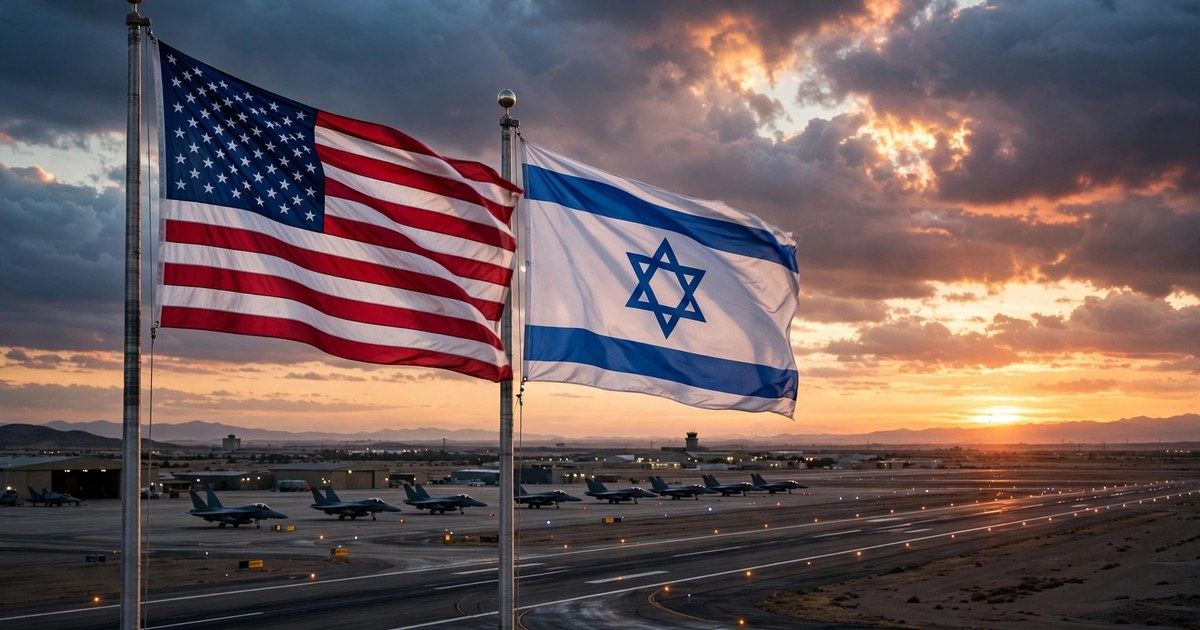
The United States defence secretary made a secret trip to Israel this week, holding an unannounced meeting with Prime Minister Benjamin Netanyahu just eight days before Israelis vote in their first national election since the October 7, 2023 Hamas attack. The visit, first reported by Axios on Monday, October 19, 2026, has put the spotlight on the extraordinary intersection of American military planning and Israeli domestic politics — with the future of a possible new round of fighting against Iran hanging in the balance.
The visit: what was reported
According to Axios, which cited two sources with knowledge of the trip, Defence Secretary Pete Hegseth met Netanyahu during a visit to Israel on Monday that had not been announced in advance. The meeting took place at Ovda Air Base in southern Israel, where US refuelling aircraft and fighter jets are deployed, the sources said. Hegseth also met American troops stationed at the base.
Neither side has officially confirmed the encounter. The Pentagon declined to comment, Israel's embassy in Washington did not immediately respond to requests for comment, and Reuters reported it could not independently confirm that the meeting took place. Hegseth himself offered only a hint in public: in a social media post, he said he had visited US service members in the Central Command area of responsibility, which covers the Middle East, northeast Africa and parts of Asia, and later posted an image of himself with troops serving under US Central Command.
The secrecy is itself the story. Defence secretaries do not normally travel to allied capitals without any public announcement — unannounced visits are usually reserved for active war zones or moments of acute crisis. That Washington chose stealth for a trip to a close ally, eight days before that ally's election, has fuelled speculation in Israel and the United States about what was actually discussed behind closed doors at Ovda.
The timing: eight days before Israel's election
Israelis go to the polls on Tuesday, October 27, 2026, to elect all 120 members of the Knesset. It is the country's first national vote since the October 7, 2023 Hamas attack — the deadliest day in Israel's history — which set off the war in Gaza and reshaped Israeli politics for years. The outgoing Knesset dissolved in July after completing a rare full four-year term, making Netanyahu's government the first Israeli government to serve a complete term since 1973.
The polls point to a deadlocked result. A Maariv survey published days ago put Netanyahu's coalition bloc and the opposition bloc level at 51 seats each — both far short of the 61 needed for a majority. Other recent polls have the two camps at 52 to 55 seats apiece. Likud, Netanyahu's party, has slipped to around 18 to 21 seats, while former army chief Gadi Eisenkot's new Yashar party leads or ties it in most surveys with 21 to 23 seats. Arab parties, holding a combined 12 to 15 seats, could end up as kingmakers in coalition negotiations, and a majority of Israelis say they would prefer a unity government to yet another election.
Into this knife-edge contest, the United States has now waded directly. A day before news of Hegseth's visit broke, President Donald Trump issued a full-throated endorsement of Netanyahu on Truth Social, declaring he had his "Complete and Total Endorsement" and praising him as an American ally in the war against Iran. For more on the endorsement and the election stakes, see our earlier explainer on Trump's endorsement of Netanyahu ahead of the October 27 vote.
The Trump–Vance split
What makes the Hegseth visit especially striking is that the Trump administration is not speaking with one voice on the Israeli election. On the same day the Axios report emerged, Vice President JD Vance explicitly declined to endorse Netanyahu in an interview with the digital outlet 2WAY.
"I endorse American candidates, and that's where I'm focused on is the midterms," Vance said. "I'm not anti-endorsing him, but I'm not pro-endorsing him, I'm not getting involved in Israeli elections."
The contrast is hard to miss. Earlier this year, Vance travelled to Budapest and endorsed Viktor Orban in Hungary's election — yet he is drawing the line at Israel's. The split exposes a genuine fault line inside the administration: Trump's instinct to back a wartime ally publicly, against a vice president wary of American interference in a foreign democracy's vote. A surprise visit by the defence secretary to meet that same prime minister, without announcement, sits squarely in the middle of that tension — and will be read in Jerusalem as a signal about where the administration's centre of gravity lies.
The Iran question: why the military was there
The other, arguably more consequential context for the visit is Iran. Reporting on the trip says discussions between Washington and Jerusalem have included the potential resumption of major combat operations against Iran — a country the two allies have been confronting militarily since a war launched in February 2026.
The backdrop is fast-moving. President Trump recently postponed planned strikes on Iran by five days after claiming "productive" talks, while the United States has issued a security alert for US personnel across the Middle East as speculation about fresh strikes intensifies. Ovda Air Base, where Hegseth met Netanyahu, is not a ceremonial venue — it is an operational hub hosting the US tanker aircraft and fighter jets that would be central to any renewed air campaign. A defence secretary does not fly to a forward airbase for election optics; he goes to talk about operations, logistics and timing.
That raises the most sensitive question of all: whether the United States and Israel are coordinating the timing of any renewed action against Iran around Israel's election — and whether an American defence secretary meeting an incumbent prime minister eight days before a vote amounts to the United States taking a side not just in the war, but in the campaign.
What to watch next
The election has now happened. Israelis voted on Tuesday, 27 October, and with all votes counted neither bloc won the 61 seats needed for a majority in the 120-seat Knesset: Prime Minister Benjamin Netanyahu's Likud-led bloc won 53 seats and Gadi Eisenkot's opposition bloc 48, according to Israel's Central Elections Committee. Likud emerged as the largest single party with 27 seats, ahead of Eisenkot's Yashar with 21, while the two Arab parties won a combined 19 seats. Turnout was 77.9%. The results are to be submitted to the president on 4 November, and the new Knesset is scheduled to be sworn in on 10 November. Neither government has formally acknowledged the Hegseth visit or explained what was discussed.
The unannounced visit is trending per news coverage across the United States, Israel, the Gulf and Europe — a sign of how rare it is for a Pentagon chief to travel in secret to an ally on the eve of its election. What happened at Ovda Air Base on Monday may shape both the October 27 vote and the next phase of the confrontation with Iran.