
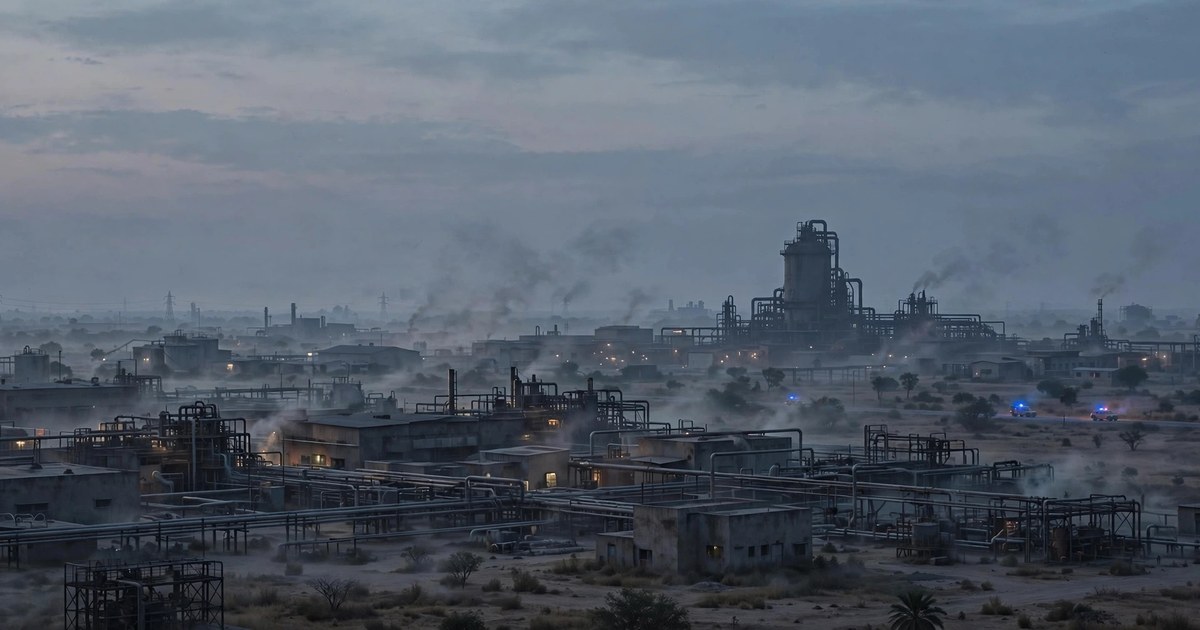
Five workers were killed and at least five others were injured when a reactor exploded at a pharmaceutical manufacturing unit in Gujarat's Bharuch district late on Friday night, triggering a reported leak of a toxic chemical and fresh questions about industrial safety in one of India's biggest chemical hubs. The blast, at SynZeal Pharmachem in the Saykha industrial estate, was the second deadly industrial explosion in Gujarat within days — and together the two incidents have killed nine workers in a single week.
Police confirmed the death toll on Saturday morning, and officials from the Gujarat Pollution Control Board (GPCB), the Directorate of Industrial Safety and Health and the police began an investigation at the site. The precise cause of the explosion has not yet been established, and officials say they are examining both what went wrong inside the reactor and whether the unit complied with applicable safety rules.
What happened at the Bharuch plant
According to police and district officials, the explosion occurred at about 10 p.m. on Friday, October 16, during a hydrogenation process at SynZeal Pharmachem in the Saykha Gujarat Industrial Development Corporation (GIDC) estate in Vagra taluka, Bharuch district. The blast involved a 15-kilolitre reactor, and it was powerful enough to rip the vessel apart, sending debris beyond the company premises and scattering machinery parts and metal sheets across the plant.
Reports also described a leak of methylene dichloride (MDC) gas at the site after the explosion. The leak reportedly left the area shrouded in dust and haze, with workers and others at the site complaining of severe eye irritation, and chemical smoke spreading to nearby areas. Emergency teams rushed to the spot, while police and district officials launched rescue operations and an investigation.
Superintendent of Police Akshyaraj Makwana told the Press Trust of India (PTI) that five people were killed in the blast and five others sustained injuries. The injured were taken to hospitals in Bharuch and Vadodara for treatment, while the bodies of the deceased were shifted to Bharuch Civil Hospital. Some early reports put the number of injured at six rather than five; the confirmed death toll in all official accounts so far is five.
The plant and the process
SynZeal Pharmachem was set up in Saykha only about a year ago and manufactures pharmaceutical intermediates, Bharuch Sub-Divisional Magistrate Manisha Manani said. Pharmaceutical intermediates are the chemical building blocks used to make finished medicines, and producing them often involves reactive chemistry at industrial scale.
The process under way at the time of the blast was hydrogenation — a widely used chemical process in which hydrogen is added to another compound, typically under pressure and often with a catalyst and heat, to change its chemical structure. Hydrogenation is routine in pharmaceutical and chemical manufacturing, but it is also a process that demands tight control: hydrogen is highly flammable, reactions run under pressure, and a loss of control over temperature, pressure, catalyst or feed can escalate quickly. None of that is a finding about this incident — investigators have not said what triggered this blast — but it explains why hydrogenation units are subject to detailed safety design, monitoring and maintenance requirements.
Manani said officials are examining the cause of the explosion and whether the unit complied with applicable industrial safety requirements. Reports said investigators will look at whether a chemical reaction, a technical fault or a sudden change in pressure caused the blast, as well as the condition of safety equipment and regular reactor maintenance.
What is methylene dichloride (MDC)?
Methylene dichloride — also called dichloromethane, with the chemical formula CH2Cl2 — is a colourless liquid with a chloroform-like odour that is widely used as a solvent in pharmaceutical and chemical manufacturing. It is highly volatile, boiling at around 40 degrees Celsius, which means it evaporates readily and can produce vapours that irritate the eyes, skin and respiratory system.
According to the US Centers for Disease Control and Prevention's NIOSH Pocket Guide to Chemical Hazards, exposure to methylene chloride can cause eye and skin irritation, dizziness, drowsiness, nausea and numbness or tingling in the limbs, and it is listed as a potential occupational carcinogen. In high concentrations, vapours can affect the central nervous system. The guidance also notes that it can form flammable vapour-air mixtures under certain conditions and should be handled with ventilation, protective equipment and strict storage and disposal controls.
That profile matters for understanding the aftermath of the Bharuch blast: even where an explosion itself is the main event, a concurrent solvent leak can widen the hazard zone, expose rescuers and nearby workers, and complicate the emergency response. In Bharuch, reports of eye irritation and haze around the site are consistent with that kind of secondary exposure, though officials have not yet published a detailed assessment of how much MDC escaped or how far it spread.
Rescue, hospitals and the official response
The blast triggered panic across the industrial estate, according to reports from the scene, prompting police and district authorities to reach the site and begin rescue operations. Fire and emergency personnel worked at the plant while officials secured the area and began documenting the damage.
The injured were taken to hospitals in Bharuch and Vadodara, and the bodies of the deceased were moved to Bharuch Civil Hospital. Teams from the Gujarat Pollution Control Board and the Directorate of Industrial Safety and Health joined the police investigation, which will cover both the technical cause of the explosion and the plant's compliance with safety and environmental rules. As of Saturday morning, no cause had been established and no finding of negligence had been made.
A second deadly blast in days — and a wider safety question
The Bharuch blast is the second deadly industrial explosion in Gujarat in a few days. On Thursday, four workers were killed in a boiler explosion at a colour company in the Chhatral GIDC area of Gandhinagar district, an incident that is also under investigation. Together, the two blasts have killed nine workers in one week in the state's industrial estates, and they have put the enforcement of safety rules in those estates under fresh scrutiny.
Gujarat is one of India's most industrialised states and a major centre for pharmaceuticals and chemicals, with large GIDC estates hosting hundreds of units that handle flammable solvents, pressurised reactors and hazardous processes. That concentration is an economic strength, but it also means that lapses in maintenance, monitoring or emergency preparedness can carry heavy consequences. Reports on the Bharuch incident noted concerns about worker safety and the enforcement of safety standards in chemical and pharmaceutical factories, and said officials will examine safety equipment, reactor maintenance and compliance with industrial safety rules.
India has seen deadly industrial accidents before, and investigations into them commonly turn on a familiar set of questions: whether pressure vessels were inspected on schedule, whether safety interlocks and relief systems worked, whether workers had adequate training and protective equipment, and whether hazardous processes were properly authorised and supervised. The Bharuch investigation will now have to answer those questions for this plant. For the families of the five men who died at Saykha, the findings will come later; the first facts are simple and hard — a reactor tore apart during a night process, gas leaked into the estate, and five workers did not come home.
What happens next
The investigation is now in the hands of the police, the pollution control board and the industrial safety directorate. If investigators find negligence or violations of safety regulations on the part of the company management, legal action may follow, according to reports on the incident. Any findings on the reactor's condition, the hydrogenation process and the handling of MDC will also feed into decisions about whether the unit can resume operations and under what conditions.
Related coverage: Jio Platforms IPO: India's largest-ever issue and the IMF's India growth outlook.
For now, the confirmed picture is this: five workers dead, at least five injured, a reactor destroyed, a chemical leak reported, and an investigation under way. The next updates that matter will be the investigators' findings on what caused the explosion, the condition of the injured, and whether any safety violations are established. This article will be updated as verified information becomes available.
This article is based on reporting by the Press Trust of India, IANS and other outlets cited in the sources below. Early casualty counts in fast-moving industrial accidents can vary; where reports differed on the number of injured, this article uses the police figure and notes the discrepancy.