
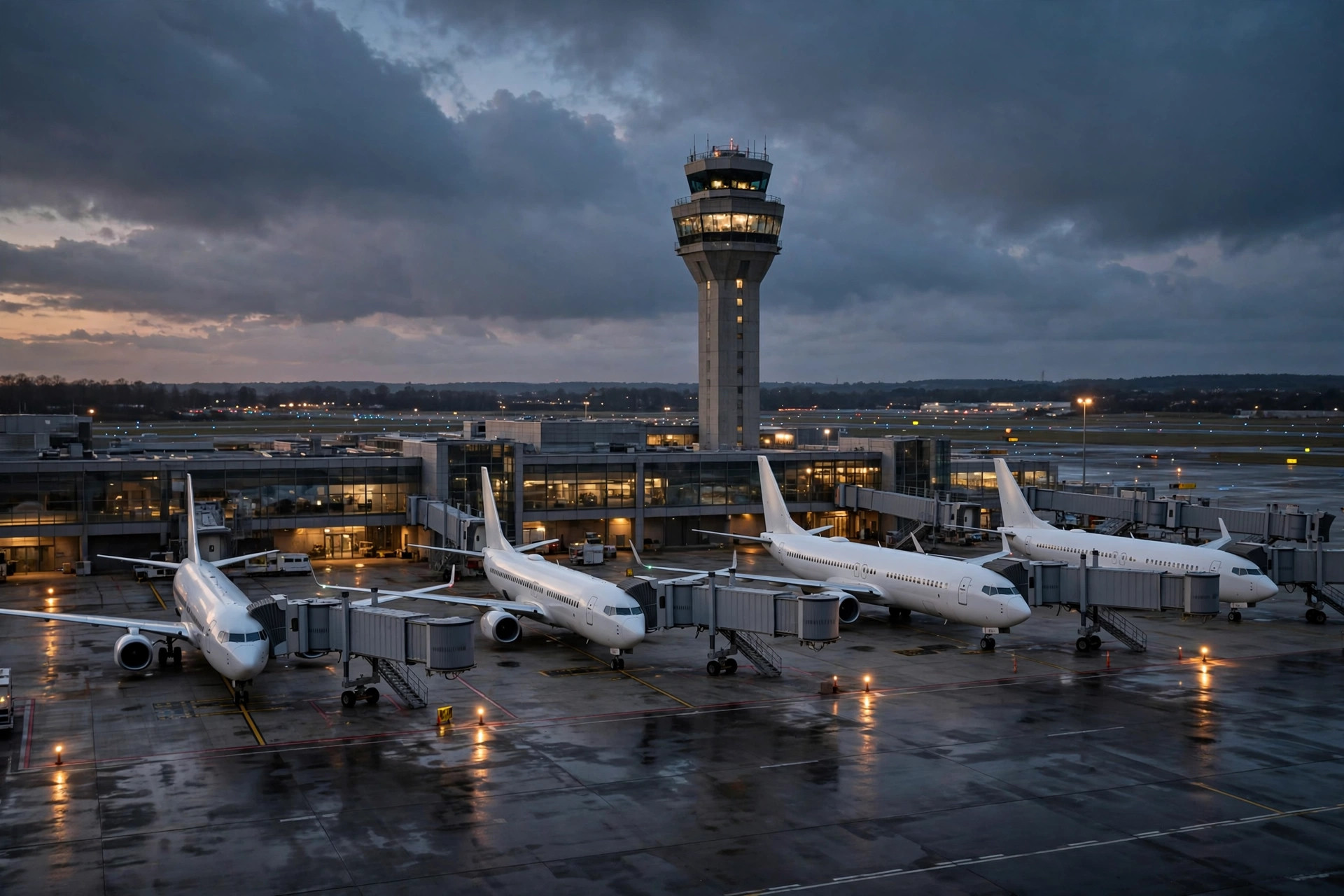
Every departing flight in the United States was held on the ground on Friday, 13 November 2026, after the Federal Aviation Administration ordered a nationwide ground stop. The FAA ground stop — the first halt of this scale since January 2023 — followed a communications failure affecting all 22 of the agency's Air Route Traffic Control Centers, the regional facilities that guide aircraft between airports. The order went out at about 3:54 p.m. Eastern time (2:24 a.m. IST on Saturday, 14 November). Planes already in the air were allowed to land, but nothing new could take off. By the end of Friday, flight tracker FlightAware counted 9,138 flights cancelled in the United States, Men's Journal reported. The FAA's own count was higher: about 12,462 flights cancelled on Friday, including 9,082 by major airlines — though the FAA said not all of those were directly caused by the ground stop. The disruption carried into Saturday, when 6,692 flights were cancelled and delays peaked at 8,723, according to FlightAware data reported by TravelPulse — and the nationwide stop itself lasted just over four hours before the FAA lifted it at 8:15 p.m. Eastern. By Sunday evening, the backlog was nearly cleared: 2,000 domestic flights were cancelled and 8,460 delayed as of 6:30 p.m. ET, according to FlightAware data reported by TravelPulse. Across Friday and Saturday alone, more than 15,000 flights were cancelled. Transportation Secretary Sean Duffy said schedules would be "back to normal" on Sunday and "probably fully normal" on Monday, 16 November.
The scale is what makes this different from an ordinary weather delay. A ground stop at a single airport is routine. A nationwide one — every departure, at every airport, at the same time — has now happened only twice since the attacks of 11 September 2001. The last time was January 2023, when a failed pilot-notification system shut departures down for less than two hours. This time, the FAA gave no end time at first. The stop lasted just over four hours before the agency lifted it at 8:15 p.m. Eastern.
What an FAA ground stop actually does
A ground stop is the FAA's bluntest traffic management tool. When controllers cannot safely handle the aircraft in their airspace — because of weather, an equipment failure, or, as on Friday, a communications breakdown — the agency orders departures to stay parked. The FAA's advisory on Friday put it plainly: "All departing traffic should remain ground stopped until further notice." Inbound international flights, the agency said, would be managed on a case-by-case basis.
What the order does not do is bring down the planes already flying. Those aircraft kept going to their destinations and landed normally. Flightradar24 reported that about 3,100 aircraft were bound for US airports when the stop took hold — and that no additional planes were taking off. The disruption also reached beyond American borders: Eurocontrol, the European air traffic organisation, said US-bound departures from 42 countries had been suspended at the FAA's request.
What caused the FAA ground stop: a communications failure
Transportation Secretary Sean Duffy said the FAA "issued a nationwide ground stop for all U.S. airports following a communication issue impacting all Air Route Traffic Control Centers. FAA technicians are investigating the issue." In a post on X, the FAA described it as "a temporary telecommunications outage" and said that "out of an abundance of caution all flights have been halted. Every flight has been accounted for."
Shortly before the nationwide order, the FAA had already halted traffic in Chicago after communications problems at O'Hare, where there were reports of radio frequency and radar outages, according to The Times. The National Weather Service said on Friday that it was also experiencing nationwide internet and communications issues, the Associated Press reported — a parallel outage that added to the confusion but has not been linked to the FAA failure.
The cause is now more specifically identified: workers from federal contractor L3Harris were replacing discontinued copper telecommunications wires with fibre-optic lines at a remote FAA location when the system went down, Transportation Secretary Sean Duffy said on Saturday, and a router began flooding the system, disrupting communications and radar. Duffy said investigators had not yet determined the exact fault — whether a contractor error or a faulty router — and stressed there was no evidence of a cyberattack, foreign interference or any AI-related cause. The investigation into the full cause continues. Officials have been clear about one thing, though: there is no evidence so far of an attack. Homeland Security Secretary Markwayne Mullin told reporters there was "no prior indication as of yet that this was a nefarious attack against us" and that the problem was "just a telecommunication outage as of right now." Transportation Secretary Sean Duffy later confirmed the airspace reopened at 8:15 p.m. Eastern, telling reporters: "At 8:15 tonight, Eastern time, we've opened up the airspace," while warning that recovery would be slow because aircraft and crews were out of position.
Duffy is also facing calls to resign over the shutdown. New York Governor Kathy Hochul said on Saturday: "Sean Duffy must resign, or President Trump must remove him immediately." FAA Administrator Bryan Bedford said "the worst is behind us" and that services should return to normal by the end of Sunday.
One question drawing attention is a new AI-based planning tool known as SMART — Strategic Management of Airspace, Routes and Trajectories — which the FAA announced on 10 November would expand across all 22 control centers. The system, which cost a reported $875 million, began operating on Thursday, and there was speculation that the outage could be related to its rollout. Air Space Intelligence, the company that developed it, denied that the ground stop was based on or a result of the system. The FAA has attributed the stop to a communications issue, and no evidence has been published linking the two.
How many flights were delayed and cancelled
The numbers grew through the evening as the backlog built. Reuters, citing FlightAware, first reported nearly 7,000 flights delayed or cancelled. By 9 p.m. Eastern, FlightAware counted more than 9,000 flights delayed and 6,275 cancelled within, into, or out of the United States, according to TravelPulse, and more than 1,200 flights scheduled for Saturday had already been scrapped, The Points Guy reported. Aviation analytics company Cirium reported that at least 827 flights had been diverted by Friday evening. The final Friday tally was higher — FlightAware counted 9,138 cancellations in the United States for the day, Men's Journal reported. The FAA's own Sunday account put Friday's cancellations higher still, at about 12,462, including 9,082 by major airlines, though it said not all were directly caused by the ground stop — and the final Saturday tally was 6,692 flights cancelled, with delays peaking at 8,723, according to FlightAware data reported by TravelPulse. On Sunday, 2,000 domestic flights were cancelled and 8,460 delayed as of 6:30 p.m. ET, according to FlightAware data reported by TravelPulse; across Friday and Saturday alone, more than 15,000 flights were cancelled.
The worst-hit airports were the big hubs. Chicago O'Hare led the cancellation count with 173, followed by LaGuardia with 143, Dallas-Fort Worth with 132, New York's JFK with 113, and Boston Logan with 104, according to the same FlightAware figures reported by USA Today. The disruption stranded college football teams flying to Saturday games, including Kansas State, Florida Atlantic, Tennessee and Ole Miss, who were still waiting to depart on Friday afternoon.
The system was already under strain before Friday. Severe storms across the Northeast on Thursday, 12 November, caused 6,466 delays and 1,021 cancellations, with ground stops at five airports — Newark, JFK, LaGuardia, Boston Logan and Washington Dulles — and a separate hail-related stop at Philadelphia. The FAA manages more than 45,000 flights a day across US airspace, about 28,000 of them commercial, according to The Times, so a halt of even a few hours ripples through the whole network.
The last nationwide FAA ground stop was in January 2023
Friday's halt was the second nationwide ground stop of all departures since the September 11, 2001, attacks, Reuters reported. It was also the longest nationwide ground stop in 25 years, the Associated Press reported. The other came on 11 January 2023, when a failure in the FAA's NOTAM system — the system that sends safety notices to pilots — paused all domestic departures for less than two hours before the agency restored it.
This one is different in an important way: when it began, there was no announced end time. The FAA said flights would be allowed to depart as en-route facilities recover, coordinated through its Air Traffic Control System Command Center, with traffic released in stages — and the full lift came at 8:15 p.m. Eastern. An FAA advisory issued at 22:46 UTC (5:46 p.m. Eastern) listed the restriction as running through 11:30 p.m. Eastern. The first signs of a staged recovery appeared by 7:04 p.m. Eastern, when San Francisco International Airport said flights headed across the Pacific, including to Hawaii and Asia, had been cleared to depart. The nationwide stop itself ended at 8:15 p.m. Eastern, when the FAA lifted it and departures began resuming — just over four hours after it began.
What travellers should do now
If you have a flight booked for Sunday or Monday, check before you leave for the airport. Check your airline's app or website for the latest status of your flight and for rebooking options, and the FAA publishes airport-level delay and ground-stop information on its National Airspace System status page, nasstatus.faa.gov. FlightAware and Flightradar24 also track delays and cancellations in real time.
The disruption outlasted the stop itself: even after departures resumed, aircraft and crews were out of position, and Saturday's schedule carried cancellations from Friday's backlog. By Sunday morning, the FAA's National Airspace System dashboard reported no active en-route events, Reuters reported, and airlines expected schedules to be largely back to normal by late Sunday. Passengers on international flights into the United States should check with their airline too, since inbound flights were handled individually rather than under a single rule.
Why it matters and what happens next
The ground stop is the latest sign of strain on an air traffic control system that Reuters described as "beset by equipment failures, communications problems and shortages of controllers" while the FAA tries to replace ageing infrastructure. Congress approved $12.5 billion for the overhaul last year, and the FAA and the White House asked lawmakers on Friday for another $30.1 billion. It is the second major technology failure to hit American infrastructure in days, after the Microsoft outage that disrupted Outlook earlier in the week — and air travellers have had a turbulent week in other ways too, after a Singapore Airlines flight was diverted to Rockhampton when smoke filled the cabin.
What happened next is now clear: the 22 control centers came back, the FAA's National Airspace System dashboard showed no active en-route events by Sunday morning, and the agency's preliminary finding points to the L3Harris router work during a copper-to-fibre upgrade. The stop itself will be measured less by the hours departures were held than by how long the recovery took — and by whether a system that moves 45,000 flights a day gets the investment its own officials say it needs.