
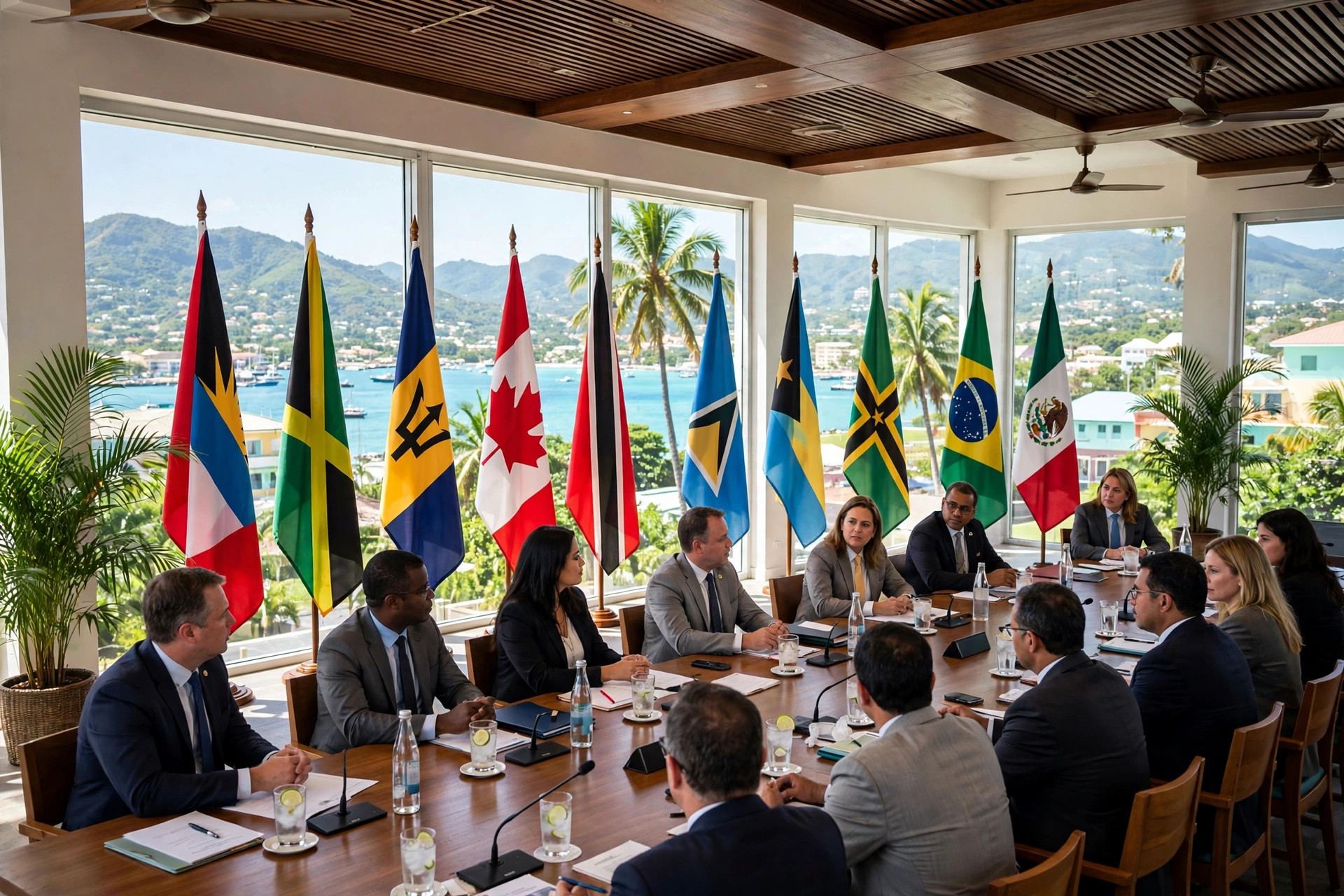
The CHOGM 2026 Carney Commonwealth summit opened in St. John's, Antigua and Barbuda, on 3 November 2026, with Canada's Prime Minister Mark Carney attending his first Commonwealth Heads of Government Meeting. Carney used the occasion to announce more than 70 million dollars in new Canadian investments for trade, investment and climate action across the Commonwealth, including the Caribbean. The meeting, held under the theme of accelerating partnerships and investment for a prosperous Commonwealth, brought together leaders from 56 countries representing 2.7 billion people, with a shared ambition to double trade between member nations by 2030.
CHOGM 2026 Carney Commonwealth: what the 70 million dollars covers
The headline figure is more than 70 million dollars in new investments, and the largest items have been spelled out. Canada will provide 10 million dollars over six years through UNICEF to help build resilient schools in the Caribbean, covering Belize, Dominica, Grenada, Jamaica, Saint Lucia, Saint Vincent and the Grenadines, and Suriname. A further 3 million dollars over three years will go through the International Trade Centre to support work on sargassum, the seaweed that washes up on Caribbean shores in huge quantities and damages beaches, fishing and tourism. And FinDev Canada, Canada's development finance institution, will provide a loan of around 50 million dollars to Zanaco, Zambia's largest financial institution, to support lending and business growth.
The mix of projects says something about how Canada sees the Commonwealth: part education, part climate adaptation, part trade finance. Resilient schools matter in a region where hurricanes regularly damage classrooms. Sargassum is a practical, visible problem for Caribbean economies that depend on the sea. And the Zambian loan connects the Commonwealth's African members to the same agenda of investment-led growth. Together, the three items account for most of the 70 million dollars announced, with the balance spread across trade and climate initiatives.
A Commonwealth of 56 countries and 2.7 billion people
To understand why the summit matters, it helps to know the scale of the club. The Commonwealth has 56 member countries and a combined population of 2.7 billion people, roughly a third of humanity. Trade between member countries is worth almost 1 trillion dollars, and leaders have set a target of doubling that to 2 trillion dollars by 2030. That is an ambitious goal, and it is the reason trade sits at the centre of this summit's theme.
Doubling trade in four years would mean much faster growth in the exchange of goods and services between member countries, from food and manufactured products to services, education and tourism. For smaller Commonwealth members, more trade with each other can mean less dependence on any single large market, and for Canada it can mean new buyers for its exports and new suppliers for its businesses. The target is deliberately ambitious, and leaders know that reaching it will require more than speeches: it will need financing, simpler customs rules and practical help for businesses that want to trade across borders. That is the context for the investments Carney announced, which are designed to unlock trade rather than simply fund projects.
Canada is a central player in that effort. It trades more than 100 billion dollars with Commonwealth partners, it is the Commonwealth's second-largest financial contributor, and it is the group's third-largest economy. For Canada, the Commonwealth is not a ceremonial network but a real market and a real source of influence, linking it to fast-growing economies in Africa, Asia, the Caribbean and the Pacific. Carney's emphasis on investment, rather than aid alone, reflects that view: the pitch is partnership and business, not charity.
Canada's role in the group also gives it a platform. As the second-largest financial contributor, it helps pay for the Commonwealth's shared institutions, and as the third-largest economy in the group, its decisions carry weight with smaller members. The leaders who gathered in St. John's represent economies at very different stages, from large industrial nations to small island states, and the summit's theme of accelerating partnerships reflects an attempt to make that diversity work as an advantage rather than a source of division.
Carney's meetings on the sidelines
As well as the main sessions, Carney hosted a meeting of Caribbean leaders to discuss a renewed Canada-CARICOM Strategic Partnership, a framework for closer cooperation between Canada and the Caribbean Community. He also held bilateral meetings with the Prime Minister of Australia, Anthony Albanese, and the President of Guyana, Mohamed Irfaan Ali. Canada's bilateral trade with Australia was nearly 8 billion dollars last year, and trade with Guyana was nearly 360 million dollars last year, figures that show how the Commonwealth's smaller economies still matter to Ottawa.
The summit was formally opened by King Charles III, the Head of the Commonwealth. In his address he called the transatlantic slave trade a shameful chapter in history and expressed profound personal sorrow, while stopping short of a formal apology. The remarks were closely watched, because calls for acknowledgement and repair over slavery and colonialism remain live issues for many Commonwealth members, particularly in the Caribbean and Africa. The King's words acknowledged the history without conceding the apology some leaders have sought.
CHOGM 2026 Carney Commonwealth: what happens next
Carney is due back in Ottawa ahead of Thursday's federal budget, which will be the first major domestic test of his government and will show how much room there is for the kind of international investment he has just promised. The budget will also be read for signals on the economy at home, where the cost of living and trade disruption remain pressing concerns.
On trade with the United States, Carney said talks will become more intensive, and that Washington is asking for less and offering more than before, but he was clear that there is no deal yet. That message will matter to Canadian businesses and to Commonwealth partners watching for signs of how the North American relationship is evolving. For more on that file, see our report on the near deal in Canada-US trade talks. Canada's broader international posture, including its recently unveiled national security strategy for 2026 and its summit with the European Union, shows a government trying to widen its circle of partners at a time of uncertainty. Whether the Commonwealth trade-doubling goal is met by 2030 will depend on whether summits like this one turn into contracts, loans and shipments, and the 70 million dollars announced in Antigua is a first step in that direction.