
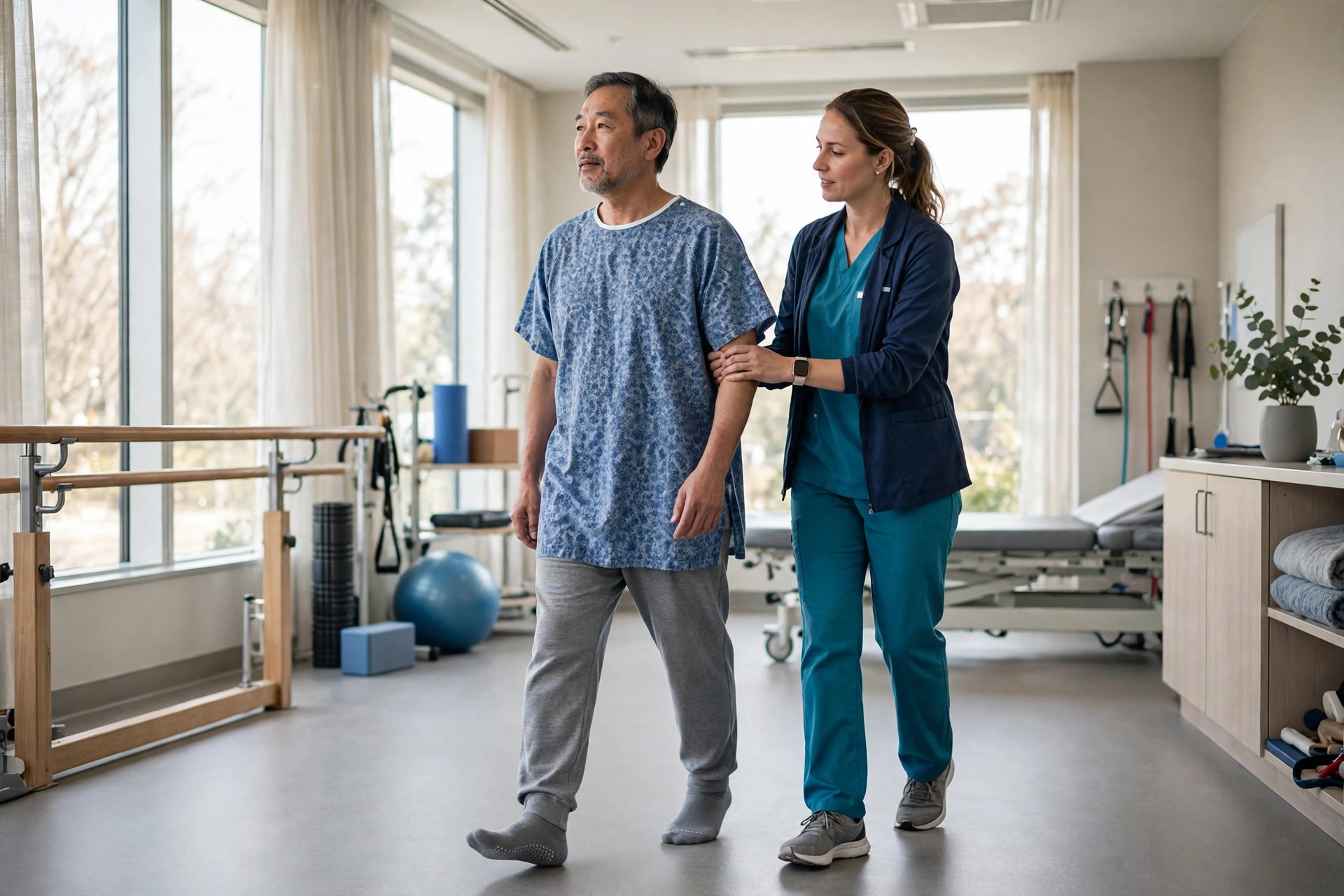
For people living with stiff person syndrome, walking across a room can become a daily battle. A stiff person syndrome CAR-T treatment tested by Mayo Clinic researchers has now brought substantial improvement to patients who had run out of good options, according to a study published on 9 November 2026 in JAMA Neurology. The trial was small, and its authors are clear that the therapy is not a cure, but the change in some patients was large enough to return them to work and to ordinary activities they had lost.
Stiff person syndrome, often shortened to SPS, is a rare autoimmune disorder that attacks the central nervous system. It causes progressive muscle stiffness and painful spasms, and over time it can leave people unable to walk unaided, drive, or manage basic daily tasks. The new study tested whether a single dose of a CAR-T cell therapy, a treatment better known in cancer care, could reset the immune attack behind the disease.
What stiff person syndrome does to the body
SPS is rare. It affects an estimated 8,000 people worldwide, according to figures cited in coverage of the study, while Johns Hopkins Medicine puts the figure at 1 to 2 people in every 1 million. The condition was first described by Mayo Clinic in 1956, and it remains little known outside neurology clinics, in part because so few people have it and its symptoms are easily mistaken for other conditions.
The stiffness in SPS is not ordinary muscle tightness. It builds gradually, often in the torso and legs, and it can lock the body into rigid postures. Painful spasms can strike without warning, sometimes triggered by sudden noise, touch, or stress. Walking becomes slow and unsteady. Falls become a constant risk. As the disease progresses, many patients need help with dressing, bathing, and moving around the house, and some stop working altogether.
Standard care has relied on medicines that calm the muscles and treatments that damp down the immune system. For many patients those treatments help for a time. For the people in the new trial, they had not helped enough. Each of the 26 adults in the study had not responded well enough to earlier immunological treatments, which is why they were offered an experimental approach instead.
That history matters when judging the results. These were not newly diagnosed patients with mild symptoms. They were people whose disease had already resisted the usual options, and whose daily lives had narrowed as a result. Any improvement in that group carries more weight than the same change in people with early, mild disease.
How stiff person syndrome CAR-T treatment works
The stiff person syndrome CAR-T treatment used in the trial is called mivocabtagene autoleucel. It was developed by Kyverna Therapeutics, which also sponsored the trial. The idea behind it is straightforward to describe, even though the laboratory work behind it is complex: take the patient's own T cells, engineer them in a laboratory so they can find and wipe out the cells driving the disease, and then return the engineered cells to the patient in a single dose.
T cells are part of the immune system. In SPS, the immune system attacks the central nervous system, and that attack drives the stiffness and spasms. The engineered T cells are designed to remove the disease-driving cells, giving the immune system a chance to stop attacking the nervous system. Each patient in the trial received one dose of the therapy.
CAR-T therapy is already used in cancer treatment, where engineered T cells are trained to attack tumour cells. Using the same approach for an autoimmune disease is a newer idea, and it is one of the reasons the study has drawn attention beyond neurology. If a single dose can produce a lasting reset of a faulty immune response, the same principle could matter for other autoimmune conditions, although that possibility has not been tested in this trial and should not be assumed.
Advanced therapies of this kind face close safety checks before they reach routine use, as regulators have shown with other new treatments. Readers following that wider picture can see how the US Food and Drug Administration handles safety questions around a gene therapy in the FDA investigation into Zolgensma and cancer risk.
What stiff person syndrome CAR-T treatment changed for patients
The study, published on 9 November 2026 in JAMA Neurology and led by Mayo Clinic researchers in Rochester, Minnesota, found that the stiff person syndrome CAR-T treatment brought substantial improvement to the 26 adults who received it. The researchers measured walking ability and stiffness, and the gains were large enough to change what patients could do in daily life, not only what their test scores showed.
Some patients returned to work. That detail matters because it is a practical measure of recovery, not a laboratory reading. Returning to work means being able to travel, to stand and move for hours, and to cope with the demands of a working day, all of which SPS had made difficult or impossible for the people in the trial.
Lead researcher Dr Anastasia Zekeridou, a Mayo Clinic neurologist, said what was most striking was the degree of improvement in some patients. She also pointed to the question that now matters most: whether the gains last. A treatment that helps for a few months and then fades is very different from one that holds its benefit over years, and the trial's follow-up so far is not long enough to answer that question. Dr Sean Pittock, chair of Mayo Clinic's Department of Neurology, also commented on the findings.
Two patients named in coverage of the study show what the improvement looked like in practice. Jonathan Walden had needed family help to walk and to do basic daily tasks before the trial. After treatment, he returned to work and to hunting and fishing, activities that had been out of reach while his symptoms controlled his days. Shari St Germain, diagnosed in 2021, walked on a treadmill for seven minutes after standard treatments stopped controlling her symptoms in 2024. Seven minutes on a treadmill may sound modest, but for a person whose walking had been limited by stiffness and spasms, it was a clear and measurable change.
Two patients, and what their recoveries show
Walden and St Germain are individual cases, and individual cases cannot prove how a treatment will work for everyone. Their stories are useful because they put concrete detail behind the study's overall finding of substantial improvement. Walden's return to hunting and fishing and St Germain's seven minutes on a treadmill are the kind of changes that patients notice first, before any formal walking test confirms them.
The two stories also show how different SPS can look from one person to another. Walden needed family help with walking and daily tasks. St Germain had lived with the diagnosis since 2021 and found that standard treatments stopped controlling her symptoms in 2024. A treatment that helps both kinds of patient is more promising than one that helps only a narrow group, but 26 people is still a small group, and the study's authors do not claim that every patient improved to the same degree.
Medicine is also changing in other ways that affect how quickly conditions like SPS are spotted. Artificial intelligence is now being tested as a way to detect serious disease earlier, as described in how AI is being used to detect pancreatic cancer, and regulators are paying closer attention to how new medical technology is overseen, including Australia's AI regulator action after the OpenAI Medicare breach.
What the study did not prove
The limits of the study are as important as its results, and the researchers have not hidden them. The trial was small, with 26 adults, and it was non-randomised, which means there was no comparison group receiving a different treatment or a placebo. Without a control group, it is harder to be certain how much of the improvement came from the therapy itself and how much came from other factors, including the natural course of the disease.
Follow-up is not long enough to show whether the benefits hold. That is the key question Dr Zekeridou raised, and it is the reason larger trials are needed before anyone can talk about lasting remission. The researchers have not called the therapy a cure, and it is not ready for routine use. Patients with SPS should not expect to be offered this treatment outside a trial at present.
Those cautions do not cancel the result. They set its proper place. A small, non-randomised trial that shows substantial improvement in people who had failed other treatments is a strong reason to run bigger trials, not a reason to declare the problem solved. The next step is a larger trial, with more patients and longer follow-up, designed to test whether the gains last and whether the treatment is safe enough for wider use.
Why the result matters, and what happens next
For the estimated 8,000 people worldwide living with SPS, the study offers something that has been missing: a treatment aimed at the cause of the disease rather than only its symptoms. Muscle relaxants and immune-suppressing drugs can ease stiffness and spasms, but they do not reset the immune attack. A single dose that wipes out the cells driving the disease, if its benefits hold up in larger trials, would be a different kind of treatment altogether.
The study also matters because SPS has had so little attention. A rare disease affecting 1 to 2 people in every 1 million, by the Johns Hopkins Medicine estimate, rarely attracts large drug trials. The fact that a therapy developed by Kyverna Therapeutics and tested at Mayo Clinic has now produced these results in a peer-reviewed journal, JAMA Neurology, gives the field a concrete result to build on rather than only hope.
Singer Celine Dion, 58, disclosed her diagnosis in December 2022 and has said it affected her singing; she did not take part in the trial and there is no suggestion she has received CAR-T therapy. Dion returned to full-length concerts in September 2026 with a 26-show Paris residency from 12 September to 17 October that drew 539,000 spectators and grossed $125.5 million, according to Billboard.
What happens next depends on larger trials. Researchers will need to enrol more patients, follow them for longer, and test whether the improvements seen in this study hold over time. Until those results arrive, the honest summary is the one the researchers themselves have given: substantial improvement in a small group of patients who had few options left, a treatment that is not yet a cure, and a key question about durability that only time and bigger trials can answer.