
The Balochistan Liberation Front launched what it described as one of its most ambitious operations against Pakistani security forces on Thursday evening, October 22, 2026 — a coordinated, multi-front assault on a military engineering camp, a police station, and an army convoy in and around Gwadar, the deep-sea port city on Pakistan's Arabian Sea coast that anchors the China-Pakistan Economic Corridor. The group claimed it overran a Frontier Works Organization (FWO) camp at Gwadar Zero Point, seized weapons from a police station, and inflicted heavy casualties. Pakistan's government says the assault was foiled, that no site fell, and that its forces killed several attackers. With independent verification nearly impossible in a region where journalists and observers face severe restrictions, the two narratives could hardly be further apart — and the truth sits somewhere in the fog between them.
The BLF, which Pakistani authorities classify as a banned militant organisation, said in a statement issued by its spokesperson, Major Gwahram Baloch, that its fighters killed a Military Intelligence (MI) captain and several personnel of the Pakistan Army's elite Special Services Group (SSG) during an operation it calls "Operation Almas" — roughly "Operation Diamond." The statement, circulated by the ANI news agency on October 23, 2026, and carried by outlets including LatestLY, InShorts, and Top Indian News, said the operation was continuing "on several fronts with full intensity and success."
What the BLF claims happened in Gwadar
According to the BLF's account, fighters from its Saddo Operational Battalion and other special units began the operation by striking the main camp of the Frontier Works Organization at Gwadar Zero Point. The FWO is the Pakistani Army's military engineering arm, responsible for major infrastructure and construction projects across Pakistan — including much of the road and port-related work in Gwadar itself. The BLF claimed its fighters overran the camp and hoisted the organisation's flag there — a claim with obvious symbolic weight in a city that has become synonymous with Pakistan's state presence in Balochistan.
The group further claimed it had taken control of the Muzhani (also rendered Mazani) police station, seizing official weapons and military equipment from the facility, and alleged that one police official was killed during the confrontation. In a separate incident at Gabd in Gwadar district, near the border crossing with Iran, the BLF said its fighters ambushed a Pakistani security-forces convoy, destroying an army vehicle and killing or injuring several personnel travelling in it. The statement also claimed the police checkpoint at Gabd Cross had fallen into the group's hands.
The BLF said further details — including a "comprehensive account" and final casualty figures — would be released after the conclusion of Operation Almas, which it described as still underway across multiple locations. It claimed Pakistani forces had been forced to retreat following clashes in different areas.
Pakistan's account: attack foiled, no site lost
Pakistan's government and military-linked sources tell a very different story. Interior Minister Mohsin Naqvi said on Thursday that security forces had foiled an attempted attack on an unoccupied camp belonging to a construction company in Gwadar, killing three militants in a counterterrorism operation. Security sources quoted by regional outlets attributed the attack to the banned Balochistan Liberation Army (BLA) — a different group from the BLF, though Pakistani authorities sometimes treat separatist claims interchangeably — while noting the affiliation had not been independently verified.
According to the official version, the attackers were stopped before they could carry out their intended assault on the vacant construction camp. The local administration and the interior minister denied that any security sites had been seized, dismissed the separatist claims as propaganda, and said damage was limited to the setting on fire of trucks and commercial containers near the port road. Security sources added that additional suspects were reportedly surrounded as clearance operations continued, and that the General Officer Commanding (GOC) in Gwadar was personally supervising the operations.
Crucially, reporting by the BBC's Urdu service — one of the few news organisations with sources inside the region — added an independent data point: three senior government officials told BBC Urdu that attacks had been reported at three locations in Gwadar district: a government construction company's camp near Gwadar city, Suntser, and the Gabd-Rimdan border crossing with Iran. That corroborates that something serious unfolded across multiple locations on Thursday evening, even if the scale and outcome remain disputed.
Security sources also described a separate operation against suspected militants reportedly hiding inside a hotel near the Gwadar Highway, saying four suspects had been surrounded at the site.
Why Gwadar matters so much
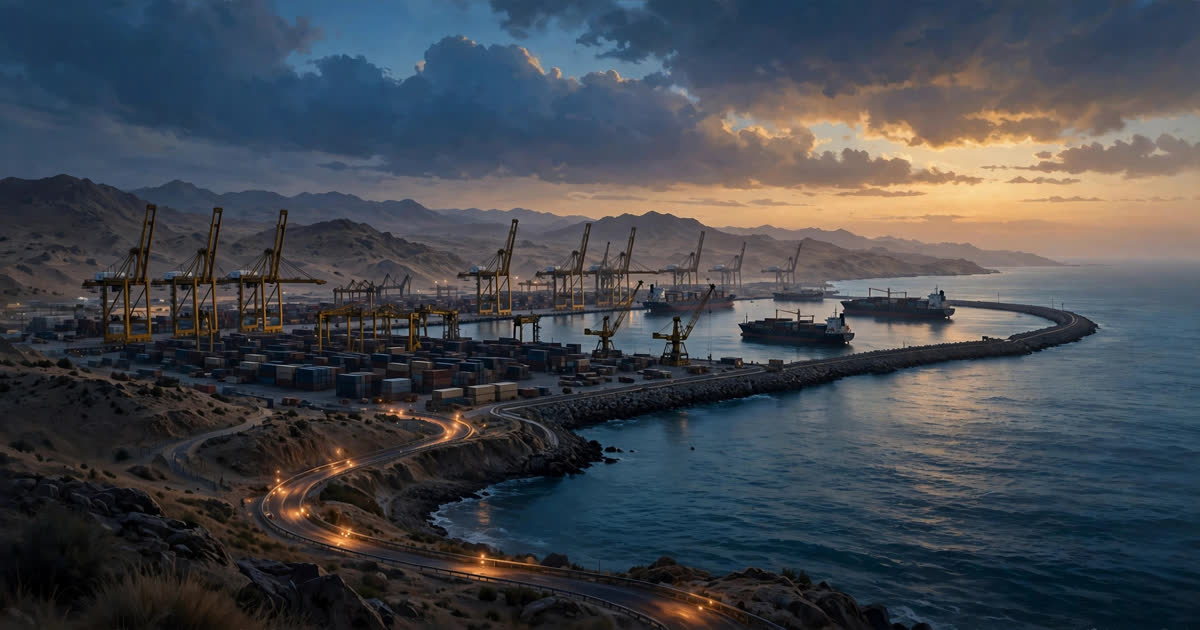
Gwadar is not just any Baloch city. The deep-sea port, developed largely with Chinese investment as the centerpiece of the China-Pakistan Economic Corridor (CPEC), is meant to give China a strategic gateway to the Arabian Sea and beyond — and Pakistan a second commercial lifeline beyond Karachi. Because of that, the port and its surrounding infrastructure are among the most heavily guarded sites in the country.
For Baloch separatist groups, Gwadar is the perfect stage: any attack there is guaranteed international attention, because it strikes at the intersection of Pakistan's state power, its army's commercial and engineering empire, and China's overseas footprint. That is also precisely why casualty and outcome claims around Gwadar operations are so hard to verify — the zone is thick with military checkpoints, surveillance, and restrictions on independent movement.
A week of escalating violence in Balochistan
The Gwadar operation did not come out of nowhere. Balochistan has seen a steady escalation of attacks through October 2026. On October 18, an improvised explosive device killed Pakistan Army Major Wajahat Waheed, 34, during clearance operations in the Shadi Kaur area of Pasni tehsil, also in Gwadar district — an attack claimed by the BLA, though the military did not confirm the group's higher casualty figure. Four suspected militants were killed in a separate intelligence-based operation in Kalat district the same week.
The pattern fits the separatists' broader campaign: IED strikes on patrols, ambushes of convoys, and periodic high-profile assaults on fortified installations — matched by large-scale military operations, sweeping detentions, and a heavy security presence that human rights groups say has brought enforced disappearances and abuses along with it. The BLF's own statement linked its operation to that wider grievance narrative.
What to watch next
The key questions in the days ahead are whether the BLF releases the "comprehensive account" of Operation Almas it promised — including verifiable casualty details — and how Pakistan's military responds operationally in Gwadar district. Any confirmed seizure of a military installation, even a construction camp, would represent a significant tactical and symbolic escalation; the government's insistence that nothing fell, and that the operation was neutralised, suggests Islamabad is determined to prevent the episode from becoming a recruiting tool for the separatist cause.
For now, what is known for certain is narrower: multiple outlets, including the BBC's Urdu service, confirm that coordinated attacks hit several locations in Gwadar district on Thursday evening, that a major security operation is ongoing, and that both the separatists and the state are already fighting over the story itself. That battle over the narrative — a flag raised over a camp versus a foiled plot and burning trucks — is, in Balochistan, often the point. The episode is a new test for Pakistan's army chief Asim Munir at home, even as regional tensions near the Iran-Pakistan border keep rising and Pakistan's broader internal security strains continue to deepen.
Sources: ANI via LatestLY, InShorts, Terror Monitor, Voice of Emirates, Top Indian News, The Balochistan Post, BBC Urdu. This story is trending per news coverage; casualty and outcome claims from all sides are reported as claims and have not been independently verified.