
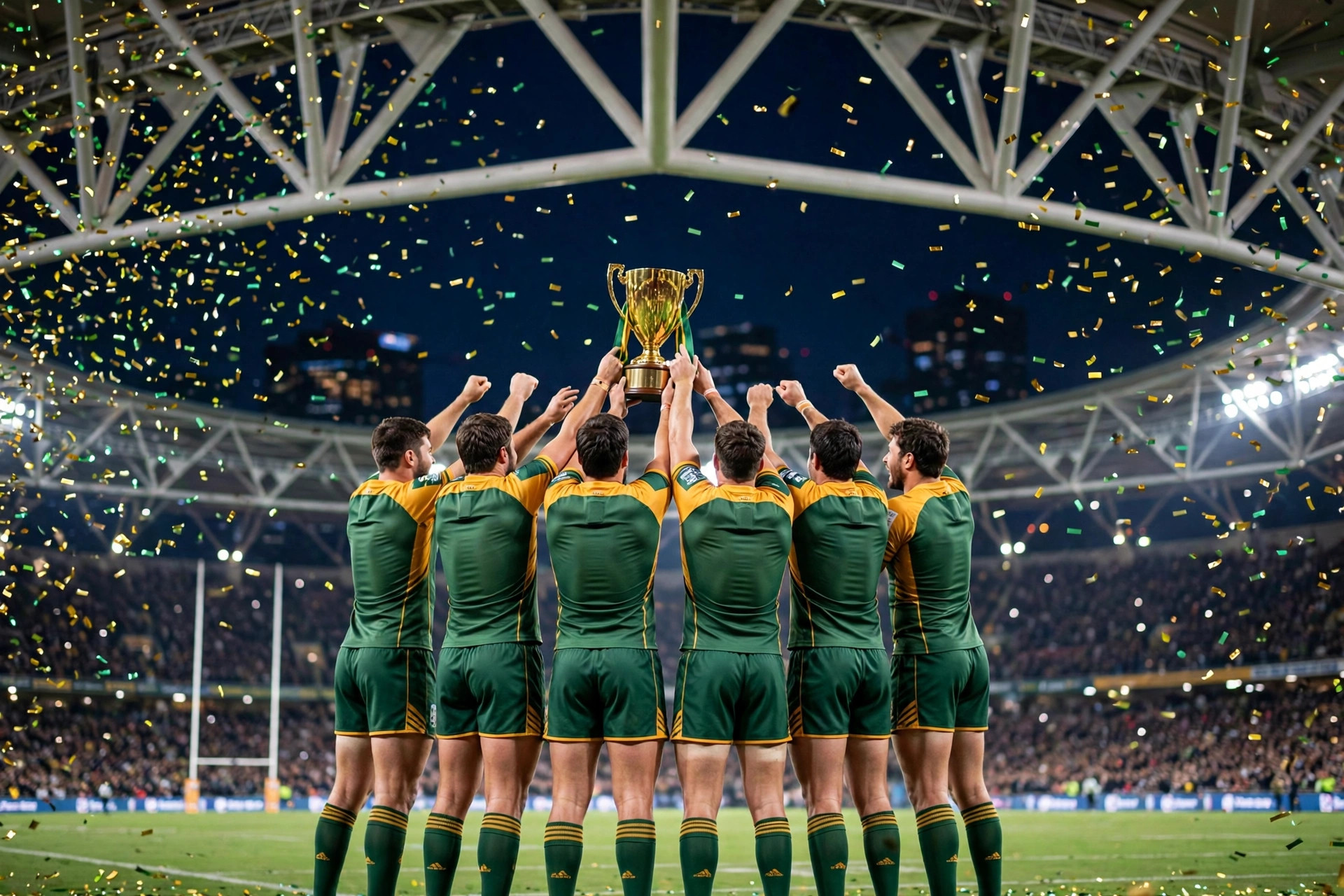
Australia swept both Rugby League World Cup finals on Sunday 15 November 2026 at Suncorp Stadium in Brisbane, completing a double that no other nation matched on the day. In the men's final, the Kangaroos beat the Kiwis 32-12, and in the women's final, played earlier on the same day at the same stadium, the Jillaroos beat the Kiwi Ferns 34-10. The Australia Rugby League World Cup 2026 double gave the Kangaroos a fourth consecutive men's title and the Jillaroos a fourth straight women's title, and it extended a run of dominance that has now lasted for years. The men's win was Australia's 13th title in 16 editions of the tournament, and the Kangaroos have now won 23 straight World Cup matches since their defeat in 2008.
The double-header format made the day unusual. Two finals, two New Zealand teams, one Australian host, and one stadium. The women's final was played first, in hot weather, according to Kiwi Kids News, and the men's final followed later that night. Both Australian teams won by clear margins, and both wins were built on fast starts. In the men's final, Liam Martin scored the fastest-ever try in a World Cup final, and in the women's final, Jaime Chapman scored a hat-trick. Those two facts, taken together, explain why the day felt like a statement rather than two separate results: Australia did not wait to take control in either match.
The crowd at Suncorp Stadium was 52,461, according to NRL.com and Reuters, and the stadium was described as sold out by AFP. The Kangaroos took a 24-6 lead into half-time in the men's final, according to AFP and Reuters, and never let New Zealand back into the match after the break. The Jillaroos scored six first-half tries on their way to the 34-10 win, according to Reuters, and their lead was already decisive by the interval. The scale of the day is best measured by the two scorelines together: 32-12 and 34-10, two wins over the same rival, in the same stadium, on the same day.
How the Australia Rugby League World Cup 2026 men's final was won
How the Australia Rugby League World Cup 2026 men's final was won starts with the first 84 seconds. Liam Martin scored after just 84 seconds in Brisbane, according to Love Rugby League, and that try was the fastest-ever try in a World Cup final. The BBC live report put the time at 85 seconds, a difference of one second between sources that does not change the record: Martin's try was the fastest ever in a final. The early try set the tone, and although New Zealand levelled the score through Casey McLean, according to Love Rugby League and the BBC, Australia pulled away again and never looked back.
Jack Bostock and Liam Martin each scored two tries for Australia, according to NRL.com, and Bradman Best and Tom Trbojevic also crossed for the Kangaroos. Bostock was named Player of the Final for his two tries either side of half-time, according to Reuters, and his second try, late in the match, sealed the win. Cameron Munster kicked three conversions and a penalty, according to Reuters. The Kangaroos led 24-6 at half-time, according to Reuters, after Martin's double helped Australia open up that lead, and two more tries after the break secured the fourth successive title. The final margin was 20 points, 32-12, and the win was described by Reuters as clinical and by AFP as a pulsating battle that Australia controlled.
The win was Australia's fourth consecutive men's title, and their 13th title in 16 editions, according to Reuters. The Kangaroos have now won their last 23 World Cup matches, according to NRL.com, with the last defeat coming at the hands of the Kiwis in the 2008 final. Since that defeat, Australia have won in Manchester in 2013 and 2022 and in Brisbane in 2017 and 2026, according to NRL.com. Coach Kevin Walters sent James Tedesco into the match with six minutes to play so he could savour another World Cup triumph, according to NRL.com, in what was Tedesco's last Test match. Tedesco had led Australia to victory in the 2022 World Cup final over Samoa, and his appearance on the field as the win was sealed gave the night a sense of continuity as well as triumph.
The men's final also carried a sense of unfinished business from the start of the tournament. New Zealand had lost the opening match 24-22 on 15 October, according to BBC Sport, when they could and perhaps should have won, and Fiji had run Australia close 10 days later before going down 36-22. Australia found a way in both of those matches, according to BBC Sport, and the final was the night when they produced their best performance of the tournament. Reece Walsh, the Australian fullback, said after the match that he felt Australia had been disrespected during the tournament, according to BBC Sport, and the final was the answer to that feeling. The win was not a surprise, but the margin and the control were.
How the Australia Rugby League World Cup 2026 women's final was won
How the Australia Rugby League World Cup 2026 women's final was won starts with Jaime Chapman. Chapman scored a hat-trick as the Jillaroos beat the Kiwi Ferns 34-10, according to the research for this article, and Reuters reported that she grabbed the opening try with just 125 seconds played. That early try was itself a record for a women's final, but her record did not last long, according to Love Rugby League, because Martin's try in the men's final came even faster. Chapman's hat-trick snuffed out any hope of a New Zealand upset, according to Bytes Europe, and the Jillaroos underlined their dominance with a performance that was decisive long before the final whistle.
The Jillaroos scored six first-half tries on their way to the 34-10 win, according to Reuters, and the match was effectively settled by the interval. The win was Australia's fourth straight women's title, following a 54-4 win in the final four years ago, according to Bytes Europe, and coming after New Zealand won the first three women's tournaments between 2000 and 2008. That history matters: New Zealand won the women's tournament first, and Australia have now won the last four in a row. The 34-10 scoreline in Brisbane was not as wide as the 54-4 margin four years ago, but it was still a clear win, and it completed the double on the same day as the men's final.
The women's final was played in hot weather at Suncorp Stadium, according to Kiwi Kids News, and the conditions made the Jillaroos' fast start all the more impressive. The Kiwi Ferns, like the Kiwis in the men's final, were well beaten, according to NZ Sports Wire, and both New Zealand teams fell to Australian rivals in the finals on the same day. The double defeat for New Zealand, in both finals, in the same stadium, is the story of the day as much as the Australian wins themselves. New Zealand had reached both finals, and both finals ended with Australia lifting the trophy.
Why the Australia Rugby League World Cup 2026 double matters
Why the Australia Rugby League World Cup 2026 double matters is a question of dominance and depth. Australia now hold both the men's and women's Rugby League World Cup titles, and both teams have won four titles in a row. The men's team have won 13 titles in 16 editions, according to Reuters, and 10 titles in the last 11 tournaments dating back to 1975, according to BBC Sport. The women's team have won four straight titles, and the men's team have won 23 straight World Cup matches since 2008. Those numbers, taken together, describe a sport in which one nation has set the standard for both men and women at the same time.
The double also matters because it was achieved against the same rival. New Zealand are the only other nation to have won the men's title, in 2008, and the Kiwi Ferns won the first three women's tournaments. Beating New Zealand in both finals, on the same day, in Brisbane, is a stronger statement than beating two different nations would have been. AFP described Australia as the sport's global powerhouse after the men's win, and NRL.com said the green and gold stranglehold on the World Cup silverware continues. The stranglehold is not a single tournament win; it is a run that now stretches across four men's titles and four women's titles.
For readers following other sport results from the same period, the double sits alongside India's fifth one-day international against New Zealand, Kenya's 2-2 draw with South Africa and the UFC 334 results. Each of those results changed a table or a record book, but none of them matched the double for scale: two world titles, two wins over the same rival, one stadium, one day. The Australia Rugby League World Cup 2026 double is the kind of result that defines an era, and the numbers behind it will be the benchmark for the next tournament.
What happens next after the Australia Rugby League World Cup 2026
What happens next after the Australia Rugby League World Cup 2026 starts with the 2030 edition. The next edition in 2030 will be played in a series of Magic Rounds in five cities across the Pacific and the United States, again organised by the Australian Rugby League Commission, according to Reuters. That format is a change from a single host nation, and it is designed to take the tournament to new audiences in the Pacific and the United States. Australia will be champions for the next four years, in the words of the AFP report, and the next tournament will be the first chance for any other nation to end the run.
For New Zealand, the next four years are a chance to rebuild. The Kiwis and the Kiwi Ferns both reached the final in 2026, and both lost to Australia, so the gap is not in reaching the final but in winning it. The Kiwis' last title was in 2008, and the Kiwi Ferns' last title was in 2008 as well, in the women's tournament. The 2030 tournament, with its Magic Rounds format, will give New Zealand a different stage on which to try again, and the Pacific cities in the plan will bring the tournament closer to the heartlands of the sport.
For Australia, the next four years are a chance to extend the run. The Kangaroos have won 23 straight World Cup matches, and the Jillaroos have won four straight titles. The 2030 tournament will test whether that dominance can survive a change of format and a change of venues, and whether the next generation of Australian players can match the standard set in Brisbane on 15 November 2026. The double in Brisbane is the benchmark, and the next tournament is the test. Until then, Australia hold both trophies, and the record books show 13 men's titles in 16 editions and four straight titles for both teams.