
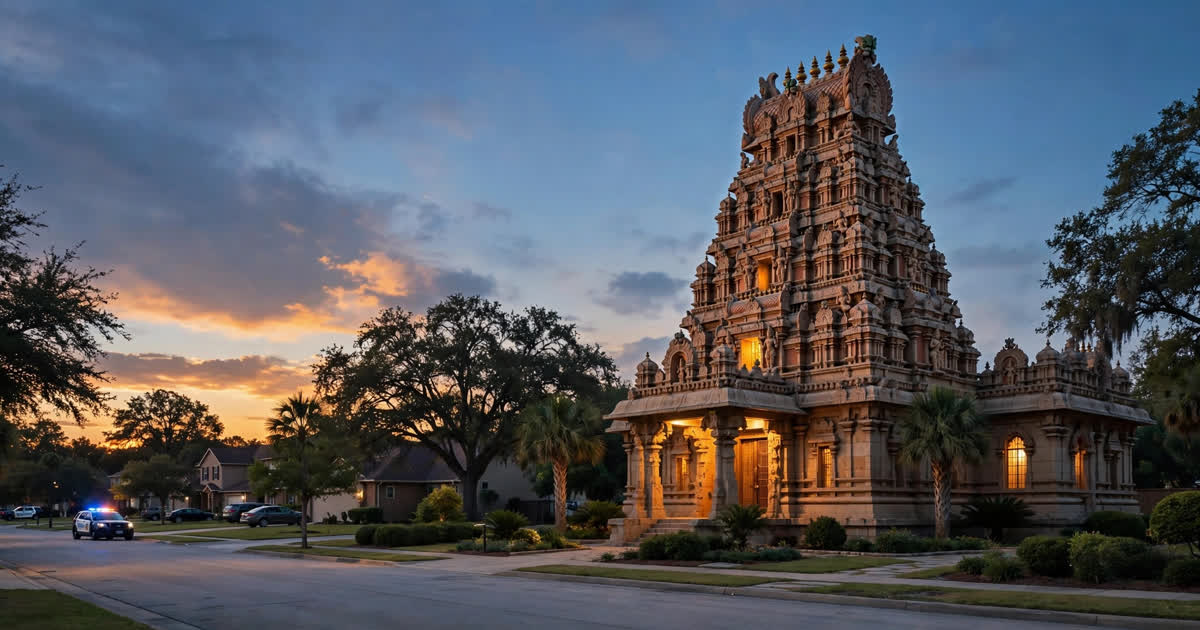
On Sunday 11 October 2026, worshippers gathered at the Sri Venkateswara Swami (Balaji) Temple in Aurora, Illinois, to mark the Hindu festival of Navaratri. According to prosecutors, a 19-year-old man drove to the temple that day intending to carry out a mass shooting. The attack never happened. Prosecutors say his rifle jammed as he tried to fire from a car, and he left the area. Within hours, after two co-workers alerted police to his messages, he was in custody. What investigators say they found next — an eight-page manifesto, a rifle with no serial number, hundreds of rounds of ammunition and items bearing Nazi symbols — has turned a foiled plot into a national story about hate, houses of worship and the safety of Indian Americans.
The case is trending per news coverage across American and Indian outlets, and it has drawn condemnation from lawmakers of both parties, a pledge of zero tolerance from the FBI, and a formal expression of deep concern from India's Ministry of External Affairs. It has also revived a question that now sits at the centre of the case: should the alleged attack be investigated and prosecuted as a hate crime?
What allegedly happened on Sunday
The timeline, as described by prosecutors and police, begins on Sunday 11 October. Prosecutors say Alexandros Paporakis, 19, of Palatine, Illinois, had spent about two years planning a mass shooting and had been focused on the Aurora temple for roughly two months. On Sunday, they say, he went to the temple and attempted to shoot a man from a car, but his AR-style rifle jammed. He allegedly told a co-worker afterwards that the man was “certainly saved by his God today.”
That co-worker, along with another employee at the Taco Bell in Arlington Heights where Paporakis worked, called 911. According to prosecutors, Paporakis also sent the co-worker a video showing a rifle malfunctioning and a photograph of himself wearing a tactical vest, and told him he intended to try again once the weapon was repaired. Police located Paporakis later that day in the parking lot of an apartment complex in Palatine and arrested him.
One detail remains contested. While prosecutors have described the rifle as jamming during the alleged attempt, police have said they have not confirmed whether the gun actually jammed, and have not determined where the video was recorded or where the alleged shooting attempt took place. Investigators have also said they do not yet know why 11 October was significant to the accused, or what radicalised him. The allegations have not been proven in court, and the case remains at an early stage.
What investigators say they found
A search of Paporakis's home, according to prosecutors and police, uncovered an AR-style rifle without a serial number, loaded magazines, hundreds of rounds of ammunition — prosecutors put the figure at about 300 — a gas canister bearing a slur targeting South Asians, a tactical vest, body armour and items displaying Nazi symbols. Police also said a car registered to the accused had been at the temple he is alleged to have targeted.
Investigators also recovered an eight-page document titled “Why I Fought: A.K.A. (Aurora Shooter's Manifesto).” According to prosecutors, the document contained white supremacist and neo-Nazi views, described Indian, Jewish and Black people as “subhumans,” outlined a plan to kill as many of them as possible, described research into the temple's location, and encouraged others to commit violence. In it, prosecutors say, Paporakis described himself as a “sociopathic white supremacist Neo Nazi” who fantasised about mass murder nearly every day. Police have declined to release further details from the document while the investigation continues.
Electronic devices seized from the home are being examined at the FBI's Chicago Regional Computer Forensic Laboratory, as investigators look for more information about the planning, any contacts and the full scope of the alleged plot. The FBI is assisting local authorities with the investigation.
Charges and the court so far
Paporakis faces state felony charges of making a terrorist threat — a Class X felony in Illinois — and unlawful possession of a weapon. At a court hearing on Wednesday 14 October, a judge ordered him to remain in detention. His next court appearance is scheduled for 30 October.
The Cook County Public Defender's office, which is representing him, has said the case is in its earliest stage and that statements by police and prosecutors are only allegations that can change significantly as the investigation continues. That reminder matters: everything described so far comes from prosecutors, police and court filings, and none of it has been tested at trial.
The case arrives in a grim week for American houses of worship and schools. Days earlier, a school shooting in Bend, Oregon left three children and a teacher dead, and federal authorities have separately been investigating a wave of suspicious letters sent to election offices and senators. Each case is distinct, but together they have sharpened public attention on threats to places where Americans gather.
The hate-crime question
The most consequential debate in the case is over how it should be charged. US Representative Raja Krishnamoorthi, a Democrat from Illinois, has said he will ask the FBI to investigate and prosecute the alleged attempt as a hate crime. His call carries unusual personal weight: Krishnamoorthi has said he was inside the Aurora temple with family members, including his parents, celebrating Navaratri when the alleged attempt took place, and that his family has worshipped there for about 40 years. He said he learned about the incident only days later, through media reports, and described the congregation as deeply shaken.
Krishnamoorthi has argued that the manifesto proves that hateful sentiment fuelled the alleged actions that day, and has also urged the administration to release federal nonprofit security grants to bolster security at religious institutions. The Congressional Asian Pacific American Caucus (CAPAC) has also condemned the plot and linked it to a broader climate of anti-Indian and anti-Hindu rhetoric, citing a reported 240% surge in anti-South Asian hate speech on the social platform X between January 2024 and June 2026, according to the Center for the Study of Organized Hate.
Condemnation has crossed party lines. Democrats including Senate Minority Leader Chuck Schumer, Senators Tammy Duckworth and Andy Kim, and Representatives Ro Khanna, Pramila Jayapal, Ami Bera, Jamie Raskin and Brad Sherman spoke out, as did Republicans including Representatives Rich McCormick and Darin LaHood. India's Ambassador to the US, Vinay Mohan Kwatra, also issued a statement. Whether federal hate-crime charges follow the current state counts is now one of the central questions of the investigation, alongside the forensic examination of the seized devices.
India's response
On Friday 16 October, India's Ministry of External Affairs (MEA) said the foiled plot was a matter of deep concern. At a media briefing, spokesperson Randhir Jaiswal said the episode highlighted increasing cases of hate crimes and racial discrimination against Indian communities in the United States. He said India had taken note of the action US law enforcement had taken, but called on the United States to ensure the safety and security of Indian nationals in the country. The MEA had earlier described the situation as “particularly disturbing.”
The diplomatic reaction reflects how closely the case is being followed in India, where the India-US relationship spans trade, technology, energy and a large diaspora. For many Indian Americans, the Aurora plot is not an abstract news story: it is about a temple their families may have attended, during a festival their families celebrate.
The wider context: rising anti-South Asian hate
Advocacy groups and researchers say the Aurora case fits a disturbing trend. According to FBI data cited in coverage of the case, reported anti-Hindu hate crimes in the United States rose to 32 last year, up from 25 in 2024 — an increase of roughly 28%. The Center for the Study of Organized Hate reported that the monthly volume of hateful posts targeting South Asians on X more than tripled between January 2024 and June 2026. A survey by the Carnegie Endowment for International Peace found that one in four Indian-American respondents had experienced racial insults since early 2025.
Stop AAPI Hate, the national reporting centre for anti-Asian hate incidents, has said the targeting of the Hindu temple is another example of heightened threats against South Asians in the US in recent years, with online slurs and threats rising significantly. Hindu organisations including the Hindu Mandir Empowerment Council, the Coalition of Hindus of North America and the Foundation for India and Indian Diaspora Studies have each condemned the alleged plot and urged stronger action against rising hostility.
FBI Chicago's acting special agent in charge, Lucas Rothaar, has pledged “zero tolerance” for violence aimed at suppressing religious freedom under the First Amendment, and has urged people to report threats rather than trying to decide on their own whether a threat is credible. “The sooner we get that information, the sooner we can do that job,” he said. Police echoed the point, praising the co-workers who came forward: “If not for this individual, you might be talking about something completely different here.”
What happens next
The immediate next step is the 30 October court appearance, where the case will continue through the Illinois courts. In parallel, the FBI's forensic examination of the seized devices could shape whether additional or federal charges are brought, including the hate-crime prosecution lawmakers are seeking. The question of federal nonprofit security grants for houses of worship is also likely to feature in the political debate that follows.
For the congregation in Aurora, the longer task is recovery. A temple is a place of prayer, weddings, festivals and community meals — the kind of place where a family can spend an entire Sunday, as the Krishnamoorthi family did. Rebuilding a sense of safety there will take more than a court case. It will take visible security, sustained attention from authorities, and a public conversation that treats threats against any house of worship as threats against all of them.
For everyone else, the case carries a simpler lesson, and it is the one the police and the FBI keep repeating: the plot was uncovered because two co-workers decided that disturbing messages were worth reporting. A jammed rifle may have prevented a massacre on Sunday. It was an ordinary phone call that may have prevented a second attempt.
Sources: Associated Press; Chicago Tribune; Chicago Sun-Times; Fox 32 Chicago; New York Post; Al Jazeera; ANI; India Today; Ministry of External Affairs (India) briefing; FBI Chicago; Palatine Police Department.