
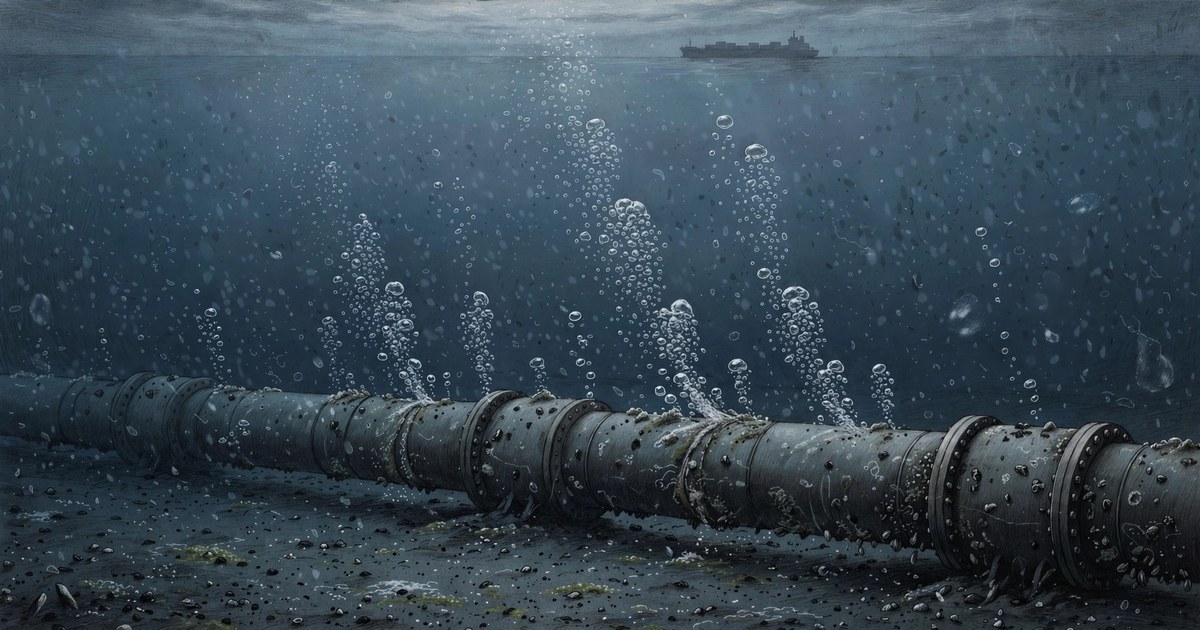
Four years after undersea explosions ripped open the Nord Stream gas pipelines in the Baltic Sea, the first person accused of carrying out the sabotage has gone on trial in Germany. On Wednesday, October 14, 2026, proceedings opened at the Hanseatic Higher Regional Court in Hamburg against a 50-year-old former Ukrainian military officer identified in court only as Serhii K. He denies any involvement.
The story is trending per news coverage across international outlets, with Reuters, the Associated Press, CNN and Le Monde all reporting on the opening day. The trial matters far beyond one defendant: it is the first public hearing of evidence in one of Europe’s most politically sensitive sabotage investigations since the Second World War, and it puts a German court in the uncomfortable position of trying an alleged act of sabotage said to have been carried out by nationals of an ally.
What happened on the opening day
The trial opened under strict security at the Hamburg court, with more than 100 media representatives from around the world accredited to cover it, according to the court. Serhii K., dressed in a grey suit and dark tie, sat between two lawyers in black robes and kept a calm expression as proceedings got under way, the Associated Press reported.
Outside the courthouse, pro-Ukraine demonstrators gathered holding placards, including one reading “Russia is a Terrorist,” and saying they had come to show solidarity with the defendant while respecting whatever verdict the court reaches. The scene captured the trial’s central tension: the man in the dock is accused of an attack on civilian infrastructure, yet many of his supporters regard the pipelines themselves as an instrument of Russian power.
The proceedings are expected to run for months, with hearings scheduled through December and further sessions planned into January and February 2027. Serhii K. is the only person on trial. The court has said the case will be limited to questions of the defendant’s own acts and guilt, and it has refused a request from Russia to join the proceedings as a co-plaintiff. It will not decide broader questions of state responsibility or reparations.
Who is the defendant?
Serhii K. is a 50-year-old former Ukrainian military officer. Reporting based on his background describes him as a former member of Ukraine’s SBU security service and of a reserve air-defence force that helped defend Kyiv at the start of Russia’s full-scale invasion in 2022. He now presents himself as an energy entrepreneur. Under German privacy rules he is identified in court only as Serhii K., although his fuller name appeared in Italian extradition documents.
He was arrested in August 2025 while on holiday with his family in Rimini, Italy, under a European arrest warrant, and extradited to Germany in November 2025. He has consistently denied any wrongdoing, and his defence lawyer has previously told reporters that he denies any involvement in the explosions. The government in Kyiv has also consistently denied any involvement in the sabotage, including denials by President Volodymyr Zelensky.
It is important to be precise about what a trial opening means: the charges are allegations, not findings. The prosecution must prove its case in court, and the defendant is presumed innocent unless and until he is convicted.
What prosecutors allege
German federal prosecutors allege that Serhii K. belonged to a group that planted explosive devices on the Nord Stream 1 and Nord Stream 2 pipelines near the Danish island of Bornholm in September 2022. They accuse him of organising and directing the operation, working with other members of the Ukrainian military, and acting on behalf of unidentified Ukrainian state entities.
According to the prosecution’s account, the group was composed of professional divers, a skipper and an explosives expert, formed under the defendant’s direction. Prosecutors say Serhii K. entered Germany from Poland on September 4, 2022, using a forged Ukrainian passport, about three weeks before the blasts. The group then allegedly chartered a sailing yacht named Andromeda from the northern German port of Rostock, using false documents, and sailed into international waters near Bornholm.
Prosecutors allege that by September 22, 2022, the group had placed several explosive devices with timed detonators on the pipelines lying on the seabed, at a depth of around 70 to 80 metres. They say the devices contained military-grade explosives, with individual charges reported to have weighed between about 14 and 27 kilograms. The alleged objective, in the prosecution’s words, was to permanently end gas deliveries through the pipelines and to prevent Russia from using revenue from natural-gas sales to fund its war operations.
The charges against Serhii K. include causing an explosion, damaging property and infrastructure, disrupting public services, and being an accomplice to a war crime by attacking civilian objects. German prosecutors say the conduct falls under Germany’s code of crimes against international law, as an attack by military means against civilian objects. The alleged aim, they say, was to disrupt a major source of foreign revenue for Russia after its full-scale invasion of Ukraine earlier that year.
The explosions of September 26, 2022
The Nord Stream 1 and Nord Stream 2 pipelines run for about 1,200 kilometres (750 miles) under the Baltic Sea from gas export terminals near St. Petersburg in Russia to the German port of Greifswald. Built between 2010 and 2021, they became potent symbols of central Europe’s dependence on Russian hydrocarbons.
On September 26, 2022, seven months after Russia’s full-scale invasion of Ukraine, a series of undersea explosions damaged both pipeline systems. Swedish seismologists registered multiple blasts roughly 17 hours apart. Three of the four concrete-coated steel pipeline strands were ruptured, and a dramatic gas leak at sea released large quantities of methane into the atmosphere, with estimates of roughly 500,000 metric tons.
At the time, only Nord Stream 1 was operational. It had previously supplied about half of Germany’s natural-gas imports, although Russia had already shut off the flow weeks before the attack. Nord Stream 2 had been completed in 2021 but never entered service, because Germany suspended its certification process shortly before the invasion. Both pipelines still contained gas under high pressure when the explosions happened, which is why the leaks were so large and so visible.
In the immediate aftermath, no one claimed responsibility. Suspicion in many Western capitals initially fell on Moscow, although no blame was formally assigned at the time. Russia’s President Vladimir Putin accused the United States and its British allies, blaming “the Anglo-Saxons,” which they denied. Denmark and Sweden concluded that the blasts were sabotage but closed their own investigations in February 2024 without identifying suspects, leaving Germany as the only country still pursuing the case.
How German investigators reached the yacht Andromeda
The German investigation gradually shifted toward a small group of deep-sea divers linked to a chartered sailing yacht. According to German media reporting and later prosecution statements, the yacht Andromeda left Rostock on September 6, 2022, and returned on September 23. It was reported to have been spotted at the small Danish island of Christianso near the blast sites, at the Swedish port of Sandhamn, and at a marina in Kolobrzeg, Poland, before returning to Germany.
German investigators raided the yacht in January 2023. German media reported that traces of the same kind of explosives found at the blast sites by Swedish investigators were discovered on board. Prosecutors have also said that data on the defendant’s mobile phone indicated a strong interest in attacks on critical infrastructure and in the technical details of the two pipelines, a claim the defence will have the opportunity to contest in court.
There was also an early warning that later took on new significance. The day after the explosions, Der Spiegel reported that the CIA had warned Germany in the summer of 2022 about possible attacks on Baltic Sea pipelines. The warning did not prevent the attack, and it has become part of the broader debate about whether European states adequately protected subsea infrastructure.
In January 2025, Germany’s Federal Court of Justice ruled that the case fell within German territorial jurisdiction and that prosecutors had a responsibility to act, because the alleged conduct threatened Germany’s internal security. That ruling cleared the way for the Hamburg trial.
A second suspect, and a wider investigation
Serhii K. is not the only person German prosecutors have pursued. A second Ukrainian man, identified as Volodymyr Z., was detained in Croatia in August 2026. German prosecutors describe him as strongly suspected of sabotage and causing an explosion, and of participating in dives to the pipelines. A Croatian court has approved his extradition to Germany, although his lawyer has dismissed the ruling and said it could be appealed. Like Serhii K., he denies involvement, according to reporting on the case.
The existence of a second suspect underlines that prosecutors view the sabotage as a team operation rather than a lone act. But it also underlines how much remains unproven: the Hamburg trial will test only the evidence against the man in the dock, and even a conviction would not by itself establish who, if anyone, ordered the operation.
Why the trial is diplomatically explosive
The trial is awkward for Berlin precisely because Germany remains one of Ukraine’s strongest supporters. Germany is Ukraine’s largest European supplier of military aid, and the two governments have worked closely since 2022 on weapons, air defence and financial support. A prosecution alleging that Ukrainian state entities ordered the destruction of German-linked civilian infrastructure cuts directly across that partnership.
Successive German chancellors have tried to keep the case politically neutral, insisting that it be handled by the judicial system without political interference. That separation is now being tested in public: every hearing will generate headlines in Berlin, Kyiv and Moscow, and critics of German support for Ukraine, including on the far right, are expected to use the proceedings as political ammunition.
For Kyiv, the stakes are equally high. The Zelensky government has always denied involvement, and any evidence presented in Hamburg that appears to link Ukrainian institutions to the sabotage would be politically damaging, even though the court is not ruling on state responsibility. Ukrainian parliamentarians have argued that the pipelines were a tool of Russian military funding, but they have also said there is no confirmed evidence for the German narrative. The trial will therefore be watched closely for what the evidence actually shows, rather than what either side claims about it.
Moscow, for its part, has said it expects a “just verdict” that reveals the identities of those who carried out the operation and those who ordered it. Russia’s interest in the trial is obvious: a courtroom airing of allegations against Ukraine serves its narrative, even though Russia itself was an early suspect and has never been cleared by any public judicial finding.
The case also matters for the wider war over energy infrastructure, which has continued into this week with overnight strikes leaving hundreds of thousands of Ukrainians without power. Attacks on pipelines, power grids and shipping have become a recurring feature of the conflict, and the Hamburg trial is the first time a court has examined whether one of the most consequential such attacks can be attributed to named individuals through criminal evidence.
What the trial could — and could not — establish
Even if the trial runs its full course, its findings will be narrower than the public debate. The court will decide whether Serhii K. personally participated in the sabotage as charged. It will not rule on whether Ukraine as a state ordered the attack, and it will not award reparations for the destroyed pipelines or the methane released.
That distinction matters because the strongest claims in the case — that the group acted on behalf of unidentified Ukrainian state entities — are also the hardest to prove in a criminal courtroom. Prosecutors will need to connect the defendant to the planning, the yacht, the explosives and the dives with concrete evidence, not just with a plausible motive. The defence will test every link, including the forensic evidence from the Andromeda, the phone data and the identification of the defendant as the group’s leader.
The trial also raises a legal question that will be debated well beyond Hamburg: when does sabotage of civilian infrastructure during an armed conflict amount to a war crime? Prosecutors have framed the pipeline attack as an attack on civilian objects. Defence lawyers and legal scholars may argue about whether pipelines that fund a war effort are purely civilian, and about how international humanitarian law applies to covert sabotage. The court’s reasoning on that point, whatever the verdict, could influence how similar cases are treated in future conflicts.
There is a parallel debate about subsea infrastructure security. The Nord Stream explosions exposed how vulnerable pipelines, cables and other seabed assets are to a small, well-organised team. Since 2022, European states have increased naval patrols and monitoring of the Baltic Sea, but the seabed remains vast and difficult to guard. The trial is a reminder that deterrence depends not only on patrols but also on the ability to investigate and prosecute attacks after they happen — a task that took Germany four years to bring to court.
What happens next
The Hamburg court has scheduled hearings through December, with further sessions planned for January and February 2027. Prosecutors will present their evidence first, including forensic material, witness testimony and documentary records, and the defence will then have its opportunity to challenge it. A verdict is not expected for months.
Meanwhile, the extradition case of the second suspect in Croatia will continue separately. If he is transferred to Germany, he could face his own trial. And the broader political argument — over who ordered the sabotage, and what it means for European support for Ukraine — will continue in parallel, regardless of what happens inside the courtroom.
For now, the most important fact is simple: after four years of speculation, leaks and competing theories, the Nord Stream case is finally being tested where such questions belong — in open court, with evidence, a defence and a judge. What emerges over the coming months may confirm the prosecution’s account, undermine it, or leave key questions unanswered. The trial’s value lies in that process, not in the headlines of its first day.
Worldlession will update this story as the trial develops.
Sources: Reuters, Associated Press, CNN, Le Monde, The Business Standard.